


Page 272 - Clinical Immunology_ Principles and Practice ( PDFDrive )
P. 272
CHAPTER 17  Cytotoxic T Lymphocytes and Natural Killer Cells               253


                                            CD56 bright                         CD56 dim
                                   CCR7                 CD16 dim      CXCR1                CD16 bright


                              CXCR3                              CX3CR1
                                                        CD62L
                               Perforin/                          Perforin/
                              Granzymes                          Granzymes
                                 +                                 +++
                                                                                        Cytokine
                                                                                        production
                                                                                           +
                                     CD94-NKG2  KIR  Cytokine           CD94-NKG2  KIR
                                       +++    +/-   production             +       +++
                                                      +++
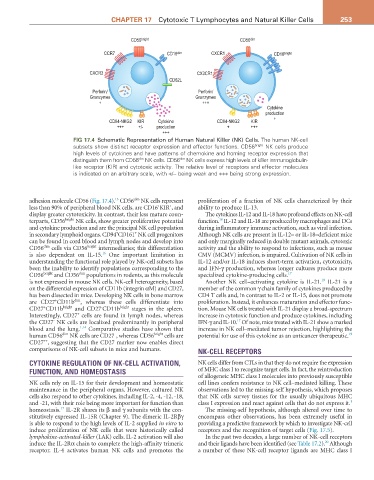
                         FIG 17.4  Schematic Representation of Human Natural Killer (NK) Cells. The human NK-cell
                         subsets show distinct receptor expression and effector functions. CD56 bright  NK cells produce
                         high levels of cytokines and have patterns of chemokine and homing receptor expression that
                                              dim
                                                            dim
                         distinguish them from CD56  NK cells. CD56  NK cells express high levels of killer immunoglobulin-
                         like receptor (KIR) and cytotoxic activity. The relative level of receptors and effector molecules
                         is indicated on an arbitrary scale, with +/− being weak and +++ being strong expression.


                                       16
                                             dim
           adhesion molecule CD56 (Fig. 17.4).  CD56  NK cells represent   proliferation of a fraction of NK cells characterized by their
                                                        +
                                                     +
           less than 90% of peripheral blood NK cells, are CD16 KIR , and   ability to produce IL-13.
           display greater cytotoxicity. In contrast, their less mature coun-  The cytokines IL-12 and IL-18 have profound effects on NK-cell
                                                                         18
           terparts, CD56 bright  NK cells, show greater proliferative potential   function.  IL-12 and IL-18 are produced by macrophages and DCs
           and cytokine production and are the principal NK cell population   during inflammatory immune activation, such as viral infection.
                                       +
                                             +
           in secondary lymphoid organs. CD94 CD161  NK cell progenitors   Although NK cells are present in IL-12– or IL-18–deficient mice
           can be found in cord blood and lymph nodes and develop into   and only marginally reduced in double mutant animals, cytotoxic
               dim
           CD56  cells via CD56 bright  intermediaries; this differentiation   activity and the ability to respond to infections, such as mouse
                                  16
           is also dependent on IL-15.  One important limitation in   CMV (MCMV) infection, is impaired. Cultivation of NK cells in
           understanding the functional role played by NK-cell subsets has   IL-12 and/or IL-18 induces short-term activation, cytotoxicity,
           been the inability to identify populations corresponding to the   and IFN-γ production, whereas longer cultures produce more
                           dim
           CD56 bright  and CD56  populations in rodents, as this molecule   specialized cytokine-producing cells. 17
                                                                                                          19
           is not expressed in mouse NK cells. NK-cell heterogeneity, based   Another NK cell–activating cytokine is IL-21.  IL-21 is a
           on the differential expression of CD11b (integrin αM) and CD27,   member of the common γ chain family of cytokines produced by
           has been dissected in mice. Developing NK cells in bone marrow   CD4 T cells and, in contrast to IL-2 or IL-15, does not promote
                   +
                         dim
           are CD27 CD11b , whereas these cells differentiate into   proliferation. Instead, it enhances maturation and effector func-
               +
                                  -
           CD27 CD11b bright  and CD27 CD11b bright  stages in the spleen.   tion. Mouse NK cells treated with IL-21 display a broad-spectrum
                          +
           Interestingly, CD27  cells are found in lymph nodes, whereas   increase in cytotoxic function and produce cytokines, including
                                                                               17
                  -
           the CD27  NK cells are localized predominantly in peripheral   IFN-γ and IL-10.  Of note, mice treated with IL-21 show a marked
           blood and the lung. 1,14  Comparative studies have shown that   increase in NK cell–mediated tumor rejection, highlighting the
                     dim
                                      –
           human CD56  NK cells are CD27 , whereas CD56 bright  cells are   potential for use of this cytokine as an anticancer therapeutic. 19
               ++
           CD27 , suggesting that the CD27 marker now enables direct
           comparisons of NK-cell subsets in mice and humans.     NK-CELL RECEPTORS
           CYTOKINE REGULATION OF NK-CELL ACTIVATION,             NK cells differ from CTLs in that they do not require the expression
           FUNCTION, AND HOMEOSTASIS                              of MHC class I to recognize target cells. In fact, the reintroduction
                                                                  of allogeneic MHC class I molecules into previously susceptible
           NK cells rely on IL-15 for their development and homeostatic   cell lines confers resistance to NK cell–mediated killing. These
           maintenance in the peripheral organs. However, cultured NK   observations led to the missing-self hypothesis, which proposes
           cells also respond to other cytokines, including IL-2, -4, -12, -18,   that NK cells survey tissues for the usually ubiquitous MHC
           and -21, with their role being more important for function than   class I expression and react against cells that do not express it. 1
                     17
           homeostasis.  IL-2R shares its β and γ subunits with the con-  The missing-self hypothesis, although altered over time to
           stitutively expressed IL-15R (Chapter 9). The dimeric IL-2Rβγ   encompass other observations, has been extremely useful in
           is able to respond to the high levels of IL-2 supplied in vitro to   providing a predictive framework by which to investigate NK-cell
           induce proliferation of NK cells that were historically called   receptors and the recognition of target cells (Fig. 17.5).
           lymphokine-activated-killer (LAK) cells. IL-2 activation will also   In the past two decades, a large number of NK-cell receptors
                                                                                                           20
           induce the IL-2Rα chain to complete the high-affinity trimeric   and their ligands have been identified (see Table 17.2).  Although
           receptor. IL-4 activates human NK cells and promotes the   a number of these NK-cell receptor ligands are MHC class I

