


Page 267 - Clinical Immunology_ Principles and Practice ( PDFDrive )
P. 267
248          PART TwO  Host Defense Mechanisms and Inflammation


                                                        Immunological
                                                         synapse

                            CTL                                            Target cell
                                                           LFA-1
                                                                 ICAM-1


                                                                                    Nucleus
                                          MTOC
                                                                    Caspases
                                                 TCR          MHC-I
                                                              FAS
                                                     FasL                       Mitochondrion


                                Perforin                    LFA1
                                Granzymes
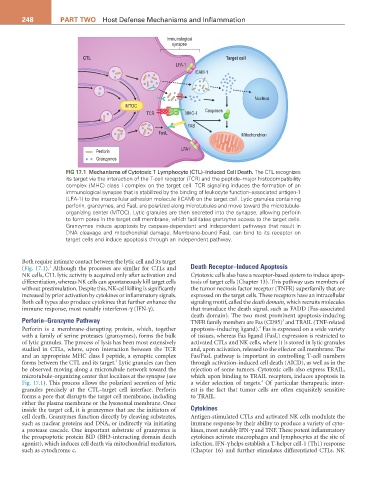
                       FIG 17.1  Mechanisms of Cytotoxic T Lymphocyte (CTL)–Induced Cell Death. The CTL recognizes
                       its target via the interaction of the T-cell receptor (TCR) and the peptide–major histocompatibility
                       complex (MHC) class I complex on the target cell. TCR signaling induces the formation of an
                       immunological synapse that is stabilized by the binding of leukocyte function–associated antigen-1
                       (LFA-1) to the intercellular adhesion molecule (ICAM) on the target cell. Lytic granules containing
                       perforin, granzymes, and FasL are polarized along microtubules and move toward the microtubule-
                       organizing center (MTOC). Lytic granules are then secreted into the synapse, allowing perforin
                       to form pores in the target cell membrane, which facilitates granzyme access to the target cells.
                       Granzymes induce apoptosis by caspase-dependent and independent pathways that result in
                       DNA cleavage and mitochondrial damage. Membrane-bound FasL can bind to its receptor on
                       target cells and induce apoptosis through an independent pathway.


        Both require intimate contact between the lytic cell and its target
                 2
        (Fig. 17.1).  Although the processes are similar for CTLs and   Death Receptor–Induced Apoptosis
        NK cells, CTL lytic activity is acquired only after activation and   Cytotoxic cells also have a receptor-based system to induce apop-
        differentiation, whereas NK cells can spontaneously kill target cells   tosis of target cells (Chapter 13). This pathway uses members of
        without prestimulation. Despite this, NK-cell killing is significantly   the tumor necrosis factor receptor (TNFR) superfamily that are
        increased by prior activation by cytokines or inflammatory signals.   expressed on the target cells. These receptors have an intracellular
        Both cell types also produce cytokines that further enhance the   signaling motif, called the death domain, which recruits molecules
        immune response, most notably interferon-γ (IFN-γ).    that transduce the death signal, such as FADD (Fas-associated
                                                               death domain). The two most prominent apoptosis-inducing
        Perforin–Granzyme Pathway                              TNFR family members are Fas (CD95)  and TRAIL (TNF-related
                                                                                             3
                                                                                      4
        Perforin is a membrane-disrupting protein, which, together   apoptosis–inducing ligand).  Fas is expressed on a wide variety
        with a family of serine proteases (granzymes), forms the bulk   of tissues, whereas Fas ligand (FasL) expression is restricted to
        of lytic granules. The process of lysis has been most extensively   activated CTLs and NK cells, where it is stored in lytic granules
        studied in CTLs, where, upon interaction between the TCR   and, upon activation, released to the effector cell membrane. The
        and an appropriate MHC class I peptide, a synaptic complex   Fas/FasL pathway is important in controlling T-cell numbers
                                       2
        forms between the CTL and its target.  Lytic granules can then   through activation-induced cell death (AICD), as well as in the
        be observed moving along a microtubule network toward the   rejection of some tumors. Cytotoxic cells also express TRAIL,
        microtubule-organizing center that localizes at the synapse (see   which upon binding to TRAIL receptors, induces apoptosis in
                                                                                      4
        Fig. 17.1). This process allows the polarized secretion of lytic   a wider selection of targets.  Of particular therapeutic inter-
        granules  precisely  at  the  CTL–target  cell  interface.  Perforin   est is the fact that tumor cells are often exquisitely sensitive
        forms a pore that disrupts the target cell membrane, including   to TRAIL.
        either the plasma membrane or the lysosomal membrane. Once
        inside the target cell, it is granzymes that are the initiators of   Cytokines
        cell death. Granzymes function directly by cleaving substrates,   Antigen-stimulated CTLs and activated NK cells modulate the
        such as nuclear proteins and DNA, or indirectly via initiating   immune response by their ability to produce a variety of cyto-
        a protease cascade. One important substrate of granzymes is   kines, most notably IFN-γ and TNF. These potent inflammatory
        the proapoptotic protein BID (BH3-interacting domain death   cytokines activate macrophages and lymphocytes at the site of
        agonist), which induces cell death via mitochondrial mediators,   infection. IFN-γ helps establish a T-helper cell-1 (Th1) response
        such as cytochrome c.                                  (Chapter 16) and further stimulates differentiated CTLs. NK

