


Page 268 - Clinical Immunology_ Principles and Practice ( PDFDrive )
P. 268
CHAPTER 17  Cytotoxic T Lymphocytes and Natural Killer Cells               249


           cells are also a potent source of a diverse range of cytokines,   THE CTL RESPONSE
           including granulocyte macrophage–colony-stimulating factor
           (GM-CSF), interleukin-5 (IL-5), IL-10, and IL-13 (Chapter 9).   The CTL response to an acute infection consists of three phases:
           The capacity to secrete a broad spectrum of cytokines provides NK   first, the initial activation and proliferation of the CTL; second,
           cells with a wide range of regulatory capabilities. CTLs and NK   the contraction of effector populations; and third, the long-term
           cells are capable of secreting a number of chemokines (Chapter   maintenance of memory cells.
           10), including chemokine ligand 3 (CCL3), CCL4, and CCL5.
           These chemokines help recruit additional lymphocytes into the   Initial Activation
           immune reaction.                                       Naïve T cells constantly circulate through secondary lymphoid
                                                                  organs, where antigen encounter occurs. For a CTL response,
           CYTOTOXIC T CELLS                                      antigen is brought to the lymph node via the lymphatic system
                                                                  by APC (Fig. 17.2). These APCs are typically DCs that mature
           The Development and Tissue Distribution of CTLs        after antigen acquisition in nonlymphoid tissues and migrate
           CD8 T lymphocytes develop in the thymus, where they are selected   to the lymph node. These antigens are recognized only when
           for their ability to recognize nonself peptides in the context   complexed to MHC molecules. APCs efficiently degrade self or
           of MHC class I molecules (Chapter 8). Upon thymic export,   foreign (pathogen-derived) proteins into shorter fragments
           these cells acquire a quiescent state and are referred to as “naïve”   (generally 8–10 amino acids in length) by the action of proteases
           cells. Naïve CD8 T cells circulate between peripheral lymphoid   in the cytosol. They are then transported into the lumen of the
           organs, such as the spleen and lymph nodes, via the arterial   endoplasmic reticulum, where they are loaded onto newly
           and lymphatic systems. The tissue distribution of lymphocytes   synthesized MHC class I molecules for presentation at the cell
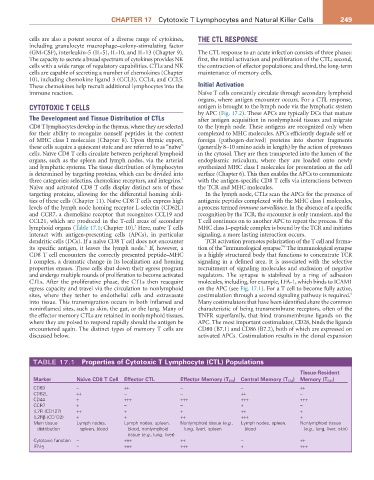
           is determined by targeting proteins, which can be divided into   surface (Chapter 6). This then enables the APCs to communicate
                                                            5
           three categories: selectins, chemokine receptors, and integrins.    with the antigen-specific CD8 T cells via interactions between
           Naïve and activated CD8 T cells display distinct sets of these   the TCR and MHC molecules.
           targeting proteins, allowing for the differential  homing  abili-  In the lymph node, CTLs scan the APCs for the presence of
           ties of these cells (Chapter 11). Naïve CD8 T cells express high   antigenic peptides complexed with the MHC class I molecules,
           levels of the lymph node homing receptor L-selectin (CD62L)   a process termed immune surveillance. In the absence of a specific
           and CCR7, a chemokine receptor that recognizes CCL19 and   recognition by the TCR, the encounter is only transient, and the
           CCL21, which are produced in the T-cell areas of secondary   T cell continues on to another APC to repeat the process. If the
                                             5
           lymphoid organs (Table 17.1; Chapter 10).  Here, naïve T cells   MHC class I–peptide complex is bound by the TCR and initiates
           interact with antigen-presenting cells (APCs), in particular   signaling, a more lasting interaction occurs.
           dendritic cells (DCs). If a naïve CD8 T cell does not encounter   TCR activation promotes polarization of the T cell and forma-
                                                5
                                                                                              6
           its specific antigen, it leaves the lymph node.  If, however, a   tion of the “immunological synapse.”  The immunological synapse
           CD8 T cell encounters the correctly presented peptide–MHC   is a highly structured body that functions to concentrate TCR
           I complex, a dramatic change in its localization and homing   signaling in a defined area. It is associated with the selective
           properties ensues. These cells shut down their egress program   recruitment of signaling molecules and exclusion of negative
           and undergo multiple rounds of proliferation to become activated   regulators. The synapse is stabilized by a ring of adhesion
           CTLs.  After the proliferative phase, the CTLs then reacquire   molecules, including, for example, LFA-1, which binds to ICAM1
           egress capacity and travel via the circulation to nonlymphoid   on the APC (see Fig. 17.1). For a T cell to become fully active,
                                                                                                                    6
           sites, where they tether to endothelial cells and extravasate   costimulation through a second signaling pathway is required.
           into tissue. This transmigration occurs in both inflamed and   Many costimulators that have been identified share the common
           noninflamed sites, such as skin, the gut, or the lung. Many of   characteristic of being transmembrane receptors, often of the
           the effector memory CTLs are retained in nonlymphoid tissues,   TNFR superfamily, that bind transmembrane ligands on the
           where they are poised to respond rapidly should the antigen be   APC. The most important costimulator, CD28, binds the ligands
           encountered again. The distinct types of memory T cells are    CD80 (B7.1) and CD86 (B7.2), both of which are expressed on
           discussed below.                                       activated APCs. Costimulation results in the clonal expansion


            TABLE 17.1  Properties of Cytotoxic T Lymphocyte (CTL) Populations
                                                                                                   Tissue-Resident
            Marker        Naïve CD8 T Cell  Effector CTL    Effector Memory (T EM )  Central Memory (T CM )  Memory (T RM )
            CD69          –               ++                –                   –                  ++
            CD62L         ++              –                 –                   ++                 –
            CD44          +               +++               +++                 +++                +++
            CCR7          +               –                 –                   +                  –
            IL7R (CD127)  ++              +                 +                   ++                 +
            IL2Rβ (CD122)  +              +                 ++                  +++                +
            Main tissue   Lymph nodes,    Lymph nodes, spleen,   Nonlymphoid tissue (e.g.,   Lymph nodes, spleen,   Nonlymphoid tissue
             distribution  spleen, blood   blood, nonlymphoid   lung, liver), spleen  blood         (e.g., lung, liver, skin)
                                           tissue (e.g., lung, liver)
            Cytotoxic function  –         +++               ++                  –                  ++
            IFN-γ         –               +++               +++                 +                  +++

