


Page 380 - Clinical Immunology_ Principles and Practice ( PDFDrive )
P. 380
360          Part two  Host Defense Mechanisms and Inflammation


        eosinophil granule protein levels (in urine, BAL fluids, and   blood, sputum, or tissue examinations, as well as results of
                                                                            24
        involved allograft tissues) have correlated with prognosis, severity,   serological tests.  The duration and magnitude of the eosinophilia
        and response to rejection therapy.                     may suggest some entities, especially if it is prolonged or markedly
                                                               elevated (see Table 24.1). Other causes of eosinophilia that are
        Endocrine Diseases                                     amenable to treatment include eosinophilia secondary to medica-
        The loss of endogenous adrenoglucocorticosteroid production   tions, for which cessation of the offending drug may be indicated
        in Addison disease, adrenal hemorrhage, or hypopituitarism can   if the eosinophilia is accompanied by organ damage. Likewise,
        cause increased blood eosinophilia, although usually not more   if eosinophilia is secondary to glucocorticosteroid deficiency,
        than mild to moderate.                                 diagnostic testing can corroborate this deficiency and lead to
                                                               the administration of replacement corticosteroids and consequent
        Other Causes of Eosinophilia                           resolution of the eosinophilia.
        The syndrome of atheromatous cholesterol embolization is at   Because allergic diseases usually are associated with at least
        times associated with hypocomplementemia, eosinophilia, and   some degree of eosinophilia, clinical and laboratory evidence of
        eosinophiluria. Rarely, cases of hereditary eosinophilia among   such disease should be sought. If the eosinophilia is not attribut-
        family members have been recognized. Irritation of serosal surfaces   able  to  allergic  diseases,  parasitic  infections,  medications,  or
        can be associated with eosinophilia, and related diseases can   steroid deficiency, further evaluation will be guided by whether
        include Dressler syndrome; eosinophilic pleural effusions;   the patient has evidence of organ disease and, if so, which organs
        peritoneal and, at times, blood eosinophilia developing during   are involved (see Table 24.2). This is germane, for instance, in
        chronic peritoneal dialysis; and perhaps the eosinophilia that   defining whether the patient has a distinct eosinophilic pulmonary,
        follows abdominal irradiation.                         GI, or cutaneous syndrome. Bone marrow examinations in most
                                                               patients with eosinophilia are not usually informative, revealing
                                                               only evidence of enhanced eosinophilopoiesis; but bone marrow
                                                               should be examined if there is suspicion of a hematological
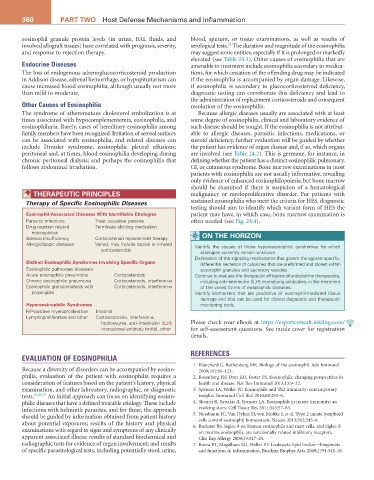
            tHEraPEUtIC PrINCIPLES                             malignancy or myeloproliferative disorder. For patients with
         Therapy of Specific Eosinophilic Diseases             sustained eosinophilia who meet the criteria for HES, diagnostic
                                                               testing should aim to identify which variant form of HES the
          Eosinophil-associated Diseases with Identifiable Etiologies  patient may have, in which case, bone marrow examination is
          Parasitic infections  Treat causative parasite       often needed (see Fig. 24.4).
          Drug-reaction related   Terminate eliciting medication
           eosinophilias                                           oN tHE HorIZoN
          Adrenal insufficiency  Corticosteroid replacement therapy
          Allergic/atopic diseases  Varied, may include topical or inhaled   Identify  the causes  of those hypereosinophilic  syndromes for which
                                  corticosteroids                  etiologies currently remain unknown.
                                                                 Delineation of the signaling mechanisms that govern the agonist-specific,
          Distinct Eosinophilic Syndromes Involving Specific organs  differential secretion of cytokines that are preformed and stored within
          Eosinophilic pulmonary diseases:                         eosinophil granules and secretory vesicles.
          Acute eosinophilic pneumonia  Corticosteroids          Continue to evaluate the therapeutic efficacies of anticytokine therapeutics,
          Chronic eosinophilic pneumonia  Corticosteroids, interferon-α  including anti–interleukin (IL)-5 neutralizing antibodies, in the treatment
          Eosinophilic granulomatosis with   Corticosteroids, interferon-α  of the varied forms of eosinophilic diseases.
           polyangiitis                                          Identify biomarkers that are predictive of eosinophil-mediated tissue
                                                                   damage and that can be used for clinical diagnostic and therapeutic
          Hypereosinophilic Syndromes                              monitoring tools.
          F/P-positive myeloproliferative  Imatinib
          Lymphoproliferative and other  Corticosteroids, interferon-α,
                                  hydroxyurea, anti–interleukin (IL)-5   Please check your eBook at https://expertconsult.inkling.com/
                                  monoclonal antibody (mAb), other  for self-assessment questions. See inside cover for registration
                                                               details.

                                                               REFERENCES
        EVALUATION OF EOSINOPHILIA
                                                                1.  Blanchard C, Rothenberg ME. Biology of the eosinophil. Adv Immunol
        Because a diversity of disorders can be accompanied by eosino-  2009;101:81–121.
        philia,  evaluation of  the patient  with eosinophilia  requires a   2.  Rosenberg HF, Dyer KD, Foster PS. Eosinophils: changing perspectives in
        consideration of features based on the patient’s history, physical   health and disease. Nat Rev Immunol 2013;13:9–22.
        examination, and other laboratory, radiographic, or diagnostic   3.  Spencer LA, Weller PF. Eosinophils and Th2 immunity: contemporary
        tests. 26,36,37  An initial approach can focus on identifying eosino-  insights. Immunol Cell Biol 2010;88:250–6.
        philic diseases that have a defined treatable etiology. These include   4.  Shamri R, Xenakis JJ, Spencer LA. Eosinophils in innate immunity: an
        infections with helminth parasites, and for these, the approach   evolving story. Cell Tissue Res 2011;343:57–83.
        should be guided by information obtained from patient history   5.  Nussbaum JC, Van Dyken SJ, von Moltke J, et al. Type 2 innate lymphoid
                                                                  cells control eosinophil homeostasis. Nature 2013;502:245–8.
        about potential exposures; results of the history and physical   6.  Bochner BS. Siglec-8 on human eosinophils and mast cells, and Siglec-F
        examinations with regard to signs and symptoms of any clinically   on murine eosinophils, are functionally related inhibitory receptors.
        apparent associated illness; results of standard biochemical and   Clin Exp Allergy 2009;39:317–24.
        radiographic tests for evidence of organ involvement; and results   7.  Bozza PT, Magalhaes KG, Weller PF. Leukocyte lipid bodies—biogenesis
        of specific parasitological tests, including potentially stool, urine,   and functions in inflammation. Biochim Biophys Acta 2009;1791:540–51.

