


Page 384 - Clinical Immunology_ Principles and Practice ( PDFDrive )
P. 384
366          Part tHrEE  Host Defenses to Infectious Agents


         TABLE 25.1  Viral Infections and Immunity               TABLE 25.2  Sensors of Viral Infection
          Viral Event     Obstacles           time Course        toll-Like receptors (tLrs)
                                                                 TLR3                dsRNA, MCMV, VSV, LCMV, HSV, EBV
          Transmission    Mechanical and chemical   0            TLR7 and TLR8       ssRNA, Influenza virus, HIV, VSV
                           barriers                              TLR9                dsDNA, HSV, MCMV
          Infection and   Innate immunity     0 →                TLR2                MV hemagglutinin protein, HSV, HCMV
           replication                                           TLR4                MMTV envelope protein, RSV
          Infection stopped or   Viral antigens transported   Within 24 hours
           spreads         to lymphoid tissues                   rIG-I-Like Helicases (rLHs)
          Infection controlled  Specific antibodies and   4–10 days
                           cell-mediated immunity                RIG-I               Influenza virus, VSV, HCV, JEV, MV,
          Sterile immunity  Immune memory     14 days to years                         RSV, Sendai virus, EBV
          Viral persistence if   Immune disruption or   Weeks to years  MDA-5        Poly(I:C), MV, Sendai virus, VSV,
           infection not   evasion                                                     MCMV, Picornaviruses
           controlled
                                                                 NOD-Like receptors (NLrs)
                                                                 NLRP3               Influenza virus, Sendai virus,
                                                                                       Adenovirus, Vaccinia virus
                                                                 NOD2                Influenza virus, VSV, RSV
          Ocular infection                                       Other sensors
          •  HSV                          Gastrointestinal tract  AIM2               Vaccinia virus, MCMV
          •  Adenoviruses                 •  Rotavirus           ZBP1 (DAI)          Cytosolic dsDNA, HSV
                                          •  Adenoviruses        IFI16               Cytosolic dsDNA, HSV
          Respiratory tract               •  Hepatitis A virus   cGAS                Cytosolic dsDNA, HSV
          •  Influenza virus              •  Caliciviruses
          •  RSV                                               AIM2, absent in melanoma-2; IFI16, Gamma-interferon-inducible protein Ifi-16; cGAS,
          •  Rhinoviruses                                      cyclic GMP-AMP Synthase; ZBP1, Z-DNA-binding protein 1; DAI, DNA-dependent
          •  Coronaviruses                                     activator of IFN; dsRNA, double-strand RNA; EBV, Epstein-Barr virus; HCMV, human
          •  Adenoviruses                                      cytomegalovirus; HCV, hepatitis C virus; HIV, human immunodeficiency virus;
            parainfluenza virus                                HSV, herpes simplex virus 1/2; JEV, Japanese encephalitis virus; LCMV, lymphocytic
          •  VZV                                               choriomeningitis virus; MCMV, murine cytomegalovirus; MDA-5, melanoma
          •  Measles virus                Genitourinary tract  differentiation-associated gene; MMTV, mouse mammary tumor virus; MV, measles
                                          •  HSV               virus; NLR, NOD-like receptor; RLH, RIG-I-like helicase; RSV, respiratory syncytial virus;
                                          •  HIV
          Skin entry and infection        •  HBV               ssRNA, single-strand RNA; TLR, Toll-like receptor; VSV, vesicular stomatitis virus.
          •  HSV                          •  CMV
          •  Human papillomavirus         •  Human papillomavirus
          •  West Nile virus
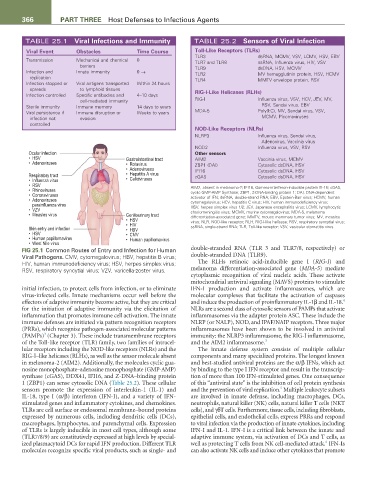
        FIG 25.1  Common Routes of Entry and Infection for Human   double-stranded RNA (TLR 3 and TLR7/8, respectively) or
        Viral Pathogens. CMV, cytomegalovirus; HBV, hepatitis B virus;   double-stranded DNA (TLR9).
        HIV, human immunodeficiency virus; HSV, herpes simplex virus;   The RLHs retinoic acid-inducible gene I (RIG-I) and
        RSV, respiratory syncytial virus; VZV, varicella-zoster virus.   melanoma  differentiation-associated gene (MDA-5) mediate
                                                               cytoplasmic recognition of viral nucleic acids. These activate
                                                               mitochondrial antiviral signaling (MAVS) proteins to stimulate
        initial infection, to protect cells from infection, or to eliminate   IFN-I  production  and activate  inflammasomes,  which  are
        virus-infected cells. Innate mechanisms occur well before the   molecular complexes that facilitate the activation of caspases
                                                                                                                 4
        effectors of adaptive immunity become active, but they are critical   and induce the production of proinflammatory IL-1β and IL-18.
        for the initiation of adaptive immunity via the elicitation of   NLRs are a second class of cytosolic sensors of PAMPs that activate
        inflammation that promotes immune cell activation. The innate   inflammasomes via the adapter protein ASC. These include the
        immune defenses are initiated via pattern recognition receptors   NLRP (or NALP), NOD, and IPAF/NAIP receptors. Three major
        (PRRs), which recognize pathogen-associated molecular patterns   inflammasomes have been shown to be involved in antiviral
               3
        (PAMPs)  (Chapter 3). These include transmembrane receptors   immunity: the NLRP3 inflammasome, the RIG-I inflammasome,
        of the Toll-like receptor (TLR) family, two families of intracel-  and the AIM2 inflammasome. 3
        lular receptors including the NOD-like receptors (NLRs) and the   The innate defense system consists of multiple cellular
        RIG-I–like helicases (RLHs), as well as the sensor molecule absent   components and many specialized proteins. The longest known
        in melanoma-2 (AIM2). Additionally, the molecules cyclic gua-  and best-studied antiviral proteins are the α/β IFNs, which act
        nosine monophosphate–adenosine monophosphate (GMP-AMP)   by binding to the type I IFN receptor and result in the transcrip-
        synthase (cGAS), DDX41, IFI16, and Z-DNA–binding protein   tion of more than 100 IFN-stimulated genes. One consequence
        1 (ZBP1) can sense cytosolic DNA (Table 25.2). These cellular   of this “antiviral state” is the inhibition of cell protein synthesis
                                                                                             5
        sensors promote the expression of interleukin-1 (IL-1) and   and the prevention of viral replication.  Multiple leukocyte subsets
        IL-18, type I (α/β) interferon (IFN-I), and a variety of IFN-  are involved in innate defense, including macrophages, DCs,
        stimulated genes and inflammatory cytokines, and chemokines.   neutrophils, natural killer (NK) cells, natural killer T cells (NKT
        TLRs are cell surface or endosomal membrane–bound proteins   cells), and γδT cells. Furthermore, tissue cells, including fibroblasts,
        expressed by numerous cells, including dendritic cells (DCs),   epithelial cells, and endothelial cells, express PRRs and respond
        macrophages, lymphocytes, and parenchymal cells. Expression   to viral infection via the production of innate cytokines, including
        of TLRs is largely inducible in most cell types, although some   IFN-I and IL-1. IFN-I is a critical link between the innate and
        (TLR7/8/9) are constitutively expressed at high levels by special-  adaptive immune system, via activation of DCs and T cells, as
                                                                                                            6
        ized plasmacytoid DCs for rapid IFN production. Different TLR   well as protecting T cells from NK cell-mediated attack.  IFN-Is
        molecules recognize specific viral products, such as single- and   can also activate NK cells and induce other cytokines that promote

