


Page 379 - Clinical Immunology_ Principles and Practice ( PDFDrive )
P. 379
CHaPtEr 24  Eosinophils and Eosinophilia              359


           the evolution of EGPA. Neurological, cutaneous, cardiac, and   Immunological Disorders
                                     33
           GI organ involvement is common.  Cardiac involvement includes
           pericarditis and small vessel cardiac vasculitis, and, much less    CLINICaL PEarLS
           commonly, endomyocardial thrombosis and fibrosis.       Eosinophilia and Drug Reactions
             Diverse drugs are capable of eliciting pulmonary eosinophilia.
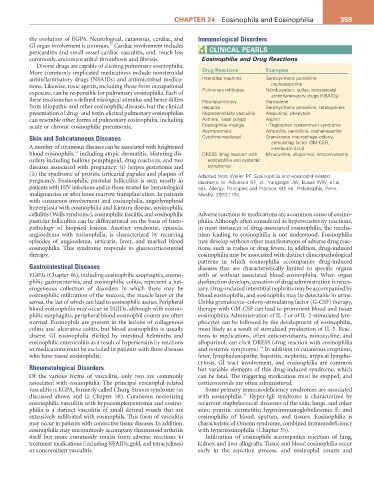
           More commonly implicated medications include nonsteroidal   Drug reactions   Examples
           antiinflammatory drugs (NSAIDs) and antimicrobial medica-  Interstitial nephritis  Semisynthetic penicillins,
           tions. Likewise, toxic agents, including those from occupational               cephalosporins
           exposure, can be responsible for pulmonary eosinophilia. Each of   Pulmonary infiltrates  Nitrofurantoin, sulfas, nonsteroidal
                                                                                          antiinflammatory drugs (NSAIDs)
           these reactions has a defined etiological stimulus and hence differs   Pleuropulmonary  Dantrolene
           from idiopathic and other eosinophilic diseases, but the clinical   Hepatitis  Semisynthetic penicillins, tetracyclines
           presentation of drug- and toxin-elicited pulmonary eosinophilias   Hypersensitivity vasculitis  Allopurinol, phenytoin
           can resemble other forms of pulmonary eosinophilia, including   Asthma, nasal polyps  Aspirin
           acute or chronic eosinophilic pneumonia.                Eosinophilia–myalgia  L-Tryptophan contaminant syndrome
                                                                   Asymptomatic         Ampicillin, penicillins, cephalosporins
           Skin and Subcutaneous Diseases                          Cytokine-mediated    Granulocyte macrophage–colony-
                                                                                          stimulating factor (GM-CSF),
           A number of cutaneous diseases can be associated with heightened               interleukin (IL)-2
                         34
           blood eosinophils,  including atopic dermatitis, blistering dis-  DRESS (drug reaction with   Minocycline, allopurinol, anticonvulsants
           orders including bullous pemphigoid, drug reactions, and two   eosinophilia and systemic
           diseases associated with pregnancy: (i) herpes gestationis and   symptoms)
           (ii) the syndrome of pruritic urticarial papules and plaques of   Adapted from Weller PF. Eosinophilia and eosinophil-related
           pregnancy.  Eosinophilic  pustular  folliculitis  is  seen  mostly  in   disorders. In: Adkinson NF, Jr., Yunginger JW, Busse WW, et al.,
           patients with HIV infections and in those treated for hematological   eds. Allergy: Principles and Practice, 6th ed. Philadelphia, Penn.:
           malignancies or after bone marrow transplantation. In patients   Mosby; 2003:1105.
           with cutaneous involvement and eosinophilia, angiolymphoid
           hyperplasia with eosinophilia and Kimura disease, eosinophilic
           cellulitis (Wells syndrome), eosinophilic fasciitis, and eosinophilic   Adverse reactions to medications are a common cause of eosino-
           pustular folliculitis can be differentiated on the basis of histo-  philia. Although often considered as hypersensitivity reactions,
           pathology of biopsied lesions.  Another syndrome, episodic   in most instances of drug-associated eosinophilia, the mecha-
           angioedema with eosinophilia, is characterized by recurring   nism leading  to eosinophilia is not understood. Eosinophilia
           episodes of angioedema, urticaria, fever, and marked blood   may develop without other manifestations of adverse drug reac-
           eosinophilia. This syndrome responds to glucocorticosteroid   tions, such as rashes or drug fevers. In addition, drug-induced
           therapy.                                               eosinophilia may be associated with distinct clinicopathological
                                                                  patterns in which eosinophilia accompanies drug-induced
           Gastrointestinal Diseases                              diseases that are characteristically limited to specific organs
           EGIDs (Chapter 46), including eosinophilic esophagitis, eosino-  with or without associated blood eosinophilia.  When organ
           philic gastroenteritis, and eosinophilic colitis, represent a het-  dysfunction develops, cessation of drug administration is neces-
           erogeneous collection of disorders in which there may be   sary. Drug-induced interstitial nephritis may be accompanied by
           eosinophilic infiltration of the mucosa, the muscle layer or the   blood eosinophilia, and eosinophils may be detectable in urine.
           serosa, the last of which can lead to eosinophilic ascites. Peripheral   Unlike granulocyte–colony-stimulating factor (G-CSF) therapy,
           blood eosinophilia may occur in EGIDs, although with eosino-  therapy with GM-CSF can lead to prominent blood and tissue
           philic esophagitis, peripheral blood eosinophil counts are often   eosinophilia. Administration of IL-2 or of IL-2-stimulated lym-
           normal. Eosinophils are present in the lesions of collagenous   phocytes can be followed by the development of eosinophilia,
           colitis and ulcerative colitis, but blood eosinophilia is usually   most likely as a result of stimulated production of IL-5. Reac-
           absent.  GI  eosinophilia  elicited  by  intestinal  helminths  and   tions to medications, often anticonvulsants, minocycline, and
           eosinophilic enterocolitis as a result of hypersensitivity reactions   allopurinol, can elicit DRESS (drug reaction with eosinophilia
                                                                                      34
           to medications must be excluded in patients with these diseases   and systemic symptoms).  In addition to cutaneous eruptions,
           who have tissue eosinophilia.                          fever, lymphadenopathy, hepatitis, nephritis, atypical lympho-
                                                                  cytosis, GI tract involvement, and eosinophilia are common
           Rheumatological Disorders                              but variable elements of this drug-induced syndrome, which
           Of the various forms of vasculitis, only two are commonly   can be fatal. The triggering medication must be stopped, and
           associated with eosinophilia. The principal eosinophil-related   corticosteroids are often administered.
           vasculitis is EGPA, formerly called Churg-Strauss syndrome (as   Some primary immunodeficiency syndromes are associated
                                                                                 35
           discussed above; and in Chapter 58). Cutaneous necrotizing   with eosinophilia.  Hyper-IgE syndrome is characterized by
           eosinophilic vasculitis with hypocomplementemia and eosino-  recurrent staphylococcal abscesses of the skin, lungs, and other
           philia  is  a distinct  vasculitis of  small  dermal  vessels that  are   sites; pruritic dermatitis; hyperimmunoglobulinemia E; and
           extensively infiltrated with eosinophils. This form of vasculitis   eosinophilia of blood, sputum, and tissues. Eosinophilia is
           may occur in patients with connective tissue diseases. In addition,   characteristic of Omenn syndrome, combined immunodeficiency
           eosinophilia may uncommonly accompany rheumatoid arthritis   with hypereosinophilia (Chapter 35).
           itself but more commonly results from adverse reactions to   Infiltration of eosinophils accompanies rejection of lung,
           treatment medications (including NSAIDs, gold, and tetracyclines)   kidney, and liver allografts. Tissue and blood eosinophilia occur
           or concomitant vasculitis.                             early in the rejection process, and eosinophil counts and

