


Page 386 - Clinical Immunology_ Principles and Practice ( PDFDrive )
P. 386
368          Part tHrEE  Host Defenses to Infectious Agents


        somatic hypermutation and affinity maturation for the selection    Primary infection      Recall infection
        of high-affinity, antibody-producing, long-lived plasma cells, as   Expansion Contraction Memory
                           17
        well as memory B cells.  At the molecular level, upregulation
        of the transcription factors Blimp-1, XBP-1, and IRF-4 dictates
        plasma cell formation, whereas Pax-5 expression delineates B
        cells destined for GC reactions and the memory B-cell lineage.
           Antibody binding to epitopes expressed by native proteins at
        the surface of free virions usually blocks viral attachment or
        penetration of target cells. Sometimes the consequence is viral   Antigen - specific T cells
        lysis (with complement proteins also involved), opsonization,
        or sensitization for destruction by Fc receptor–bearing cells that
        mediate  antibody-dependent  cellular cytotoxicity  (ADCC).
        Occasionally, however, Fc receptor binding of antibody-bound
        virus may facilitate infection and result in more severe tissue                  Time
        damage. This occurs in Dengue fever and may happen in some   A
        instances in HIV infection. The antibody involved in the protec-
        tion of mucosal surfaces in humans is predominantly secretory   Naive  Effector  90–95% death
        immunoglobulin A (IgA), but serum-derived IgG may also be                                 T EM       T CM
                                                         13
        protective, particularly in such sites as the vaginal mucosa.
        Both antibody isotypes act mainly to block infection of epithelial
        cells, although in some instances, the antibody may transport   hi                                     hi
        antigen from within the body across epithelial cells to the outside.   CD62L hi  CD62L lo  CD62L lo lo  CD62L hi
                                                                                                           CCR7
                                                                 CCR7
        Mucosal antibody persists for a much shorter period compared   CD69 lo  CCR7 lo         CCR7 lo    CD69 lo
                                                                                                CD69
        with serum antibody, which explains, in part, why immunity to                     T RM
        mucosal pathogens is usually of much shorter duration compared                       CD62L lo
        with immunity to systemic viral infections.                                          CCR7 lo
                                                                                             CD69 hi
                                                                 B
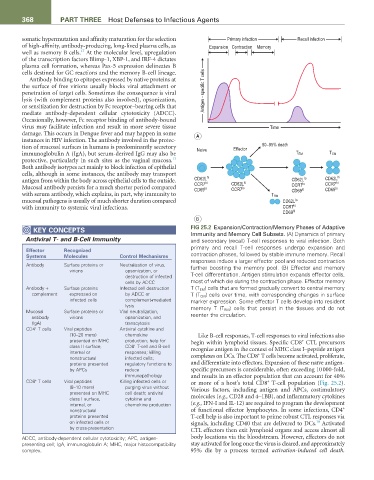
            KEY CONCEPtS                                       FIG 25.2  Expansion/Contraction/Memory Phases of Adaptive
                                                               Immunity and Memory Cell Subsets. (A) Dynamics of primary
         Antiviral T- and B-Cell Immunity                      and secondary (recall) T-cell responses to viral infection. Both
                                                               primary and recall T-cell responses undergo expansion and
          Effector    recognized
          Systems     Molecules         Control Mechanisms     contraction phases, followed by stable immune memory. Recall
                                                               responses induce a larger effector pool and reduced contraction
          Antibody    Surface proteins or   Neutralization of virus,   further  boosting  the  memory  pool.  (B)  Effector  and memory
                        virions           opsonization, or     T-cell differentiation. Antigen stimulation expands effector cells,
                                          destruction of infected
                                          cells by ADCC        most of which die during the contraction phase. Effector memory
          Antibody +   Surface proteins   Infected cell destruction   T (T EM ) cells that are formed gradually convert to central memory
           complement   expressed on      by ADCC or           T (T CM ) cells over time, with corresponding changes in surface
                        infected cells    complement-mediated   marker expression. Some effector T cells develop into resident
                                          lysis                memory T (T RM ) cells that persist in the tissues and do not
          Mucosal     Surface proteins or   Viral neutralization,   reenter the circulation.
           antibody     virions           opsonization, and
           (IgA)                          transcytosis
          CD4  T cells  Viral peptides   Antiviral cytokine and
             +
                        (10–20 mers)      chemokine               Like B-cell responses, T-cell responses to viral infections also
                        presented on MHC   production; help for   begin within lymphoid tissues. Specific CD8  CTL precursors
                                                                                                    +
                                             +
                        class II surface,   CD8  T-cell and B-cell   recognize antigen in the context of MHC class I–peptide antigen
                        internal or       responses; killing                         +
                        nonstructural     infected cells;      complexes on DCs. The CD8  T cells become activated, proliferate,
                        proteins presented   regulatory functions to   and differentiate into effectors. Expansion of these naïve antigen-
                        by APCs           reduce               specific precursors is considerable, often exceeding 10 000-fold,
                                          immunopathology      and results in an effector population that can account for 40%
             +
          CD8  T cells  Viral peptides   Killing infected cells or   or more of a host’s total CD8  T-cell population (Fig. 25.2).
                                                                                        +
                        (8–10 mers)       purging virus without   Various factors, including antigen and  APCs, costimulatory
                        presented on MHC   cell death; antiviral
                        class I surface,   cytokine and        molecules (e.g., CD28 and 4–1BB), and inflammatory cytokines
                        internal, or      chemokine production  (e.g., IFN-I and IL-12) are required to program the development
                                                                                                                 +
                        nonstructural                          of functional effector lymphocytes. In some infections, CD4
                        proteins presented                     T-cell help is also important to prime robust CTL responses via
                        on infected cells or                   signals, including CD40 that are delivered to DCs.  Activated
                                                                                                         18
                        by cross-presentation                  CTL effectors then exit lymphoid organs and access almost all
        ADCC, antibody-dependent cellular cytotoxicity; APC, antigen-  body locations via the bloodstream. However, effectors do not
        presenting cell; IgA, immunoglobulin A; MHC, major histocompatibility   stay activated for long once the virus is cleared, and approximately
        complex.                                               95% die by a process termed  activation-induced cell death.

