


Page 388 - Clinical Immunology_ Principles and Practice ( PDFDrive )
P. 388
370          Part tHrEE  Host Defenses to Infectious Agents


        survives the contraction phase and gradually differentiates into   T RM  cells can trigger enhanced early inflammation to drive local
                               24
        a stable memory population.  Upon reinfection, these memory   immunity. This is in contrast to T EM  cells, which continue to
        cells can be rapidly activated and, by virtue of their increased   migrate through nonlymphoid tissues, rather than being seques-
                                                                                                              +
        frequency, mediate more rapid clearance of the viral pathogen.   tered in peripheral tissues, and also differs from the CD8  and
                                                                   +
        Moreover, repeated stimulation of memory cells via multiple   CD4  T CM , which migrate largely through lymphoid organs (spleen
        infections with the same virus, or prime-boost vaccine regimes,   and lymph nodes). These differences may define the physiological
        further increases the size of the antigen-specific memory T-cell   raison d'être for these memory T-cell subsets, highlighting that
            25
        pool.  Restimulation also affects the activation status and tissue   measurement of memory T cells in human peripheral blood is
        distribution of memory T cells, which may enhance protection   a poor representation of the total-body memory T cell pool.
        from viral infection in mucosal and other tissues.        T RM  cells can be detected in tissues by using markers, such
           Experiments in humans and mice have demonstrated that   as CD69 and CD103, although these are imperfect identifiers,
        memory T cells are heterogeneous. Memory T cells were divided   including in human tissues. T RM  cells in different anatomical
        into effector memory (T EM ) and central memory (T CM ) subsets,   locations share a common genetic signature and require common
        defined by expression of two surface molecules involved in T-cell   transcription factors for their formation. Yet, these cells also
                                           lo
                                24
                                                 lo
        migration: CD62L and CCR7.  The CD62L CCR7  T EM  subset   adopt unique gene expression that is imprinted by the tissue
        is found primarily in nonlymphoid tissues and the spleen, whereas   environment, and presumably imparts specialized functions on
                 hi
                       hi
        the CD62L CCR7  T CM  subset is largely present in lymph nodes   T RM  cells in each location. However, memory in certain peripheral
        and the spleen. The current model predicts that effector T cells   tissues, such as lungs, appears to wane over time, suggesting that
        form the T EM  subset and that these cells gradually convert to a   memory T cells may not persist in sufficient numbers in this
        T CM  phenotype over time (Fig. 25.2B). Although the conditions   site. This rationalizes a need for vaccines that induce optimal
        that control the rate of this conversion are unknown, it is likely   numbers of memory T cells in tissues as well as blood.
        that the amounts of antigen and inflammatory signals received
        during the effector phase greatly influence this. It has also been
                      +
        shown that CD4  T-cell help is required for the generation of   IMMUNE EVASION AND IMMUNITY TO CHRONIC
                            +
        long-lived memory CD8  T cells, via interactions with DCs. 21  VIRAL INFECTIONS
           Studies suggest that T CM  are capable of mounting stronger
        proliferative responses following reinfection. Tissue-specific   Many, if not all, viruses employ immune blunting or delay tactics
        homing of T EM  cells permits them to enter sites of potential viral   to circumvent aspects of the immune system, allowing them
                                                                                                             27
        infection, such as skin and mucosae. However, we now know   time to replicate further or escape detection (Table 25.3).  One
        that many memory T cells found at sites of previous viral infec-  such mechanism may involve killing or infecting APCs. Viruses
                                          26
        tions take up long-term residence in tissues.  This includes skin,   may also delay or prevent apoptosis induced by CTLs within
                                                                                                               +
        intestines, lungs, the liver, and the brain. These resident memory   infected cells. Other viral evasion measures aimed at the CD8  T
        T cells (T RM  cells) are sequestered from the circulation and provide   cell–mediated antiviral defense system inhibit antigen processing,
        rapid protection against viruses, such as HSV, in skin, where   thereby minimizing effector CTL induction. To escape CTL killing,
        they localize with a unique dendritic morphology and undergo   many viruses also downregulate the MHC molecules on the
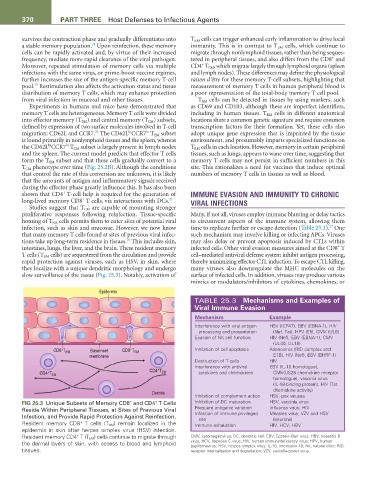
        slow surveillance of the tissue (Fig. 25.3). Notably, activation of   surface of infected cells. In addition, viruses may produce various
                                                               mimics or modulators/inhibitors of cytokines, chemokines, or
                                 Epidermis
                                                                 TABLE 25.3  Mechanisms and Examples of
                                                                 Viral Immune Evasion
                                                                 Mechanism               Example
                                                                 Interference with viral antigen   HSV (ICP47), EBV (EBNA-1), HIV
                                                                  processing and presentation  (Nef, Tat), HPV (E5), CMV (UL6)
                                                                 Evasion of NK cell function  HIV (Nef), EBV (EBNA-1), CMV
                                                                                          (UL40, UL18)
                                            +
                     +
                   CD8 T RM   Basement   CD8 T RM                Inhibition of cell apoptosis  Adenovirus (RID complex and
                              membrane                                                    E1B), HIV (Nef), EBV (BHRF-1)
                                                                 Destruction of T cells  HIV
                                                                 Interference with antiviral   EBV (IL-10 homologue),
                                                     +
                                                  CD4 T
              CD4 T EM                                EM          cytokines and chemokines  CMV(US28 chemokine receptor
                 +
                                                                                          homologue), vaccinia virus
                                                                                          (IL-18-binding protein), HIV (Tat
                                                                                          chemokine activity)
                                                   Dermis
                                                                 Inhibition of complement action  HSV, pox viruses
                                           +
                                                    +
        FIG 25.3  Unique Subsets of Memory CD8  and CD4  T Cells   Inhibition of DC maturation  HSV, vaccinia virus
        Reside Within Peripheral Tissues, at Sites of Previous Viral   Frequent antigenic variation  Influenza virus, HIV
        Infection, and Provide Rapid Protection Against Reinfection.   Infection of immune privileged   Measles virus, VZV and HSV
                                                                                          (neurons)
                                                                  site
                           +
        Resident memory CD8  T cells (T RM ) remain localized in the   Immune exhaustion  HIV, HCV, HBV
        epidermis in skin after herpes simplex virus (HSV) infection.
        Resident memory CD4  T (T EM ) cells continue to migrate through   CMV, cytomegalovirus; DC, dendritic cell; EBV, Epstein–Barr virus; HBV, hepatitis B
                          +
        the dermal layers of skin, with access to blood and lymphoid   virus; HCV, hepatitis C virus; HIV, human immunodeficiency virus; HPV, human
                                                               papillomavirus; HSV, herpes simplex virus; IL-18, interleukin-18; NK, natural killer; RID,
        tissues.                                               receptor internalization and degradation; VZV, varicella-zoster virus.

