


Page 389 - Clinical Immunology_ Principles and Practice ( PDFDrive )
P. 389
CHaPtEr 25  Host Defenses to Viruses              371


           other components of the immune system or their receptors.   exhausted T cells. These studies implicated multiple inhibitory
           Viruses also resort to antigenic hypervariability to escape antibody   receptors as a potential therapeutic targets, and although combina-
           or T-cell recognition. This can occur during transmission from   tions of these checkpoint inhibitor blockade therapies are proving
                                                                                                            31
           host to host (e.g., influenza virus), or within hosts during chronic   highly beneficial to the treatment of certain cancers,  similarly
           infection through the generation of viral escape mutants. The   efficacious responses have yet to be demonstrated during chronic
           latter is particularly important for HIV and HCV infections.  virus infection.
             The success of many viral pathogens rests in their ability to
           subvert the host immune response. The most successful human
           viruses can escape the immune system and persist for the life   OUTCOMES OF VIRUS INFECTION: IMMUNITY
                    28
           of the host.  Two well-studied examples of this are CMV and   OR IMMUNOPATHOLOGY
           EBV. T-cell responses to these viruses are prominent and readily
           detectable in humans, and yet the immune system is unable to   Typically, individual humans respond to a virus infection in
           clear either pathogen completely. However, these viruses generally   different ways.  When the common cold or even pandemic
           remain undetectable in immunocompetent individuals. Other   influenza infection occurs, only a small percentage of exposed
           viral infections, such as those caused by the herpes viruses HSV   persons may develop overt clinical disease. In the prevaccine
           and VZV, are marked by periods of latency when no virus can   days, poliomyelitis was a much-feared consequence of poliovirus
           be detected. Yet, periods of viral reactivation, often triggered by   infection, but only a very small percentage of infected persons
           stress, can lead to episodes of disease. These are controlled by   developed the paralyzing complications. Similarly, only an
           the immune response, which plays a central role in controlling   unfortunate few develop life-threatening meningoencephalitis
           herpes virus latency. 29                               following infection with the insect-transmitted West Nile virus.
             Many of the most medically important human viruses are   It is particularly characteristic of chronic viral infections that
           associated with persistent viremia. These include those causing   clinical expression is highly variable. With HCV, for example,
           chronic infections, such as HIV, HCV, HBV, and human   in 70–80% of patients, some form of chronic liver disease develops,
           T-lymphotropic virus (HTLV), among others. Such chronic viral   and the virus is not cleared. However, in up to 30%, the infection
           infections are marked by high levels of persisting antigen and   is controlled, the virus is cleared, and immunity to reinfection
           can result in skewed T-cell immunodominance hierarchies, altered   develops. The latter group of individuals make a type of immune
           tissue localization of immune cells, and severely impaired T-cell   response that includes protective antibodies along with an
                  30
           function.  This altered T-cell function is hierarchical and results   appropriate pattern of T-cell responsiveness. 32
           in functional T-cell defects ranging from reduced cytokine   We do not fully understand the reasons for the varying
           production and altered proliferative capacity (exhaustion) to   outcomes of virus infections in different persons, and almost
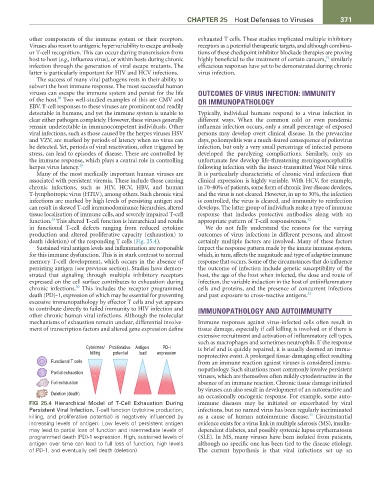
           death (deletion) of the responding T cells (Fig. 25.4).  certainly multiple factors are involved. Many of these factors
             Sustained viral antigen levels and inflammation are responsible   impact the response pattern made by the innate immune system,
           for this immune dysfunction. This is in stark contrast to normal   which, in turn, affects the magnitude and type of adaptive immune
           memory T-cell development, which occurs in the absence of   response that occurs. Some of the circumstances that do influence
           persisting antigen (see previous section). Studies have demon-  the outcome of infection include genetic susceptibility of the
           strated  that  signaling  through  multiple  inhibitory  receptors   host, the age of the host when infected, the dose and route of
           expressed on the cell surface contributes to exhaustion during   infection, the variable induction in the host of antiinflammatory
                          30
           chronic infections.  This includes the receptor programmed   cells and proteins, and the presence of concurrent infections
           death (PD)-1, expression of which may be essential for preventing   and past exposure to cross-reactive antigens. 32
           excessive immunopathology by effector T cells and yet appears
           to contribute directly to failed immunity to HIV infection and   IMMUNOPATHOLOGY AND AUTOIMMUNITY
           other chronic human viral infections. Although the molecular
           mechanisms of exhaustion remain unclear, differential involve-  Immune responses against virus-infected cells often result in
           ment of transcription factors and altered gene expression define   tissue damage, especially if cell killing is involved or if there is
                                                                  extensive recruitment and activation of inflammatory cell types,
                                                                  such as macrophages and sometimes neutrophils. If the response
                             Cytokines/ Proliferative  Antigen   PD-I  is brief and is quickly repaired, it is usually deemed an immu-
                               killing  potential  load  expression
                                                                  noprotective event. A prolonged tissue-damaging effect resulting
                  Functional T cells                              from an immune reaction against viruses is considered immu-
                                                                  nopathology. Such situations most commonly involve persistent
                  Partial exhaustion
                                                                  viruses, which are themselves often mildly cytodestructive in the
                  Full exhaustion                                 absence of an immune reaction. Chronic tissue damage initiated
                                                                  by viruses can also result in development of an autoreactive and
                  Deletion (death)
                                                                  an occasionally oncogenic response. For example, some auto-
           FIG 25.4  Hierarchical Model of T-Cell Exhaustion During   immune diseases may be initiated or exacerbated by viral
           Persistent Viral Infection. T-cell function (cytokine production,   infections, but no named virus has been regularly incriminated
                                                                                                      33
           killing, and proliferative potential) is negatively influenced by   as a cause of human autoimmune disease.  Circumstantial
           increasing levels of antigen. Low levels of persistent antigen   evidence exists for a virus link in multiple sclerosis (MS), insulin-
           may lead to partial loss of function and intermediate levels of   dependent diabetes, and possibly systemic lupus erythematosus
           programmed death (PD)-1 expression. High, sustained levels of   (SLE). In MS, many viruses have been isolated from patients,
           antigen over time can lead to full loss of function, high levels   although no specific one has been tied to the disease etiology.
           of PD-1, and eventually cell death (deletion).         The current hypothesis is that viral infections set up an

