


Page 390 - Clinical Immunology_ Principles and Practice ( PDFDrive )
P. 390
372          Part tHrEE  Host Defenses to Infectious Agents


         TABLE 25.4  Lesions resulting
         From Immunopathology
          Primarily involving CD8  T   Murine lymphocytic choriomeningitis
                         +
           cells acting as cytotoxic T   virus;
           lymphocytes or sources of   Hepatitis B virus (HBV)–induced
           proinflammatory cytokines  chronic hepatitis
                                Coxsackie B virus–induced diabetes
                                Coxsackie B virus–induced
                                 myocarditis
                                Demyelination caused by some
                                 strains of mouse coronavirus and
                                 Theiler virus
                         +
          Primarily involving CD4  T   Demyelination caused by some
           cells that produce Th1   strains of mouse coronavirus and
           cytokines             Theiler’s virus;
                                Herpes simplex virus (HSV)–induced
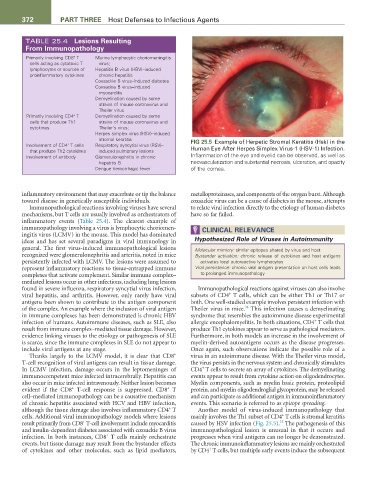
                                 stromal keratitis             FIG 25.5  Example of Herpetic Stromal Keratitis (Hsk) in the
          Involvement of CD4  T cells   Respiratory syncytial virus (RSV)–  Human Eye After Herpes Simplex Virus-1 (HSV-1) Infection.
                       +
           that produce Th2 cytokines  induced pulmonary lesions
          Involvement of antibody  Glomerulonephritis in chronic   Inflammation of the eye and eyelid can be observed, as well as
                                 hepatitis B                   neovascularization and substantial necrosis, ulceration, and opacity
                                Dengue hemorrhagic fever       of the cornea.


        inflammatory environment that may exacerbate or tip the balance   metalloproteinases, and components of the oxygen burst. Although
        toward disease in genetically susceptible individuals.  coxsackie virus can be a cause of diabetes in the mouse, attempts
           Immunopathological reactions involving viruses have several   to relate viral infection directly to the etiology of human diabetes
        mechanisms, but T cells are usually involved as orchestrators of   have so far failed.
        inflammatory events (Table 25.4). The clearest example of
        immunopathology involving a virus is lymphocytic choriomen-   CLINICaL rELEVaNCE
        ingitis virus (LCMV) in the mouse. This model has dominated
        ideas and has set several paradigms in viral immunology in   Hypothesized Role of Viruses in Autoimmunity
        general. The first virus-induced immunopathological lesions   Molecular mimicry: similar epitopes shared by virus and host
        recognized were glomerulonephritis and arteritis, noted in mice   Bystander activation: chronic release of cytokines and host antigens
        persistently infected with LCMV. The lesions were assumed to   activates local autoreactive lymphocytes
        represent inflammatory reactions to tissue-entrapped immune   Viral persistence: chronic viral antigen presentation on host cells leads
        complexes that activate complement. Similar immune complex–  to prolonged immunopathology
        mediated lesions occur in other infections, including lung lesions
        found in severe influenza, respiratory syncytial virus infection,   Immunopathological reactions against viruses can also involve
                                                                            +
        viral hepatitis, and arthritis. However, only rarely have viral   subsets of CD4  T cells, which can be either Th1 or Th17 or
        antigens been shown to contribute to the antigen component   both. One well-studied example involves persistent infection with
                                                                                 34
        of the complex. An example where the inclusion of viral antigen   Theiler virus in mice.  This infection causes a demyelinating
        in immune complexes has been demonstrated is chronic HBV   syndrome that resembles the autoimmune disease experimental
                                                                                                        +
        infection of humans. Autoimmune diseases, such as SLE, also   allergic encephalomyelitis. In both situations, CD4  T cells that
        result from immune complex–mediated tissue damage. However,   produce Th1 cytokines appear to serve as pathological mediators.
        evidence linking viruses to the etiology or pathogenesis of SLE   Furthermore, in both models an increase in the involvement of
        is scarce, since the immune complexes in SLE do not appear to   myelin-derived autoantigens occurs as the disease progresses.
        include viral antigens at any stage.                   Once again, such observations indicate the possible role of a
                                                          +
           Thanks largely to the LCMV model, it is clear that CD8    virus in an autoimmune disease. With the Theiler virus model,
        T-cell recognition of viral antigens can result in tissue damage.   the virus persists in the nervous system and chronically stimulates
                                                                   +
        In LCMV infection, damage occurs in the leptomeninges of   CD4  T cells to secrete an array of cytokines. The demyelinating
        immunocompetent mice infected intracerebrally. Hepatitis can   events appear to result from cytokine action on oligodendrocytes.
        also occur in mice infected intravenously. Neither lesion becomes   Myelin components, such as myelin basic protein, proteolipid
                         +
                                                        +
        evident if the CD8  T-cell response is suppressed. CD8  T   protein, and myelin oligodendroglial glycoprotein, may be released
        cell–mediated immunopathology can be a causative mechanism   and can participate as additional antigen in immunoinflammatory
        of chronic hepatitis associated with HCV and HBV infection,   events. This scenario is referred to as epitope spreading.
                                                        +
        although the tissue damage also involves inflammatory CD4  T   Another model of virus-induced immunopathology that
                                                                                             +
        cells. Additional viral immunopathology models where lesions   mainly involves the Th1 subset of CD4  T cells is stromal keratitis
                            +
                                                                                             35
        result primarily from CD8  T-cell involvement include myocarditis   caused by HSV infection (Fig. 25.5).  The pathogenesis of this
        and insulin-dependent diabetes associated with coxsackie B virus   immunopathological lesion is unusual in that it occurs and
                                    +
        infection. In both instances, CD8  T cells mainly orchestrate   progresses when viral antigens can no longer be demonstrated.
        events, but tissue damage may result from the bystander effects   The chronic immunoinflammatory lesions are mainly orchestrated
                                                                     +
        of cytokines and other molecules, such as lipid mediators,   by CD4  T cells, but multiple early events induce the subsequent

