


Page 391 - Clinical Immunology_ Principles and Practice ( PDFDrive )
P. 391
CHaPtEr 25  Host Defenses to Viruses              373


           pathology. Viral replication, the production of certain cytokines   biology approaches are expected to result in novel screening for
           and chemokines (IL-1, IL-6, IL-12, and CXCL8), recruitment of   immune protection parameters after vaccination. In the near
           inflammatory cells (e.g., neutrophils), and neovascularization   future, this should also assist in the formulation of new vaccines
           of the avascular cornea all precede immunopathology. Recently,   containing key immune activators, such as those that stimulate
           it has become evident that Th17 T cells participate in stromal   certain subsets of T cells or induce appropriate homing molecule
           keratitis lesions. The role of Th17 T cells as orchestrators of   expression on these cells to direct them to tissues where they
           inflammatory reactions has been a major research focus, especially   are required to mediate protection (e.g., mucosal sites, or skin).
                                      36
           in lesions of autoimmune diseases.  When Th17 T cells are the
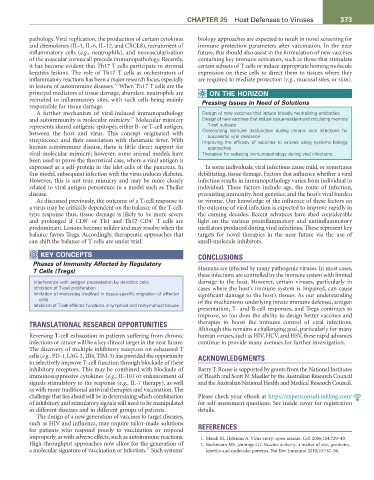
           principal mediators of tissue damage, abundant neutrophils are    ON tHE HOrIZON
           recruited to inflammatory sites, with such cells being mainly   Pressing Issues in Need of Solutions
           responsible for tissue damage.
             A further mechanism of viral-induced immunopathology     Design of new vaccines that induce broadly neutralizing antibodies
                                            33
           and autoimmunity is molecular mimicry.  Molecular mimicry   Design of new vaccines that induce tissue-resident and circulating memory
           represents shared antigenic epitopes, either B- or T-cell antigen,   T-cell subsets
           between the host and virus. This concept originated with   Overcoming immune dysfunction during chronic viral infections for
                                                                     successful viral clearance
           streptococci and their association with rheumatic fever. With   Improving the efficacy of vaccines to viruses using systems biology
           human  autoimmune  disease, there is  little  direct  support  for   approaches
           viral molecular mimicry; however, some animal models have   Therapies for reducing immunopathology during viral infections
           been used to prove the theoretical case, where a viral antigen is
           expressed as a self-protein in the islet cells of the pancreas. In   In some individuals, viral infections cause mild, or sometimes
           this model, subsequent infection with the virus induces diabetes.   debilitating, tissue damage. Factors that influence whether a viral
           However, this is not true mimicry and  may be more closely   infection results in immunopathology varies from individual to
           related to viral antigen persistence in a model such as Theiler   individual. These factors include age, the route of infection,
           disease.                                               preexisting immunity, host genetics, and the host’s viral burden
             As discussed previously, the outcome of a T-cell response to   or virome. Our knowledge of the influence of these factors on
           a virus may be critically dependent on the balance of the T-cell-  the outcome of viral infection is expected to improve rapidly in
           type response thus, tissue damage is likely to be more severe     the coming decades. Recent advances have shed considerable
                                                   +
                             +
           and prolonged if CD8  or Th1 and Th17 CD4  T cells are   light on the various proinflammatory and antiinflammatory
           predominant. Lesions become milder and may resolve when the   mediators produced during viral infections. These represent key
           balance favors Tregs. Accordingly, therapeutic approaches that   targets  for  novel  therapies  in  the  near  future  via  the  use  of
           can shift the balance of T cells are under trial.      small-molecule inhibitors.
               KEY CONCEPtS                                       CONCLUSIONS
            Phases of Immunity Affected by Regulatory
            T Cells (Tregs)                                       Humans are infected by many pathogenic viruses. In most cases,
                                                                  these infections are controlled by the immune system with limited
            Interference with antigen presentation by dendritic cells  damage to the host. However, certain viruses, particularly in
            Inhibition of T-cell proliferation                    cases where the host’s immune system is impaired, can cause
            Inhibition of molecules involved in tissue-specific migration of effector   significant damage to the host’s tissues. As our understanding
              cells                                               of the mechanisms underlying innate immune defenses, antigen
            Inhibition of T-cell effector functions in lymphoid and nonlymphoid tissues
                                                                  presentation, T- and B-cell responses, and Tregs continues to
                                                                  improve, so too does the ability to design better vaccines and
           TRANSLATIONAL RESEARCH OPPORTUNITIES                   therapies to boost the immune control of viral infections.
                                                                  Although this remains a challenging goal, particularly for many
           Reversing T-cell exhaustion in patients suffering from chronic   human viruses, such as HIV, HCV, and HSV, these rapid advances
           infections or cancer will be a key clinical target in the near future.   continue to provide many avenues for further investigation.
           The discovery of multiple inhibitory receptors on exhausted T
           cells (e.g., PD-1, LAG-3, 2B4, TIM-3) has provided the opportunity   ACKNOWLEDGMENTS
           to selectively improve T-cell function through blockade of these
           inhibitory receptors. This may be combined with blockade of   Barry T. Rouse is supported by grants from the National Institutes
           immunosuppressive cytokines (e.g., IL-10) or enhancement of   of Health and Scott N. Mueller by the Australian Research Council
           signals stimulatory to the response (e.g., IL-7 therapy), as well   and the Australian National Health and Medical Research Council.
           as with more traditional antiviral therapies and vaccination. The
           challenge that lies ahead will be in determining which combination   Please check your eBook at https://expertconsult.inkling.com/
           of inhibitory and stimulatory signals will need to be manipulated   for self-assessment questions. See inside cover for registration
           in different diseases and in different groups of patients.  details.
             The design of a new generation of vaccines to target diseases,
           such as HIV and influenza, may require tailor-made solutions   REFERENCES
           for patients who respond poorly to vaccination or respond
           improperly, as with adverse effects, such as autoimmune reactions.   1.  Marsh M, Helenius A. Virus entry: open sesame. Cell 2006;124:729–40.
           High-throughput approaches now allow for the generation of   2.  Bachmann MF, Jennings GT. Vaccine delivery: a matter of size, geometry,
                                                 37
           a molecular signature of vaccination or infection.  Such systems’   kinetics and molecular patterns. Nat Rev Immunol 2010;10:787–96.

