


Page 397 - Clinical Immunology_ Principles and Practice ( PDFDrive )
P. 397
378          PARt tHREE  Host Defenses to Infectious Agents


                                      12
        because of its potential for dual use.  Infection can be spread   Bartonella
        to humans via contaminated animals or tick bites. This gram-  Bartonella spp. represent gram-negative facultative intracellular
        negative bacterium survives in macrophages and primarily causes   pathogens transmitted by insect vectors, such as fleas, sandflies,
                                                                             18
        acute pneumonia as well as skin sores, with subsequent involve-  and mosquitoes.  The most clinically relevant species are  B.
        ment of lymph nodes.                                   henselae, B. quintana, and B. bacilliformis. B. henselae causes cat
                                                               scratch disease (CSD) resulting in local lymphadenopathy in the
        Nongranulomatous Infections                            lymph node draining the scratch site accompanied by fever,
        Legionnaires’ Disease or Legionellosis                 headache, and  splenomegaly.  Oculoglandular  involvement
        Legionnaires’ disease is caused by Legionella pneumophila, an   (Parinaud syndrome), encephalopathy, neuroretinitis, or osteo-
        environmental bacterium that persists within amoeba living in   myelitis can occur, albeit in rare cases. In immunosuppressed
        water reservoirs (e.g., air-cooling systems), from where it is spread   patients, bacillary angiomatosis and peliosis can occur, character-
        aerogenically. Infection is exacerbated by a compromised immune   ized by pseudotumoral proliferation of endothelial cells. Bacteria
        status. Characteristically, Legionnaires’ disease presents as atypical   persist within erythrocytes with the intracellular location provid-
        pneumonia associated with general symptoms and is complicated   ing a protective niche.
        by extrapulmonary infection, renal failure, and lung abscesses.
        Cases of Legionnaires’ disease in the United States increased   GRANULOMA PATHOLOGY AS HALLMARK OF
        from 0.39 to 1.36 per 100 000 people from 2000 to 2011. 13
                                                               INTRACELLULAR BACTERIAL INFECTION
        Chlamydial Urethritis, Cervicitis, and Conjunctivitis
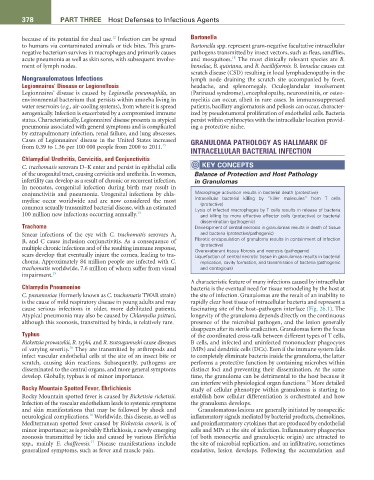
        C. trachomatis serovars D–K enter and persist in epithelial cells    KEY CONCEPtS
        of the urogenital tract, causing cervicitis and urethritis. In women,   Balance of Protection and Host Pathology
        infertility can develop as a result of chronic or recurrent infection.   in Granulomas
        In  neonates,  congenital  infection  during  birth  may  result  in
        conjunctivitis and pneumonia. Urogenital infections by chla-  Macrophage activation results in bacterial death (protective)
        mydiae occur worldwide and are now considered the most   Intracellular bacterial killing by “killer molecules” from T cells
                                                                   (protective)
        common sexually transmitted bacterial disease, with an estimated   Lysis of infected macrophages by T cells results in release of bacteria
        100 million new infections occurring annually. 14          and killing by more effective effector cells (protective) or bacterial
                                                                   dissemination (pathogenic)
        Trachoma                                                 Development of central necrosis in granulomas results in death of tissue
        Smear infections of the eye with  C. trachomatis  serovars A,   and bacteria (protective/pathogenic)
        B, and C cause inclusion conjunctivitis. As a consequence of   Fibrotic encapsulation of granuloma results in containment of infection
                                                                   (protective)
        multiple chronic infections and of the resulting immune response,   Overexuberant tissue fibrosis and necrosis (pathogenic)
        scars develop that eventually injure the cornea, leading to tra-  Liquefaction of central necrotic tissue in granulomas results in bacterial
        choma. Approximately 84 million people are infected with C.   replication, cavity formation, and transmission of bacteria (pathogenic
        trachomatis worldwide, 7.6 million of whom suffer from visual    and contagious)
        impairment. 15
                                                               A characteristic feature of many infections caused by intracellular
        Chlamydia Pneumoniae                                   bacteria is the eventual need for tissue remodeling by the host at
        C. pneumoniae (formerly known as C. trachomatis TWAR strain)   the site of infection. Granulomas are the result of an inability to
        is the cause of mild respiratory disease in young adults and may   rapidly clear host tissue of intracellular bacteria and represent a
        cause  serious  infections  in  older,  more  debilitated  patients.   fascinating site of the host–pathogen interface (Fig. 26.1). The
        Atypical pneumonia may also be caused by Chlamydia psittaci,   longevity of the granuloma depends directly on the continuous
        although this zoonosis, transmitted by birds, is relatively rare.  presence of the microbial pathogen, and the lesion generally
                                                               disappears after its sterile eradication. Granulomas form the focus
        Typhus                                                 of the coordinated cross-talk between different types of T cells,
        Rickettsia prowazekii, R. typhi, and R. tsutsugamushi cause diseases   B cells, and infected and uninfected mononuclear phagocytes
                        16
        of varying severity.  They are transmitted by arthropods and   (MPs) and dendritic cells (DCs). Even if the immune system fails
        infect vascular endothelial cells at the site of an insect bite or   to completely eliminate bacteria inside the granuloma, the latter
        scratch, causing skin reactions. Subsequently, pathogens are   performs a protective function by containing microbes within
        disseminated to the central organs, and more general symptoms   distinct foci and preventing their dissemination. At the same
        develop. Globally, typhus is of minor importance.      time, the granuloma can be detrimental to the host because it
                                                                                                     19
                                                               can interfere with physiological organ functions.  More detailed
        Rocky Mountain Spotted Fever, Ehrlichiosis             study of cellular phenotype within granulomas is starting to
        Rocky Mountain spotted fever is caused by Rickettsia rickettsii.   establish how cellular differentiation is orchestrated and how
        Infection of the vascular endothelium leads to systemic symptoms   the granuloma develops.
        and skin manifestations that may be followed by shock and   Granulomatous lesions are generally initiated by nonspecific
                              16
        neurological complications.  Worldwide, this disease, as well as   inflammatory signals mediated by bacterial products, chemokines,
        Mediterranean spotted fever caused by Rickettsia conorii, is of   and proinflammatory cytokines that are produced by endothelial
        minor importance; as is probably Ehrlichiosis, a newly emerging   cells and MPs at the site of infection. Inflammatory phagocytes
        zoonosis transmitted by ticks and caused by various Ehrlichia   (of both monocytic and granulocytic origin) are attracted to
                               17
        spp., mainly  E. chaffeensis.  Disease manifestations include   the site of microbial replication, and an infiltrative, sometimes
        generalized symptoms, such as fever and muscle pain.   exudative, lesion develops. Following the accumulation and

