


Page 394 - Clinical Immunology_ Principles and Practice ( PDFDrive )
P. 394
26


                                           Host Defenses to Intracellular Bacteria


                                                                          Stephen T. Reece, Stefan H.E. Kaufmann


           The evolutionary relationship between humans and bacteria is    CLINICAL PEARLS
           so intimate that it is impossible to imagine the development of
                             1
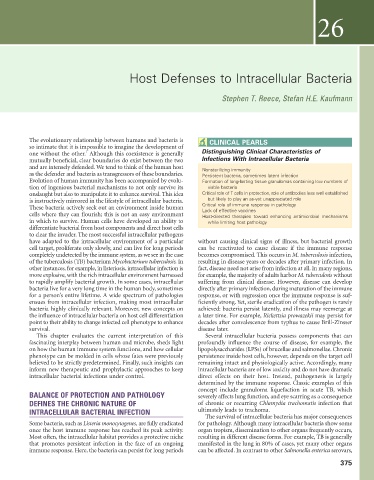
           one without the other.  Although this coexistence is generally   Distinguishing Clinical Characteristics of
           mutually beneficial, clear boundaries do exist between the two   Infections With Intracellular Bacteria
           and are intensely defended. We tend to think of the human host   Nonsterilizing immunity
           as the defender and bacteria as transgressors of these boundaries.   Persistent bacteria, sometimes latent infection
           Evolution of human immunity has been accompanied by evolu-  Formation of long-lasting tissue granulomas containing low numbers of
           tion of ingenious bacterial mechanisms to not only survive its   viable bacteria
           onslaught but also to manipulate it to enhance survival. This idea   Critical role of T cells in protection, role of antibodies less well established
           is instructively mirrored in the lifestyle of intracellular bacteria.   but likely to play an as-yet unappreciated role
           These bacteria actively seek out an environment inside human   Critical role of immune response in pathology
                                                                   Lack of effective vaccines
           cells where they can flourish; this is not an easy environment   Host-directed therapies  toward  enhancing  antimicrobial  mechanisms
           in which to survive. Human cells have developed an ability to   while limiting host pathology
           differentiate bacterial from host components and direct host cells
           to clear the invader. The most successful intracellular pathogens
           have adapted to the intracellular environment of a particular   without causing clinical signs of illness, but bacterial growth
           cell target, proliferate only slowly, and can live for long periods   can be reactivated to cause disease if the immune response
           completely undetected by the immune system, as we see in the case   becomes compromised. This occurs in M. tuberculosis infection,
           of the tuberculosis (TB) bacterium Mycobacterium tuberculosis. In   resulting in disease years or decades after primary infection. In
           other instances, for example, in listeriosis, intracellular infection is   fact, disease need not arise from infection at all. In many regions,
           more explosive, with the rich intracellular environment harnessed   for example, the majority of adults harbor M. tuberculosis without
           to rapidly amplify bacterial growth. In some cases, intracellular   suffering from clinical disease. However, disease can develop
           bacteria live for a very long time in the human body, sometimes   directly after primary infection, during maturation of the immune
           for a person’s entire lifetime. A wide spectrum of pathologies   response, or with regression once the immune response is suf-
           ensues from intracellular infection, making most intracellular   ficiently strong. Yet, sterile eradication of the pathogen is rarely
           bacteria highly clinically relevant. Moreover, new concepts on   achieved: bacteria persist latently, and illness may reemerge at
           the influence of intracellular bacteria on host cell differentiation   a later time. For example, Rickettsia prowazekii may persist for
           point to their ability to change infected cell phenotype to enhance   decades after convalescence from typhus to cause Brill-Zinsser
           survival.                                              disease later.
             This chapter evaluates the current interpretation of this   Several  intracellular bacteria possess components  that  can
           fascinating interplay between human and microbe, sheds light   profoundly influence the course of disease, for example, the
           on how the human immune system functions, and how cellular   lipopolysaccharides (LPSs) of brucellae and salmonellae. Chronic
           phenotype can be molded in cells whose fates were previously   persistence inside host cells, however, depends on the target cell
           believed to be strictly predetermined. Finally, such insights can   remaining intact and physiologically active. Accordingly, many
           inform new therapeutic and prophylactic approaches to keep   intracellular bacteria are of low toxicity and do not have dramatic
           intracellular bacterial infections under control.      direct effects on their host. Instead, pathogenesis is largely
                                                                  determined by the immune response. Classic examples of this
                                                                  concept include granuloma liquefaction in acute TB, which
           BALANCE OF PROTECTION AND PATHOLOGY                    severely affects lung function, and eye scarring as a consequence
           DEFINES THE CHRONIC NATURE OF                          of chronic or recurring Chlamydia trachomatis infection that
           INTRACELLULAR BACTERIAL INFECTION                      ultimately leads to trachoma.
                                                                    The survival of intracellular bacteria has major consequences
           Some bacteria, such as Listeria monocytogenes, are fully eradicated   for pathology. Although many intracellular bacteria show some
           once the host immune response has reached its peak activity.   organ tropism, dissemination to other organs frequently occurs,
           Most often, the intracellular habitat provides a protective niche   resulting in different disease forms. For example, TB is generally
           that promotes persistent infection in the face of an ongoing   manifested in the lung in 80% of cases, yet many other organs
           immune response. Here, the bacteria can persist for long periods   can be affected. In contrast to other Salmonella enterica serovars,

                                                                                                                375

