


Page 395 - Clinical Immunology_ Principles and Practice ( PDFDrive )
P. 395
376          PARt tHREE  Host Defenses to Infectious Agents


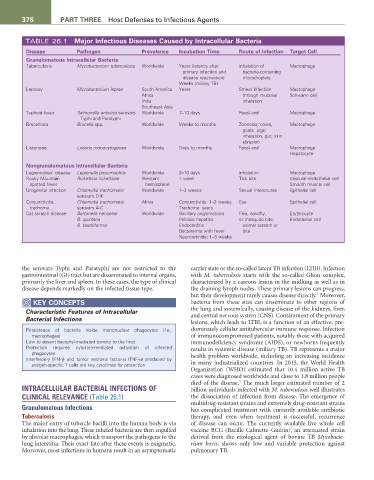
         TABLE 26.1  Major Infectious Diseases Caused by Intracellular Bacteria
          Disease         Pathogen             Prevalence   Incubation time    Route of Infection  target Cell
          Granulomatous Intracellular Bacteria
          Tuberculosis    Mycobacterium tuberculosis  Worldwide  Years (latency after   Inhalation of   Macrophage
                                                             primary infection and   bacteria-containing
                                                             disease reactivation)  microdroplets
                                                            Weeks (miliary TB)
          Leprosy         Mycobacterium leprae  South America  Years           Smear infection   Macrophage
                                               Africa                           through mucosa/  Schwann cell
                                               India                            inhalation
                                               Southeast Asia
          Typhoid fever   Salmonella enterica serovars   Worldwide  7–10 days  Fecal–oral       Macrophage
                           Typhi and Paratyphi
          Brucellosis     Brucella spp.        Worldwide    Weeks to months    Zoonosis; cows,   Macrophage
                                                                                goats, pigs;
                                                                                inhalation, gut, skin
                                                                                abrasion
          Listeriosis     Listeria monocytogenes  Worldwide  Days to months    Fecal–oral       Macrophage
                                                                                                Hepatocyte
          Nongranulomatous Intracellular Bacteria
          Legionnaires’ disease  Legionella pneumophila  Worldwide  2–10 days  Inhalation       Macrophage
          Rocky Mountain   Rickettsia rickettsiae  Western   1 week            Tick bite        Vascular endothelial cell
           spotted fever                         hemisphere                                     Smooth muscle cell
          Urogenital infection  Chlamydia trachomatis  Worldwide  1–3 weeks    Sexual intercourse  Epithelial cell
                          serovars D-K
          Conjunctivitis,   Chlamydia trachomatis  Africa   Conjunctivitis: 1–3 weeks  Eye      Epithelial cell
           trachoma       serovars A-C                      Trachoma: years
          Cat scratch disease  Bartonella henselae  Worldwide  Bacillary angiomatosis  Flea, sandfly,  Erythrocyte
                          B. quintana                       Peliosis hepatitis  or mosquito bite;   Endothelial cell
                          B. bacilliformis                  Endocarditis        animal scratch or
                                                            Bacteremia with fever  bite
                                                            Neuroretinitis: 1–3 weeks


        the serovars Typhi and Paratyphi are not restricted to the   carrier state or the so-called latent TB infection (LTBI). Infection
        gastrointestinal (GI) tract but are disseminated to internal organs,   with  M. tuberculosis starts with the so-called Ghon complex,
        primarily the liver and spleen. In these cases, the type of clinical   characterized by a caseous lesion in the midlung as well as in
        disease depends markedly on the infected tissue type.  the draining lymph nodes. These primary lesions can progress,
                                                                                                         2
                                                               but their development rarely causes disease directly.  Moreover,
            KEY CONCEPtS                                       bacteria from these sites can disseminate to other regions of
         Characteristic Features of Intracellular              the lung and systemically, causing disease of the kidneys, liver,
         Bacterial Infections                                  and central nervous system (CNS). Containment of the primary
                                                               lesions, which leads to LTBI, is a function of an effective, pre-
          Persistence of bacteria inside mononuclear phagocytes (i.e.,   dominately cellular antitubercular immune response. Infection
           macrophages)                                        of immunocompromised patients, notably those with acquired
          Low to absent bacterial-mediated toxicity to the host  immunodeficiency syndrome (AIDS), or newborns frequently
          Protection  requires  cytokine-mediated  activation  of  infected  results in systemic disease (miliary TB). TB represents a major
           phagocytes                                          health problem worldwide, including an increasing incidence
          Interferon-γ (IFN-γ) and tumor necrosis factor-α (TNF-α) produced by
           antigen-specific T cells are key cytokines for protection  in many industrialized countries. In 2015, the  World Health
                                                               Organization (WHO) estimated that 10.4 million active TB
                                                               cases were diagnosed worldwide and close to 1.8 million people
                                                                               3
                                                               died of the disease.  The much larger estimated number of 2
        INTRACELLULAR BACTERIAL INFECTIONS OF                  billion individuals infected with M. tuberculosis well illustrates
        CLINICAL RELEVANCE (Table 26.1)                        the dissociation of infection from disease. The emergence of
                                                               multidrug-resistant strains and extremely drug-resistant strains
        Granulomatous Infections                               has complicated treatment with currently available antibiotic
        Tuberculosis                                           therapy, and even when treatment is successful, recurrence
        The major entry of tubercle bacilli into the human body is via   of disease can occur. The currently available live whole cell
        inhalation into the lung. These inhaled bacteria are then engulfed   vaccine BCG (Bacille Calmette–Guérin), an attenuated strain
        by alveolar macrophages, which transport the pathogens to the   derived  from the  etiological  agent  of bovine  TB  Mycobacte-
        lung interstitia. Their exact fate after these events is enigmatic.   rium bovis, shows only low and variable protection against
        Moreover, most infections in humans result in an asymptomatic   pulmonary TB.

