


Page 413 - Clinical Immunology_ Principles and Practice ( PDFDrive )
P. 413
394          PARt tHREE  Host Defenses to Infectious Agents


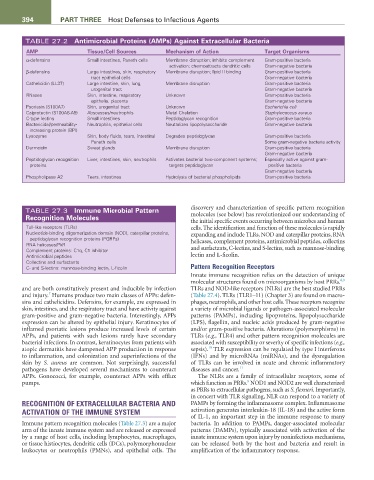
         TABLE 27.2  Antimicrobial Proteins (AMPs) Against Extracellular Bacteria
          AMP                 tissue/Cell Sources      Mechanism of Action              target Organisms
          α-defensins         Small intestines, Paneth cells  Membrane disruption; inhibits complement   Gram-positive bacteria
                                                        activation; chemoattracts dendritic cells  Gram-negative bacteria
          β-defensins         Large intestines, skin, respiratory   Membrane disruption; lipid II binding  Gram-positive bacteria
                               tract epithelial cells                                   Gram-negative bacteria
          Cathelicidin (LL37)  Large intestine, skin, lung,   Membrane disruption       Gram-positive bacteria
                               urogenital tract                                         Gram-negative bacteria
          RNases              Skin, intestine, respiratory   Unknown                    Gram-positive bacteria
                               epithelia, placenta                                      Gram-negative bacteria
          Psoriasin (S100A7)  Skin, urogenital tract   Unknown                          Escherichia coli
          Calprotectin (S100A8-A9)  Abscesses/neutrophils  Metal Chelation              Staphylococcus aureus
          C-type lectins      Small intestines         Peptidoglycan recognition        Gram-positive bacteria
          Bactericidal/permeability-  Neutrophils, epithelial cells  Neutralizes lipopolysaccharide  Gram-negative bacteria
           increasing protein (BPI)
          Lysozyme            Skin, body fluids, tears, intestinal   Degrades peptidoglycan  Gram-positive bacteria
                               Paneth cells                                             Some gram-negative bacteria activity
          Dermcidin           Sweat glands             Membrane disruption              Gram-positive bacteria
                                                                                        Gram-negative bacteria
          Peptidoglycan recognition   Liver, intestines, skin, neutrophils  Activates bacterial two-component systems;   Especially active against gram-
           proteins                                     targets peptidoglycan            positive bacteria
                                                                                        Gram-negative bacteria
          Phospholipase A2    Tears, intestines        Hydrolysis of bacterial phospholipids  Gram-positive bacteria


         TABLE 27.3  Immune Microbial Pattern                  discovery and characterization of specific pattern recognition
         Recognition Molecules                                 molecules (see below) has revolutionized our understanding of
                                                               the initial specific events occurring between microbes and human
          Toll-like receptors (TLRs)                           cells. The identification and function of these molecules is rapidly
          Nucleotide-binding oligomerization domain (NOD), caterpillar proteins,   expanding and include TLRs, NOD and caterpillar proteins, RNA
           peptidoglycan recognition proteins (PGRPs)          helicases, complement proteins, antimicrobial peptides, collectins
          RNA helicases/PkR
          Complement proteins: C1q, C1 inhibitor               and surfactants, C-lectins, and S-lectins, such as mannose-binding
          Antimicrobial peptides                               lectin and L-ficolin.
          Collectins and surfactants
          C- and S-lectins: mannose-binding lectin, L-ficolin  Pattern Recognition Receptors
                                                               Innate immune recognition relies on the detection of unique
                                                                                                                8,9
                                                               molecular structures found on microorganisms by host PRRs.
        and are both constitutively present and inducible by infection   TLRs and NOD-like receptors (NLRs) are the best studied PRRs
                 7
        and injury.  Humans produce two main classes of APPs: defen-  (Table 27.4). TLRs (TLR1–11) (Chapter 3) are found on macro-
        sins and cathelicidins. Defensins, for example, are expressed in    phages, neutrophils, and other host cells. These receptors recognize
        skin, intestines, and the respiratory tract and have activity against   a variety of microbial ligands or pathogen-associated molecular
        gram-positive and gram-negative bacteria. Interestingly, APPs   patterns (PAMPs), including lipoproteins, lipopolysaccharide
        expression can be altered by epithelial injury. Keratinocytes of   (LPS), flagellin, and nucleic acids produced by gram-negative
        inflamed psoriatic lesions produce increased levels of certain   and/or gram-positive bacteria. Alterations (polymorphisms) in
        APPs, and patients with such lesions rarely have secondary   TLRs (e.g., TLR4) and other pattern recognition molecules are
        bacterial infections. In contrast, keratinocytes from patients with   associated with susceptibility or severity of specific infections (e.g.,
                                                                     10
        atopic dermatitis have dampened APP production in response   sepsis).  TLR expression can be regulated by type I interferons
        to inflammation, and colonization and superinfections of the   (IFNs) and by microRNAs (miRNAs), and the dysregulation
        skin by  S. aureus are common. Not surprisingly, successful   of TLRs can be involved in acute and chronic inflammatory
        pathogens have developed several mechanisms to counteract   diseases and cancer. 11
        APPs. Gonococci, for example, counteract  APPs with efflux    The NLRs are a family of intracellular receptors, some of
                                                                                  8
        pumps.                                                 which function as PRRs.  NOD1 and NOD2 are well characterized
                                                               as PRRs to extracellular pathogens, such as S. flexneri. Importantly,
                                                               in concert with TLR signaling, NLR can respond to a variety of
        RECOGNITION OF EXTRACELLULAR BACTERIA AND              PAMPs by forming the inflammasome complex. Inflammasome
        ACTIVATION OF THE IMMUNE SYSTEM                        activation generates interleukin-18 (IL-18) and the active form
                                                               of IL-1, an important step in the immune response to many
        Immune pattern recognition molecules (Table 27.3) are a major   bacteria. In addition to PAMPs, danger-associated molecular
        arm of the innate immune system and are released or expressed   patterns (DAMPs), typically associated with activation of the
        by a range of host cells, including lymphocytes, macrophages,   innate immune system upon injury by noninfectious mechanisms,
        or tissue histiocytes, dendritic cells (DCs), polymorphonuclear   can  be released both by  the host  and bacteria  and  result  in
        leukocytes or neutrophils (PMNs), and epithelial cells. The   amplification of the inflammatory response.

