


Page 416 - Clinical Immunology_ Principles and Practice ( PDFDrive )
P. 416
CHAPtER 27  Host Defenses to Extracellular Bacteria             397


           the MHC-like molecule CD1d. iNKT cells can be directly activated
           by bacterial pathogens as a result of binding of cell wall com-
           ponents of gram-negative bacteria to CD1d. Interestingly,
           cytokines secreted by  APCs that have encountered bacterial
           pathogens  can  increase  iNKT-cell  accumulation  of  self-lipid
           antigen for CD1d activation. Mucosa-associated invariant T
           (MAIT) cells are restricted by MR1, a MHC-like receptor that
           binds molecules derived from the microbial riboflavin synthesis
           pathway. 24,26  Both gram-positive and gram-negative bacteria have
           been shown to activate MAIT cells. Murine models of intraperi-
           toneal inoculation of gram-negative bacteria suggest the MAIT
           cells are important for the early clearance of pathogens. 25,26

           Immunoglobulins
           Immunoglobulins (Igs), principally secretory IgA and IgG, are
           present at mucosal surfaces and in mucosal secretions. Important
           in the generation of these immunoglobulins at mucosal surfaces
           is the dissemination of IgA and IgG class–committed B- and
           T-helper (Th) cells with specificity to an antigen encountered
           and processed at one mucosal site to local and distant mucosal
           sites. Protective mucosal antibodies against bacteria may be
           derived from prior colonization, vaccines, or shared cross-reactive
           antigens on normal flora. Mucosal Igs may neutralize bacterial
           toxins, facilitate phagocytosis or bactericidal activity, inhibit
           bacterial adherence ligands, or sterically hinder other events
           necessary for bacterial colonization and invasion. Many extracel-
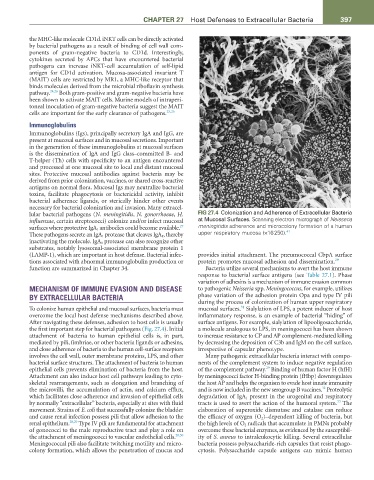
           lular bacterial pathogens (N. meningitidis, N. gonorrhoeae, H.   FIG 27.4  Colonization and Adherence of Extracellular Bacteria
           influenzae, certain streptococci) colonize and/or infect mucosal   at Mucosal Surfaces. Scanning electron micrograph of Neisseria
                                                            27
           surfaces where protective IgA 1  antibodies could become available.    meningitidis adherence and microcolony formation of a human
                                                                                               41
           These pathogens secrete an IgA 1  protease that cleaves IgA 1 , thereby   upper respiratory mucosa (×16 250).
           inactivating the molecule. IgA 1  protease can also recognize other
           substrates, notably lysosomal-associated membrane protein 1
           (LAMP-1), which are important in host defense. Bacterial infec-  provides initial attachment. The pneumococcal CbpA surface
           tions associated with abnormal immunoglobulin production or   protein promotes mucosal adhesion and dissemination. 29
           function are summarized in Chapter 34.                   Bacteria utilize several mechanisms to avert the host immune
                                                                  response to bacterial surface antigens (see  Table 27.1). Phase
                                                                  variation of adhesins is a mechanism of immune evasion common
           MECHANISM OF IMMUNE EVASION AND DISEASE                to pathogenic Neisseria spp. Meningococcus, for example, utilizes
           BY EXTRACELLULAR BACTERIA                              phase variation of the adhesion protein Opa and type IV pili
                                                                  during the process of colonization of human upper respiratory
                                                                                31
           To colonize human epithelial and mucosal surfaces, bacteria must   mucosal surfaces.  Sialylation of LPS, a potent inducer of host
           overcome the local host defense mechanisms described above.   inflammatory response, is an example of bacterial “hiding” of
           After navigating these defenses, adhesion to host cells is usually   surface antigens. For example, sialylation of lipooligosaccharide,
           the first important step for bacterial pathogens (Fig. 27.4). Initial   a molecule analogous to LPS, in meningococci has been shown
           attachment of bacteria to human epithelial cells is, in part,   to increase resistance to CP and AP complement-mediated killing
           mediated by pili, fimbriae, or other bacteria ligands or adhesins,   by decreasing the deposition of C3b and IgM on the cell surface,
           and close adherence of bacteria to the human cell-surface receptors   irrespective of capsular phenotype.
           involves the cell wall, outer membrane proteins, LPS, and other   Many pathogenic extracellular bacteria interact with compo-
           bacterial surface structures. The attachment of bacteria to human   nents of the complement system to induce negative regulation
                                                                                        29
           epithelial cells prevents elimination of bacteria from the host.   of the complement pathway.  Binding of human factor H (hfH)
           Attachment can also induce host cell pathways leading to cyto-  by meningococci factor H-binding protein (fHbp) downregulates
           skeletal rearrangements, such as elongation and branching of   the host AP and helps the organism to evade host innate immunity
                                                                                                          32
           the microvilli, the accumulation of actin, and calcium efflux,   and is now included in the new serogroup B vaccines.  Proteolytic
           which facilitates close adherence and invasion of epithelial cells   degradation of IgA 1  present in the urogenital and respiratory
                                                                                                               33
           by normally “extracellular” bacteria, especially at sites with fluid   tracts is used to avert the action of the humoral system.  The
           movement. Strains of E. coli that successfully colonize the bladder   elaboration of superoxide dismutase and catalase can reduce
           and cause renal infection possess pili that allow adhesion to the   the efficacy of oxygen (O 2 )–dependent killing of bacteria, but
           renal epithelium. 28,29  Type IV pili are fundamental for attachment   the high levels of O 2  radicals that accumulate in PMNs probably
           of gonococci to the male reproductive tract and play a role on   overcome these bacterial enzymes, as evidenced by the susceptibil-
           the attachment of meningococci to vascular endothelial cells. 28,30    ity of S. aureus to intraleukocytic killing. Several extracellular
           Meningococcal pili also facilitate twitching motility and micro-  bacteria possess polysaccharide-rich capsules that resist phago-
           colony formation, which allows the penetration of mucus and   cytosis. Polysaccharide capsule antigens can mimic human

