


Page 414 - Clinical Immunology_ Principles and Practice ( PDFDrive )
P. 414
CHAPtER 27  Host Defenses to Extracellular Bacteria             395


                                                                                 4
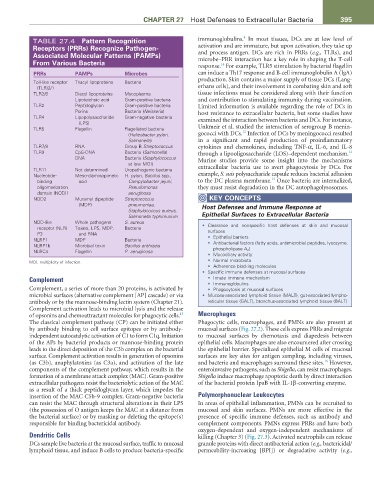
            TABLE 27.4  Pattern Recognition                       immunoglobulins.  In most tissues, DCs are at low level of
            Receptors (PRRs) Recognize Pathogen-                  activation and are immature, but upon activation, they take up
            Associated Molecular Patterns (PAMPs)                 and process antigen. DCs are rich in PRRs (e.g., TLRs), and
                                                                  microbe–PRR interaction has a key role in shaping the T-cell
            From Various Bacteria                                 response.  For example, TLR5 stimulation by bacterial flagellin
                                                                         14
            PRRs          PAMPs           Microbes                can induce a Th17 response and B-cell immunoglobulin A (IgA)
            Toll-like receptor   Triacyl lipoproteins  Bacteria   production. Skin contains a major supply of tissue DCs (Lang-
             (TLR)2/1                                             erhans cells), and their involvement in combating skin and soft
            TLR2/6        Diacyl lipoproteins  Mycoplasma         tissue infections must be considered along with their function
                          Lipoteichoic acid  Gram-positive bacteria  and contribution to stimulating immunity during vaccination.
            TLR2          Peptidoglycan   Gram-positive bacteria  Limited information is available regarding the role of DCs in
                          Porins          Bacteria (Neisseria)    host resistance to extracellular bacteria, but some studies have
            TLR4          Lipopolysaccharide   Gram-negative bacteria  examined the interaction between bacteria and DCs. For instance,
                           (LPS)
            TLR5          Flagellin       Flagellated bacteria    Unkmeir et al. studied the interaction of serogroup B menin-
                                                                                12
                                           (Helicobacter pylori,   gococci with DCs.  Infection of DCs by meningococci resulted
                                           Salmonella)            in  a  significant  and  rapid  production  of  proinflammatory
            TLR7/8        RNA             Group B Streptococcus   cytokines and chemokines, including TNF-α, IL-6, and IL-8
            TLR9          CpG-DNA         Bacteria (Salmonella)   through a lipooligosaccharide (LOS)–dependent mechanism.
                                                                                                                   12
                          DNA             Bacteria (Staphylococcus   Murine studies provide some insight into the mechanisms
                                           at low MOI)
            TLR11         Not determined  Uropathogenic bacteria  extracellular bacteria use to avert phagocytosis by DCs. For
            Nucleotide-   Meso-diaminopimelic   H. pylori, Bacillus spp.,   example, S. suis polysaccharide capsule reduces bacterial adhesion
                                                                                          15
             binding       acid            Campylobacter jejuni,   to the DC plasma membrane.  Once bacteria are internalized,
             oligomerization               Pseudomonas            they must resist degradation in the DC autophagolysosomes.
             domain (NOD)1                 aeruginosa
            NOD2          Muramyl dipeptide   Streptococcus           KEY CONCEPtS
                           (MDP)           pneumoniae,             Host Defenses and Immune Response at
                                           Staphylococcus aureus,
                                           Salmonella typhimurium  Epithelial Surfaces to Extracellular Bacteria
            NOD-like      Whole pathogens  S. aureus               •  Clearance and nonspecific host defenses at skin and mucosal
             receptor (NLR)  Toxins, LPS, MDP,   Bacteria
             P3            and RNA                                   surfaces
            NLRP1         MDP             Bacteria                   •  Epithelial barriers
            NLRP1b        Microbial toxin  Bacillus anthracis        •  Antibacterial factors (fatty acids, antimicrobial peptides, lysozyme,
                                                                       phospholipase A 2 )
            NLRC4         Flagellin       P. aeruginosa
                                                                     •  Mucociliary activity
                                                                     •  Normal microbiota
           MOI, multiplicity of infection.
                                                                     •  Adherence blocking molecules
                                                                   •  Specific immune defenses at mucosal surfaces
           Complement                                                •  Innate immune mechanism
                                                                     •  Immunoglobulins
           Complement, a series of more than 20 proteins, is activated by   •  Phagocytosis at mucosal surfaces
           microbial surfaces (alternative complement [AP] cascade) or via   •  Mucosa-associated lymphoid tissue (MALT), gut-associated lympho-
           antibody or by the mannose-binding lectin system (Chapter 21).   reticular tissue (GALT), bronchus-associated lymphoid tissue (BALT)
           Complement activation leads to microbial lysis and the release
                                                            13
           of opsonins and chemoattractant molecules for phagocytic cells.    Macrophages
           The classical complement pathway (CP) can be initiated either   Phagocytic cells, macrophages, and PMNs are also present at
           by antibody binding to cell surface epitopes or by antibody-  mucosal surfaces (Fig. 27.2). These cells express PRRs and migrate
           independent autocatalytic activation of C1 to form C1q. Initiation   to  mucosal  surfaces  by  chemotaxis  and  diapedesis  between
           of the APs by bacterial products or mannose-binding protein   epithelial cells. Macrophages are also encountered after crossing
           leads to the direct deposition of the C3b complex on the bacterial   the epithelial barrier. Specialized epithelial M cells of mucosal
           surface. Complement activation results in generation of opsonins   surfaces are key sites for antigen sampling, including viruses,
                                                                                                           16
           (as C3b), anaphylatoxins (as C3a), and activation of the late   and bacteria and macrophages surround these sites.  However,
           components of the complement pathway, which results in the   enteroinvasive pathogens, such as Shigella, can resist macrophages.
           formation of a membrane attack complex (MAC). Gram-positive   Shigella induce macrophage apoptotic death by direct interaction
           extracellular pathogens resist the bacteriolytic action of the MAC   of the bacterial protein IpaB with IL-1β-converting enzyme.
           as a result of a thick peptidoglycan layer, which impedes the
           insertion of the MAC C5b-9 complex. Gram-negative bacteria   Polymorphonuclear Leukocytes
           can resist the MAC through structural alterations in their LPS   In areas of epithelial inflammation, PMNs can be recruited to
           (the possession of O antigen keeps the MAC at a distance from   mucosal and  skin surfaces. PMNs are  more  effective in  the
           the bacterial surface) or by masking or deleting the epitope(s)   presence of specific immune defenses, such as antibody and
           responsible for binding bactericidal antibody.         complement components. PMNs express PRRs and have both
                                                                  oxygen-dependent  and  oxygen-independent  mechanisms  of
           Dendritic Cells                                        killing (Chapter 3) (Fig. 27.3). Activated neutrophils can release
           DCs sample live bacteria at the mucosal surface, traffic to mucosal   granule proteins with direct antibacterial action (e.g., bactericidal/
           lymphoid tissue, and induce B cells to produce bacteria-specific   permeability-increasing [BPI]) or degradative activity (e.g.,

