


Page 417 - Clinical Immunology_ Principles and Practice ( PDFDrive )
P. 417
398          PARt tHREE  Host Defenses to Infectious Agents


        antigens. Antigen mimicry can lead to autoantibodies, as in the       LPS, PG monomers, DNA repeats
        case of rheumatic fever and glomerulonephritis after S. pyogenes        Lipoproteins, Teichoic acid
        infection. Antigen mimicry can also dampen the immune response     Microbial toxins, other microbial components
        to bacterial antigens, as in the case of serogroup B Meningococcus.        (Superantigens)
        Other microbial surface structures, such as the pili of the gonococ-
        cus, can “stiff-arm” neutrophils, keeping them at a distance. A     Pattern recognition receptors (e.g., TLRs)
        number of pyogenic bacteria (e.g., S. aureus) secrete leukocidins,
        which lyse phagocytes. Other pathogens (e.g., group A strepto-
        cocci) inhibit chemotaxis of neutrophils through the elaboration          Cytokine stimulation
        of enzymes (e.g., C5a peptidase) that proteolytically cleave
        chemotactic signals. Some bacteria possess mechanisms to prevent   Coagulopathy  TNF-a  Complement activation
                                          30
        opsonization by changing surface antigens.  Many bacteria form   Kinin stimulation  IL-1  C5a
        biofilms, which shield these microorganisms from host defense   Prostaglandins  INF-γ   C3a
                              34
        molecules and antibiotics.  Leukocytes that invade  S. aureus   Leukotrienes  IL-6, IL-8  Leukocyte chemotaxis
        biofilms exhibit impaired phagocytosis and decreased ability to   PAF          IL-10    Inflammation
        kill bacteria. In addition, biofilm matrices can protect bacteria
        from antibody-mediated phagocytosis.                         Fibrin deposition     Nitric oxide
           As previously noted, many “extracellular” bacteria have an   DIC
        intracellular component to their lifecycle. The intracellular
        environment provides protection from proteins of the comple-           Generalized endothelial damage
        ment system, Igs, and nonspecific barriers to infection present             Vascular leak
                    28
        in the epithelia.  The entry of bacteria into epithelial cells provides     Tissue edema
        access to nutrients and protection from host defenses, allows                Vasodilation
        protected multiplication, and leads to shedding of organisms              Leukocyte activation
                                                                                      Bleeding
        back to the mucosal surface, to facilitate transmission and further   Temperature dysregulation (e.g. fever)
        spread of the infection on the epithelium. Attachment can also
        initiate epithelial cell apoptosis or toxin-mediated cell death and     Tachycardia, hyperventilation
        lead to the breakdown of the epithelial barrier.                        Hypotension (↑CO, ↓SVR)
                                                                              Pallor, peripheral vasoconstriction
                                                                                   Cutaneous signs
        HOST RISK FACTORS FOR LOCAL AND SYSTEMIC                                   Multiorgan failure
        INVASION BY EXTRACELLULAR PATHOGENS                                       (ARDS, renal failure)
                                                                                  Altered mental status
        Bacteria that breach mucosal and skin barriers and reach sub-                 Shock
                                                                                      Death
        mucosal tissues of sites, such as pulmonary alveoli or the middle
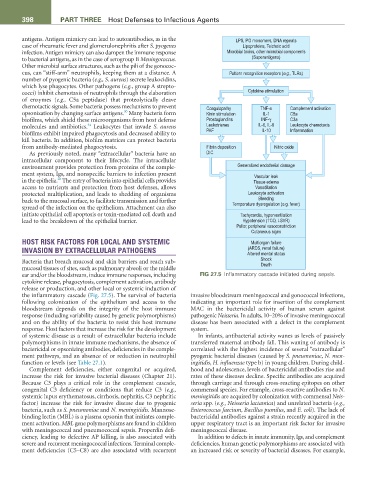
        ear and/or the bloodstream, induce immune responses, including   FIG 27.5  Inflammatory cascade initiated during sepsis.
        cytokine release, phagocytosis, complement activation, antibody
        release or production, and other local or systemic induction of
        the inflammatory cascade (Fig. 27.5). The survival of bacteria   invasive bloodstream meningococcal and gonococcal infections,
        following colonization of the epithelium and access to the   indicating an important role for insertion of the complement
        bloodstream depends on the integrity of the host immune   MAC in the bactericidal activity of human serum against
        response (including variability caused by genetic polymorphisms)   pathogenic Neisseria. In adults, 10–20% of invasive meningococcal
        and on the ability of the bacteria to resist this host immune   disease has been associated with a defect in the complement
        response. Host factors that increase the risk for the development   system.
        of systemic disease as a result of extracellular bacteria include   In infants, antibacterial activity wanes as levels of passively
        polymorphisms in innate immune mechanisms, the absence of   transferred maternal antibody fall. This waning of antibody is
        bactericidal or opsonizing antibodies, deficiencies in the comple-  correlated with the highest incidence of several “extracellular”
        ment pathways, and an absence of or reduction in neutrophil   pyogenic bacterial diseases (caused by S. pneumoniae, N. men-
        function or levels (see Table 27.1).                   ingitidis, H. influenzae type b) in young children. During child-
           Complement deficiencies, either congenital or acquired,   hood and adolescence, levels of bactericidal antibodies rise and
        increase the risk for invasive bacterial diseases (Chapter 21).   rates of these diseases decline. Specific antibodies are acquired
        Because C3 plays a critical role in the complement cascade,   through carriage and through cross-reacting epitopes on other
        congenital C3 deficiency or conditions that reduce C3 (e.g.,   commensal species. For example, cross-reactive antibodies to N.
        systemic lupus erythematosus, cirrhosis, nephritis, C3 nephritic   meningitidis are acquired by colonization with commensal Neis-
        factor) increase the risk for invasive disease due to pyogenic   seria spp. (e.g., Neisseria lactamica) and unrelated bacteria (e.g.,
        bacteria, such as S. pneumoniae and N. meningitidis. Mannose-  Enterococcus faecium, Bacillus pumilus, and E. coli). The lack of
        binding lectin (MBL) is a plasma opsonin that initiates comple-  bactericidal antibodies against a strain recently acquired in the
        ment activation. MBL gene polymorphisms are found in children   upper respiratory tract is an important risk factor for invasive
        with meningococcal and pneumococcal sepsis. Properdin defi-  meningococcal disease.
        ciency, leading to defective AP killing, is also associated with   In addition to defects in innate immunity, Igs, and complement
        severe and recurrent meningococcal infections. Terminal comple-  deficiencies, human genetic polymorphisms are associated with
        ment deficiencies (C5–C8) are also associated with recurrent   an increased risk or severity of bacterial diseases. For example,

