


Page 45 - Clinical Immunology_ Principles and Practice ( PDFDrive )
P. 45
CHaPter 2  Organization of the Immune System                  31


                                                   0XFRVD
                                                                         Red pulp
                                                                                                 Central
                                                                                                 arteriole


                                                                                                T-cell
                                                                                     Germinal   zone
                                                                              Mantle  center
                                               )ROOLFOH DVVRFLDWHG            zone
                                %ORRG YHVVHOV  HSLWKHOLXP  )$(


                              /\PSKRLG IROOLFOH
                                                                                        Marginal zone


                                                                     A
              A


                                                                      B
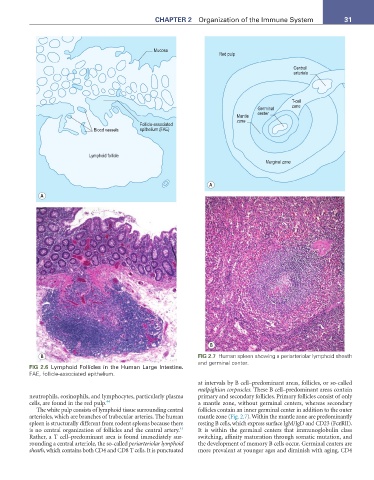
              B                                                   FIG 2.7  Human spleen showing a periarteriolar lymphoid sheath
                                                                  and germinal center.
           FIG 2.6  Lymphoid Follicles in the Human Large Intestine.
           FAE, follicle-associated epithelium.
                                                                  at intervals by B cell–predominant areas, follicles, or so-called
                                                                  malpighian corpuscles. These B cell–predominant areas contain
           neutrophils, eosinophils, and lymphocytes, particularly plasma   primary and secondary follicles. Primary follicles consist of only
           cells, are found in the red pulp. 44                   a mantle zone, without germinal centers, whereas secondary
             The white pulp consists of lymphoid tissue surrounding central   follicles contain an inner germinal center in addition to the outer
           arterioles, which are branches of trabecular arteries. The human   mantle zone (Fig. 2.7). Within the mantle zone are predominantly
           spleen is structurally different from rodent spleens because there   resting B cells, which express surface IgM/IgD and CD23 (FcεRII).
                                                            44
           is no central organization of follicles and the central artery.    It is within the germinal centers that immunoglobulin class
           Rather, a T cell–predominant area is found immediately sur-  switching, affinity maturation through somatic mutation, and
           rounding a central arteriole, the so-called periarteriolar lymphoid   the development of memory B cells occur. Germinal centers are
           sheath, which contains both CD4 and CD8 T cells. It is punctuated   more prevalent at younger ages and diminish with aging. CD4

