


Page 46 - Clinical Immunology_ Principles and Practice ( PDFDrive )
P. 46
32           Part one  Principles of Immune Response


        T cells play a key role in B-cell responses through CD40L and
        other interactions. The signaling that occurs through this interac-              Capsule
        tion is central to B-cell activation and class switching. In addition
        to activated B cells and CD4 T cells, the germinal center contains
        FDCs and macrophages.
           At the interface between the white pulp and the red pulp is
        a region known as the marginal zone, which receives blood from
        branches of central arterioles opening into this region. It contains
        T cells, as well as subsets of macrophages and B cells. Marginal
        zone (MZ) B cells are distinct from follicular B cells. They express
        surface IgM and low levels of IgD and lack CD23. The initial    Medulla
        encounter of T cells and B cells with antigen occurs in the marginal       Germinal
                                                                                   center
        zone after blood enters through branches of the central arteriole.
        Antigen presentation is enhanced by MZ B cells, which are                    Cortex
        important in T cell–independent responses.
        Lymph Nodes and Lymphatics
        Lymph nodes occur as chains or groups located along lymphatic   A
        vessels. Lymph nodes exist in two major groups: those that drain
        the skin and superficial tissues (e.g., cervical, axillary, or inguinal
        lymph nodes) and those that drain the mucosal and deep tissues
        of the body (e.g., mesenteric, mediastinal, and periaortic lymph
        nodes). Lymph nodes are oval structures surrounded by adipose
        tissue with an indentation at the region of a hilus, where blood
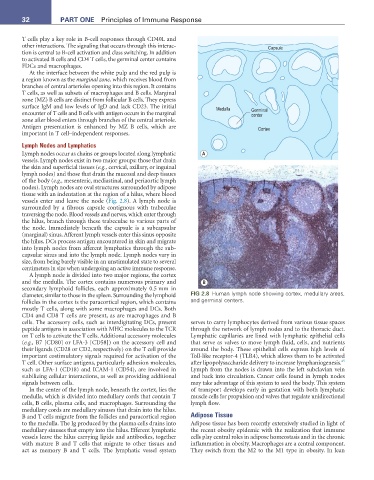
        vessels enter and leave the node (Fig. 2.8). A lymph node is
        surrounded by a fibrous capsule contiguous with trabeculae
        traversing the node. Blood vessels and nerves, which enter through
        the hilus, branch through these trabeculae to various parts of
        the  node.  Immediately  beneath  the  capsule  is  a  subcapsular
        (marginal) sinus. Afferent lymph vessels enter this sinus opposite
        the hilus. DCs process antigen encountered in skin and migrate
        into lymph nodes from afferent lymphatics through the sub-
        capsular sinus and into the lymph node. Lymph nodes vary in
        size, from being barely visible in an unstimulated state to several
        centimeters in size when undergoing an active immune response.
           A lymph node is divided into two major regions, the cortex
        and the medulla. The cortex contains numerous primary and   B
        secondary lymphoid follicles, each approximately 0.5 mm in
        diameter, similar to those in the spleen. Surrounding the lymphoid   FIG 2.8  Human lymph node showing cortex, medullary areas,
        follicles in the cortex is the paracortical region, which contains   and germinal centers.
        mostly T cells, along with some macrophages and DCs. Both
        CD4 and CD8 T cells are present, as are macrophages and B
        cells. The accessory cells, such as interdigitating DCs, present   serves to carry lymphocytes derived from various tissue spaces
        peptide antigens in association with MHC molecules to the TCR   through the network of lymph nodes and to the thoracic duct.
        on T cells to activate the T cells. Additional accessory molecules   Lymphatic capillaries are lined with lymphatic epithelial cells
        (e.g., B7 [CD80] or LFA-3 [CD58]) on the accessory cell and   that serve as valves to move lymph fluid, cells, and nutrients
        their ligands (CD28 or CD2, respectively) on the T cell provide   around the body. These epithelial cells express high levels of
        important costimulatory signals required for activation of the   Toll-like receptor-4 (TLR4), which allows them to be activated
                                                                                                                 45
        T cell. Other surface antigens, particularly adhesion molecules,   after lipopolysaccharide delivery to increase lymphaniogenesis.
        such as LFA-1 (CD18) and ICAM-1 (CD54), are involved in   Lymph from the nodes is drawn into the left subclavian vein
        stabilizing cellular interactions, as well as providing additional   and back into circulation. Cancer cells found in lymph nodes
        signals between cells.                                 may take advantage of this system to seed the body. This system
           In the center of the lymph node, beneath the cortex, lies the   of transport develops early in gestation with both lymphatic
        medulla, which is divided into medullary cords that contain T   muscle cells for propulsion and valves that regulate unidirectional
        cells, B cells, plasma cells, and macrophages. Surrounding the   lymph flow.
        medullary cords are medullary sinuses that drain into the hilus.
        B and T cells migrate from the follicles and paracortical region   Adipose Tissue
        to the medulla. The Ig produced by the plasma cells drains into   Adipose tissue has been recently extensively studied in light of
        medullary sinuses that empty into the hilus. Efferent lymphatic   the recent obesity epidemic with the realization that immune
        vessels leave the hilus carrying lipids and antibodies, together   cells play central roles in adipose homeostasis and in the chronic
        with mature B and T cells that migrate to other tissues and   inflammation in obesity. Macrophages are a central component.
        act as memory B and T cells. The lymphatic vessel system   They switch from the M2 to the M1 type in obesity. In lean

