


Page 47 - Clinical Immunology_ Principles and Practice ( PDFDrive )
P. 47
CHaPter 2  Organization of the Immune System                  33


           adipose tissue, there are numerous Tregs and few CD8 T cells,   Lamina propria             Villous epithelium
           which reverses during obesity when inflammation increases. 46
           Mucosal Immune System
           The mucosal immune system is located along the surfaces of
           mucosal tissues (Chapter 20). Each mucosal immune system
           consists of organized secondary lymphoid structures, termed
           mucosa-associated lymphoreticular tissue (MALT), where inductive       Germinal center    Blood
                                                                                                     vessels
           immune responses occur, and more diffuse tissues, such as the
           exocrine glands and lamina propria, where effector immune
                        47
           responses occur.  Some mucosal sites, such as the intestine and
           lungs, have well-developed MALT. Others, such as the vaginal–
           cervical mucosal surface, have minimally developed MALT.
             MALT organization resembles lymph nodes with B cell follicles,
           intervening T-cell zones and numerous APCs, such as DCs and
           macrophages. Naïve T and B cells encounter antigen, become
           activated, exit the tissue via efferent lymphatics, and migrate to
           the local lymph nodes and then into the thoracic duct and the   A
           bloodstream. The cells home to effector sites, particularly the
           lamina propria of various mucosal tissues. IELs, contained within
           mucosal epithelium and the lamina propria located beneath the
           epithelium, are responsible for effector functions. They occur
           diffusely in mucosal tissues and lack the well-defined structure
           of the organized mucosal immune system.
             The homing of activated lymphocytes from one inductive
           site to several mucosal surface effector sites has led to the concept
           of  a  common  mucosal  immune  system,  although  significant
                                              48
           compartmentalization remains in humans.  Trafficking from
           MALT to the lamina propria is well regulated. Expression of cell
           surface molecules, such as sphingosine 1 phosphate (S1P),
           MAdCAM-1,  VLA-1, LFA-1, and  VCAM-1; the cell surface
           integrin, α4β7; and chemokines, such as CCR9, CCL25, CCR10,
           and CCL28, are important in directing activated lymphocytes
                                  49
           to the lamina propria surface.  The environment at the mucosal
           surface is favorable for induction of IgA. Low-affinity IgA inhibits
           commensal bacteria on mucosal surfaces. High-affinity IgA helps
           neutralize microbial pathogens.                            B
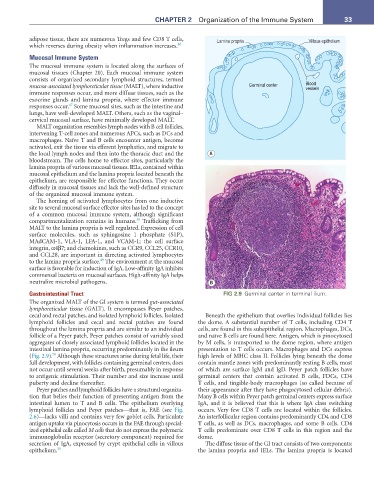
           Gastrointestinal Tract                                         FIG 2.9  Germinal center in terminal ilium.
           The organized MALT of the GI system is termed gut-associated
           lymphoreticular tissue (GALT). It encompasses Peyer patches,
           cecal and rectal patches, and isolated lymphoid follicles. Isolated   Beneath the epithelium that overlies individual follicles lies
           lymphoid follicles and cecal and rectal patches are found   the dome. A substantial number of T cells, including CD4 T
           throughout the lamina propria and are similar to an individual   cells, are found in this subepithelial region. Macrophages, DCs,
           follicle of a Peyer patch. Peyer patches consist of variably sized   and naïve B cells are found here. Antigen, which is pinocytosed
           aggregates of closely associated lymphoid follicles located in the   by M cells, is transported to the dome region, where antigen
           intestinal lamina propria, occurring predominantly in the ileum   presentation to T cells occurs. Macrophages and DCs express
                  50
           (Fig. 2.9).  Although these structures arise during fetal life, their   high levels of MHC class II. Follicles lying beneath the dome
           full development, with follicles containing germinal centers, does   contain mantle zones with predominantly resting B cells, most
           not occur until several weeks after birth, presumably in response   of which are surface IgM and IgD. Peyer patch follicles have
           to antigenic stimulation. Their number and size increase until   germinal centers that contain activated B cells, FDCs, CD4
           puberty and decline thereafter.                        T cells, and tingible-body macrophages (so called because of
             Peyer patches and lymphoid follicles have a structural organiza-  their appearance after they have phagocytosed cellular debris).
           tion that belies their function of presenting antigen from the   Many B cells within Peyer patch germinal centers express surface
           intestinal lumen to T and B cells. The epithelium overlying   IgA, and it is believed that this is where IgA class switching
           lymphoid follicles and Peyer patches—that is, FAE (see  Fig.   occurs. Very few CD8 T cells are located within the follicles.
           2.6)—lacks villi and contains very few goblet cells. Particulate   An interfollicular region contains predominantly CD4 and CD8
           antigen uptake via pinocytosis occurs in the FAE through special-  T cells, as well as DCs, macrophages, and some B cells. CD4
           ized epithelial cells called M cells that do not express the polymeric   T cells predominate over CD8 T cells in this region and the
           immunoglobulin receptor (secretory component) required for   dome.
           secretion of IgA, expressed by crypt epithelial cells in villous   The diffuse tissue of the GI tract consists of two components:
           epithelium. 51                                         the lamina  propria and  IELs. The  lamina propria  is located

