


Page 579 - Clinical Immunology_ Principles and Practice ( PDFDrive )
P. 579
556          ParT fOur  Immunological Deficiencies


        even among participants who had baseline CD4 counts >500
                3
        cells/mm . Earlier ART initiation appears to increase the prob-
        ability of restoring normal CD4 counts, a normal CD4/CD8
        ratio, and lower levels of immune activation and inflammation,             Trp62
                                                24
        as summarized in the US adult treatment guidelines.  Individuals
        initiating  ART during the first 6 months after infection also
        appear  to achieve lower  immune  activation  levels and  better
        immune function during  ART-mediated viral suppression
        compared with those who delay therapy. 25
           Recommendations for initiating therapy in children have
        always been relatively more aggressive compared with those for   Phe43
        adolescents and adults because most infected children were
                                                         26
        infected perinatally and experience rapid disease progression.
        The decision to initiate ART should always include consideration       Arg59
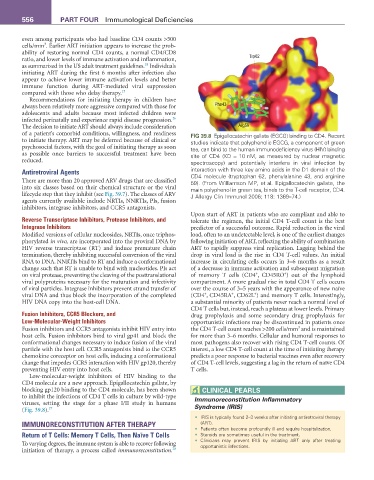
        of a patient’s comorbid conditions, willingness, and readiness   fIG 39.8  Epigallocatechin gallate (EGCG) binding to CD4. Recent
        to initiate therapy. ART may be deferred because of clinical or   studies indicate that polyphenolic EGCG, a component of green
        psychosocial factors, with the goal of initiating therapy as soon   tea, can bind to the human immunodeficiency virus (HIV) binding
        as possible once barriers to successful treatment have been   site  of  CD4  (KD  =  10 nM,  as  measured  by  nuclear  magnetic
        reduced.                                               spectroscopy)  and  potentially  interfere  in  viral  infection  by
        Antiretroviral Agents                                  interaction with three key amino acids in the D1 domain of the
                                                               CD4 molecule (tryptophan 62, phenylalanine 43, and arginine
        There are more than 20 approved ARV drugs that are classified   59). (From Williamson MP, et al. Epigallocatechin gallate, the
        into six classes based on their chemical structure or the viral   main polyphenol in green tea, binds to the T-cell receptor, CD4.
        lifecycle step that they inhibit (see Fig. 39.7). The classes of ARV   J Allergy Clin Immunol 2006; 118: 1369–74.)
        agents currently available include NRTIs, NNRTIs, PIs, fusion
        inhibitors, integrase inhibitors, and CCR5 antagonists.
                                                               Upon start of ART in patients who are compliant and able to
        Reverse Transcriptase Inhibitors, Protease Inhibitors, and   tolerate  the  regimen, the  initial  CD4  T-cell  count  is  the  best
        Integrase Inhibitors                                   predictor of a successful outcome. Rapid reduction in the viral
        Modified versions of cellular nucleosides, NRTIs, once triphos-  load, often to an undetectable level, is one of the earliest changes
        phorylated in vivo, are incorporated into the proviral DNA by   following initiation of ART, reflecting the ability of combination
        HIV reverse transcriptase  (RT) and induce premature chain   ART to rapidly suppress viral replication. Lagging behind the
        termination, thereby inhibiting successful conversion of the viral   drop in viral load is the rise in CD4 T-cell values. An initial
        RNA to DNA. NNRTIs bind to RT and induce a conformational   increase in circulating cells occurs in 3–6 months as a result
        change such that RT is unable to bind with nucleotides. PIs act   of a decrease in immune activation and subsequent migration
                                                                                     +
                                                                                              +
        on viral protease, preventing the cleaving of the posttranslational   of memory T cells (CD4 , CD45RO ) out of the lymphoid
        viral polyproteins necessary for the maturation and infectivity   compartment. A more gradual rise in total CD4 T cells occurs
        of viral particles. Integrase inhibitors prevent strand transfer of   over the course of 3–5 years with the appearance of new naïve
                                                                                    +
                                                                    +
                                                                             +
        viral DNA and thus block the incorporation of the completed   (CD4 , CD45RA , CD62L ) and memory T cells. Interestingly,
        HIV DNA copy into the host-cell DNA.                   a substantial minority of patients never reach a normal level of
                                                               CD4 T cells but, instead, reach a plateau at lower levels. Primary
        Fusion Inhibitors, CCR5 Blockers, and                  drug prophylaxis and some secondary drug prophylaxis for
        Low-Molecular-Weight Inhibitors                        opportunistic infections may be discontinued in patients once
                                                                                                   3
        Fusion inhibitors and CCR5 antagonists inhibit HIV entry into   the CD4 T-cell count reaches >200 cells/mm  and is maintained
        host cells. Fusion inhibitors bind to viral gp41 and block the   for more than 3–6 months. Cellular and humoral responses to
        conformational changes necessary to induce fusion of the viral   most pathogens also recover with rising CD4 T-cell counts. Of
        particle with the host cell. CCR5 antagonists bind to the CCR5   interest, a low CD4 T-cell count at the time of initiating therapy
        chemokine coreceptor on host cells, inducing a conformational   predicts a poor response to bacterial vaccines even after recovery
        change that impedes CCR5 interaction with HIV gp120, thereby   of CD4 T-cell levels, suggesting a lag in the return of naïve CD4
        preventing HIV entry into host cells.                  T cells.
           Low-molecular-weight  inhibitors  of HIV  binding  to  the
        CD4 molecule are a new approach. Epigallocatechin gallate, by
        blocking gp120 binding to the CD4 molecule, has been shown    CLINICaL PEarLS
        to inhibit the infections of CD4 T cells in culture by wild-type   Immunoreconstitution Inflammatory
        viruses, setting the stage for a phase I/II study in humans     Syndrome (IRIS)
        (Fig. 39.8). 27
                                                                 •  IRIS is typically found 2–3 weeks after initiating antiretroviral therapy
        IMMUNORECONSTITUTION AFTER THERAPY                         (ART).
                                                                 •  Patients often become profoundly ill and require hospitalization.
        Return of T Cells: Memory T Cells, Then Naïve T Cells    •  Steroids are sometimes useful in the treatment.
                                                                 •  Clinicians may prevent IRIS by initiating ART only after treating
        To varying degrees, the immune system is able to recover following   opportunistic infections.
                                                         28
        initiation of  therapy,  a process  called  immunoreconstitution.

