


Page 577 - Clinical Immunology_ Principles and Practice ( PDFDrive )
P. 577
554          ParT fOur  Immunological Deficiencies


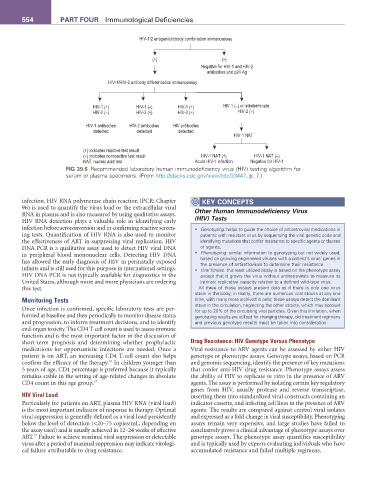
                                               HIV-1/2 antigen/antibody combination immunoassay


                                                   (+)                    (–)
                                                                   Negative for HIV-1 and HIV-2
                                                                     antibodies and p24 Ag
                                    HIV-1/HIV-2 antibody differentiation immunoassay


                               HIV-1 (+)      HIV-1 (–)    HIV-1 (+)      HIV-1 (–) or indeterminate
                               HIV-2 (–)      HIV-2 (+)    HIV-2 (+)           HIV-2 (–)

                             HIV-1 antibodies  HIV-2 antibodies  HIV antibodies
                                detected      detected     detected
                                                                             HIV-1 NAT

                            (+) indicates reactive test result
                            (–) indicates nonreactive test result  HIV-1 NAT (+)    HIV-1 NAT (–)
                            NAT: nucleic acid test               Acute HIV-1 infection  Negative for HIV-1
                       fIG 39.6  Recommended laboratory human immunodeficiency virus (HIV) testing algorithm for
                       serum or plasma specimens. (From http://stacks.cdc.gov/view/cdc/23447, p. 7.)


        infection. HIV RNA polymerase chain reaction (PCR; Chapter    KEY CONCEPTS
        96) is used to quantify the virus load or the extracellular viral   Other Human Immunodeficiency Virus
        RNA in plasma and is also measured by using qualitative assays.
        HIV RNA detection plays a valuable role in identifying early   (HIV) Tests
        infection before seroconversion and in confirming reactive screen-  •  Genotyping: helps to guide the choice of antiretroviral medications in
        ing tests. Quantification of HIV RNA is also used to monitor   patients with resistant virus by sequencing the viral genetic code and
        the effectiveness of ART in suppressing viral replication. HIV   identifying mutations that confer resistance to specific agents or classes
        DNA PCR is a qualitative assay used to detect HIV viral DNA   of agents.
        in  peripheral  blood  mononuclear  cells.  Detecting  HIV  DNA   •  Phenotyping: similar information to genotyping but not widely used;
        has allowed the early diagnosis of HIV in perinatally exposed   based on growing engineered viruses with a patient’s virus’ genes in
                                                                   the presence of antiretrovirals to determine their resistance.
        infants and is still used for this purpose in international settings.   •  Viral fitness: this least utilized assay is based on the phenotype assay
        HIV DNA PCR is not typically available for diagnostics in the   except that it grows the virus without antiretrovirals to measure its
        United States, although more and more physicians are ordering     intrinsic replicative capacity relative to a defined wild-type virus.
        this test.                                                All three of these assays present data as if there is only one virus
                                                                 strain in the body; in reality, there are numerous viral strains at any one
        Monitoring Tests                                         time, with many more archived in cells; these assays detect the dominant
                                                                 strain in the circulation, neglecting the other strains, which may account
        Once infection is confirmed, specific laboratory tests are per-  for up to 20% of the circulating viral particles. Given this limitation, when
        formed at baseline and then periodically to monitor disease status   genotyping results are utilized for changing therapy, old treatment regimens
        and progression, to inform treatment decisions, and to identify   and previous genotype results must be taken into consideration.
        end-organ toxicity. The CD4 T-cell count is used to assess immune
        function and is the most important factor in the discussion of
        short-term prognosis and determining whether prophylactic   Drug Resistance: HIV Genotype Versus Phenotype
        medications for opportunistic infections are needed. Once a   Viral resistance to ARV agents can be assessed by either HIV
        patient is on ART, an increasing CD4 T-cell count also helps   genotype or phenotype assays. Genotype assays, based on PCR
                                     24
        confirm the efficacy of the therapy.  In children younger than   and genomic sequencing, identify the presence of key mutations
        5 years of age, CD4 percentage is preferred because it typically   that confer anti-HIV drug resistance. Phenotype assays assess
        remains stable in the setting of age-related changes in absolute   the ability of HIV to replicate in vitro in the presence of ARV
        CD4 count in this age group. 25                        agents. The assay is performed by isolating certain key regulatory
                                                               genes from HIV, usually protease and reverse transcriptase,
        HIV Viral Load                                         inserting them into standardized viral constructs containing an
        Particularly for patients on ART, plasma HIV RNA (viral load)   indicator cassette, and infecting cell lines in the presence of ARV
        is the most important indicator of response to therapy. Optimal   agents. The results are compared against control viral isolates
        viral suppression is generally defined as a viral load persistently   and expressed as a fold-change in viral susceptibility. Phenotyping
        below the level of detection (<20–75 copies/mL, depending on   assays remain very expensive, and large studies have failed to
        the assay used) and is usually achieved in 12–24 weeks of effective   conclusively prove a clinical advantage of phenotype assays over
            24
        ART.  Failure to achieve maximal viral suppression or detectable   genotype assays. The phenotype assay quantifies susceptibility
        virus after a period of maximal suppression may indicate virologi-  and is typically used by experts evaluating individuals who have
        cal failure attributable to drug resistance.           accumulated resistance and failed multiple regimens.

