


Page 576 - Clinical Immunology_ Principles and Practice ( PDFDrive )
P. 576
CHaPTEr 39  HIV and Acquired Immunodeficiency Syndrome                   553


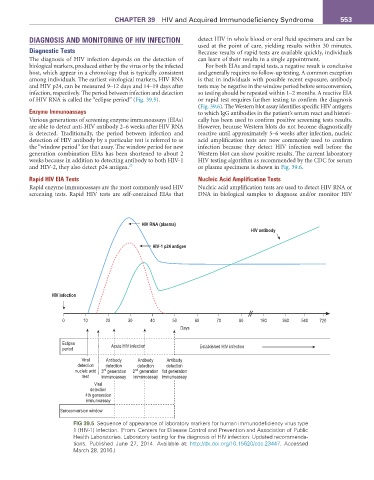
           DIAGNOSIS AND MONITORING OF HIV INFECTION              detect HIV in whole blood or oral fluid specimens and can be
                                                                  used at the point of care, yielding results within 30 minutes.
           Diagnostic Tests                                       Because results of rapid tests are available quickly, individuals
           The diagnosis of HIV infection depends on the detection of   can learn of their results in a single appointment.
           biological markers, produced either by the virus or by the infected   For both EIAs and rapid tests, a negative result is conclusive
           host, which appear in a chronology that is typically consistent   and generally requires no follow-up testing. A common exception
           among individuals. The earliest virological markers, HIV RNA   is that in individuals with possible recent exposure, antibody
           and HIV p24, can be measured 9–12 days and 14–19 days after   tests may be negative in the window period before seroconversion,
           infection, respectively. The period between infection and detection   so testing should be repeated within 1–2 months. A reactive EIA
           of HIV RNA is called the “eclipse period” (Fig. 39.5).  or rapid test requires further testing to confirm the diagnosis
                                                                  (Fig. 39.6). The Western blot assay identifies specific HIV antigens
           Enzyme Immunoassays                                    to which IgG antibodies in the patient’s serum react and histori-
           Various generations of screening enzyme immunoassays (EIAs)   cally has been used to confirm positive screening tests results.
           are able to detect anti-HIV antibody 2–6 weeks after HIV RNA   However, because Western blots do not become diagnostically
           is detected. Traditionally, the period between infection and   reactive until approximately 5–6 weeks after infection, nucleic
           detection of HIV antibody by a particular test is referred to as   acid amplification tests are now commonly used to confirm
           the “window period” for that assay. The window period for new   infection because they detect HIV infection well before the
           generation combination EIAs has been shortened to about 2   Western blot can show positive results. The current laboratory
           weeks because in addition to detecting antibody to both HIV-1   HIV testing algorithm as recommended by the CDC for serum
           and HIV-2, they also detect p24 antigen. 23            or plasma specimens is shown in Fig. 39.6.
           Rapid HIV EIA Tests                                    Nucleic Acid Amplification Tests
           Rapid enzyme immunoassays are the most commonly used HIV   Nucleic acid amplification tests are used to detect HIV RNA or
           screening tests. Rapid HIV tests are self-contained EIAs that   DNA in biological samples to diagnose and/or monitor HIV


                                               HIV RNA (plasma)
                                                                                   HIV antibody


                                                   HIV-1 p24 antigen


                  HIV infection


                     0      10      20     30     40     50      60     70     80     180    360    540   720
                                                            Days

                     Eclipse
                     period          Acute HIV infection          Established HIV infection

                            Viral   Antibody  Antibody  Antibody
                          detection  detection  detection  detection
                                             nd
                                   rd
                          nucleic acid  3  generation  2  generation 1st generation
                            test  immunoassay  immunoassay immunoassay
                                Viral
                               detection
                             4th generation
                             immunoassay
                     Seroconversion window

                         fIG 39.5  Sequence of appearance of laboratory markers for human immunodeficiency virus type
                         1 (HIV-1) infection. (From: Centers for Disease Control and Prevention and Association of Public
                         Health Laboratories. Laboratory testing for the diagnosis of HIV infection: Updated recommenda-
                         tions. Published June 27, 2014. Available at:  http://dx.doi.org/10.15620/cdc.23447. Accessed
                         March 28, 2016.)

