


Page 603 - Clinical Immunology_ Principles and Practice ( PDFDrive )
P. 603
CHaPTEr 41  Immunological Mechanisms of Airway Diseases and Pathways to Therapy                      581


           and possibly infectious matter. Pulmonary involvement is typically   airway obstruction. Epidemiological studies have shown that
           diffuse and consists predominantly of mononuclear inflammation   lung cancer risk is strongly related to radiographic emphysema,
           of the terminal bronchioles, interstitium, and alveoli, with little   independent of air flow obstruction. In contrast, nonsmoking
           involvement of the larger airways. Although the term “extrinsic   patients with asthma have no greater risk of lung cancer than
           allergic alveolitis” is commonly used for this disorder, low-grade   the general nonsmoking population.
           eosinophilia is only seen in 1–3% of BAL specimens and is not   The Global Initiative for Chronic Obstructive Lung Disease
           a consistent or characteristic feature of disease. Over time, this   (GOLD) has in the past decade promoted the use of a fixed
           pattern of inflammation leads to destruction of alveoli and to   FEV 1 /forced vital capacity (FVC) ratio of  <70% to diagnose
           irreversible pulmonary fibrosis that may ultimately be fatal.  COPD. This latter guideline is now widely used to classify smokers
             The etiology of HP is usually idiopathic, but many cases can be   with and without COPD, but it excludes up to 20% of smokers
           traced to exposure to organic aerosols that contain thermophilic   with emphysema who have normal lung function, and it under-
           bacteria (e.g., Saccharopolyspora rectivirgula), filamentous fungi   diagnoses and overdiagnoses COPD in young and old smokers,
           (e.g., Aspergillus spp.), animal proteins and fecal matter (e.g.,   respectively. Recognizing different COPD phenotypes based on
           pigeon breeder’s disease), and industrial chemicals, such as isocya-  lung function, symptom severity, and exacerbation frequency,
           nates. Symptoms, including chest tightness, chest pain, dyspnea,   smokers are categorized into one of  four  stages: (A)  fewer
           and fever, appear 4–6 hours after exposure. Cessation of exposure   symptoms, low risk; (B) more symptoms, low risk; (C) fewer
           to the provoking antigen may prevent progression to chronic,   symptoms, high risk; (D) more symptoms, high risk. Those in
           irreversible disease. Other than oxygen therapy in the setting   groups C and D are thought to benefit from inhaled corticosteroids
           of profound hypoxemia, there is no defined medical therapy   in addition to bronchodilators. 40
           for HP; in particular, there is no role for glucocorticosteroids.  Smokers with emphysema have enlarged alveoli that contain
             The immunopathogenesis of HP is complex and not well   increased numbers of macrophages containing nano-sized elemen-
           understood. During the acute presentation, the histological picture   tal carbon black (nCB). The key property underlying the initiation
           is an immune complex–mediated interstitial injury with a   of destructive lung inflammation with nCB inhalation appears to
           predominant neutrophilic infiltrate. Subsequently, the disease   be its chemical characteristics, namely, its insolubility and small
           evolves into predominant mononuclear inflammatory infiltrates   particle size that activate the inflammasome pathway and promote
           consisting of lymphocytes, plasma cells, and foamy macrophages,   differentiation of lung Th1 and Th17 cells. nCB can be readily
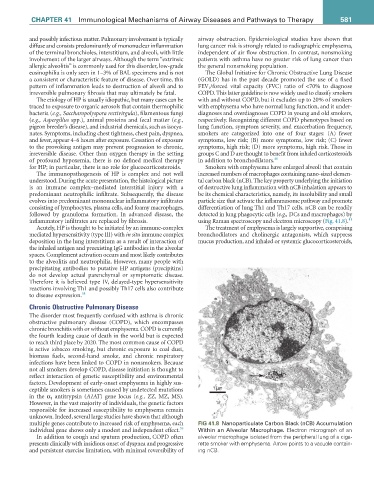
           followed by granuloma formation. In advanced disease, the   detected in lung phagocytic cells (e.g., DCs and macrophages) by
           inflammatory infiltrates are replaced by fibrosis.     using Raman spectroscopy and electron microscopy (Fig. 41.8). 41
             Acutely, HP is thought to be initiated by an immune-complex   The treatment of emphysema is largely supportive, comprising
           mediated hypersensitivity (type III) with in situ immune complex   bronchodilators and cholinergic antagonists, which suppress
           deposition in the lung interstitium as a result of interaction of   mucus production, and inhaled or systemic glucocorticosteroids,
           the inhaled antigen and preexisting IgG antibodies in the alveolar
           spaces. Complement activation occurs and most likely contributes
           to the alveolitis and neutrophilia. However, many people with
           precipitating antibodies to putative HP antigens (precipitins)
           do not develop actual parenchymal or symptomatic disease.
           Therefore it is believed type IV, delayed-type hypersensitivity
           reactions involving Th1 and possibly Th17 cells also contribute
           to disease expression. 38
           Chronic Obstructive Pulmonary Disease
           The disorder most frequently confused with asthma is chronic
           obstructive pulmonary disease (COPD), which encompasses
           chronic bronchitis with or without emphysema. COPD is currently
           the fourth leading cause of death in the world but is expected
           to reach third place by 2020. The most common cause of COPD
           is active tobacco smoking, but chronic exposure to coal dust,
           biomass fuels, second-hand smoke, and chronic respiratory
           infections have been linked to COPD in nonsmokers. Because
           not all smokers develop COPD, disease initiation is thought to
           reflect interaction of genetic susceptibility and environmental
           factors. Development of early-onset emphysema in highly sus-
           ceptible smokers is sometimes caused by undetected mutations   1 µm
           in the  α 1  antitrypsin (A1AT) gene locus (e.g., ZZ, MZ, MS).
           However, in the vast majority of individuals, the genetic factors
           responsible for increased susceptibility to emphysema remain
           unknown. Indeed, several large studies have shown that although
           multiple genes contribute to increased risk of emphysema, each   FIG 41.8  Nanoparticulate Carbon Black (nCB) Accumulation
           individual gene shows only a modest and independent effect. 39  Within an Alveolar Macrophage. Electron micrograph of an
             In addition to cough and sputum production, COPD often   alveolar macrophage isolated from the peripheral lung of a ciga-
           presents clinically with insidious onset of dyspnea and progressive   rette smoker with emphysema. Arrow points to a vacuole contain-
           and persistent exercise limitation, with minimal reversibility of   ing nCB.

