


Page 604 - Clinical Immunology_ Principles and Practice ( PDFDrive )
P. 604
582          ParT FIvE  Allergic Diseases


        which suppress inflammation. Additional therapies for moderate   production of matrix metalloproteinases (MMPs) and other
        to severe disease include theophylline and the phosphodiesterase   enzymes that degrade elastin (elastases), including MMP2, MMP9,
        inhibitor  roflumilast.  During exacerbations of  COPD, which   MMP12, and neutrophil elastase (NE). The activity of most of
        become increasingly frequent with advancing disease and are   these enzymes is controlled by endogenous inhibitors, such as
        often caused by bacterial and viral infections, tailored use of   tissue inhibitors of metalloproteinases (TIMPs) and A1AT, the
        antibiotics is frequently helpful. For severe disease with resting   principal antagonist of elastases. Cigarette smoke exposure is
        hypoxemia, continuous nasal oxygen can both extend life and   sufficient to enhance elastase secretion from macrophages and
        relieve dyspnea. Surgical interventions, such as lung volume   neutrophils and to reduce the activity of elastase inhibitors. In
        reduction  surgery  and  lung  transplantation,  are  reserved  for   addition to elastin, MMP12 specifically inhibits A1AT, leading
        advanced disease.                                      to unopposed NE activity. These biochemical events are critically
           The immunological basis of COPD differs markedly from   important to the expression of emphysema because elastin is an
        asthma: smoking-related lung inflammation appears to be the   important MMP that is partly responsible for both the structural
        fundamental underlying cause of both airway obstruction and   integrity of the lung and its stretchiness. In genetically susceptible
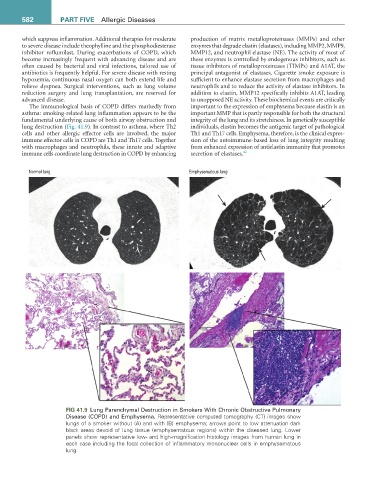
        lung destruction (Fig. 41.9). In contrast to asthma, where Th2   individuals, elastin becomes the antigenic target of pathological
        cells and other allergic effector cells are involved, the major   Th1 and Th17 cells. Emphysema, therefore, is the clinical expres-
        immune effector cells in COPD are Th1 and Th17 cells. Together   sion of the autoimmune-based loss of lung integrity resulting
        with macrophages and neutrophils, these innate and adaptive   from enhanced expression of antielastin immunity that promotes
        immune cells coordinate lung destruction in COPD by enhancing   secretion of elastases. 42

          Normal lung                                          Emphysematous lung


                       FIG 41.9  Lung Parenchymal Destruction in Smokers With Chronic Obstructive Pulmonary
                       Disease (COPD) and Emphysema. Representative computed tomography (CT) images show
                       lungs of a smoker without (A) and with (B) emphysema; arrows point to low attenuation dark
                       black areas devoid of lung tissue (emphysematous regions) within the diseased lung. Lower
                       panels show representative low- and high-magnification histology images from human lung in
                       each case including the focal collection of inflammatory mononuclear cells in emphysematous
                       lung.

