


Page 687 - Clinical Immunology_ Principles and Practice ( PDFDrive )
P. 687
660          ParT FivE  Allergic diseases


                                  H                 H
                          ROCHN      S      ROCHN     S               R   H  H H
                                  N                 N                     N     S
                              O                 O         X            O      N
                                     CO 2 H           CO H                O
                                                        2
                                Penicillins      Cephalosporins                  CO Na
                                                                                   2
                                                                            NH 2
                                                     O      OH        Carrier
                            R 1     S                                 protein
                                         R         N
                                  N            O                                          Hydrolysis
                             O                       CO 2 H
                                    CO 2 H
                                                Clavulanic acid
                                Penems          (an oxapenem)
                                                                         H H H S
                                                                     R   N
                                   H          RHN                              N   CO Na
                           HO                                          O       H     2
                                         R                               HN   O   Penicilloyl
                                   N                N    –
                               O                O      SO 3              Carrier
                                     CO 2 H
                               Carbapenems       Monobactams             protein
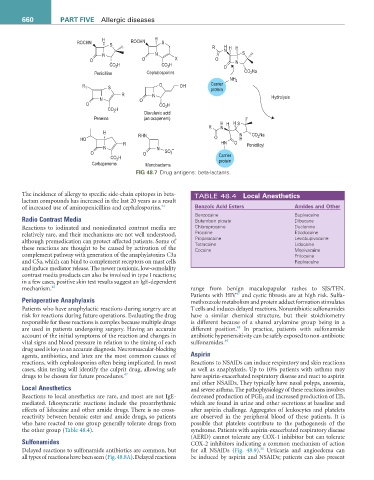
                                             FiG 48.7  Drug antigens: beta-lactams.


        The incidence of allergy to specific side-chain epitopes in beta-  TABLE 48.4  Local anesthetics
        lactam compounds has increased in the last 20 years as a result
        of increased use of aminopenicillins and cephalosporins. 44  Benzoic acid Esters         amides and Other
                                                                 Benzocaine                      Bupivacaine
        Radio Contrast Media                                     Butamben picrate                Dibucane
        Reactions  to  iodinated  and  noniodinated  contrast  media  are   Chloroprocaine       Duclonine
        relatively rare, and their mechanisms are not well understood,   Procaine                Etiodocaine
        although premedication can protect affected patients. Some of   Proparacaine             Levobupivacaine
                                                                 Tetracaine
                                                                                                 Lidocaine
        these reactions are thought to be caused by activation of the   Cocaine                  Mepivacaine
        complement pathway with generation of the anaphylatoxins C3a                             Prilocaine
        and C5a, which can bind to complement receptors on mast cells                            Ropivacaine
        and induce mediator release. The newer nonionic, low-osmolality
        contrast media products can also be involved in type I reactions;
        in a few cases, positive skin test results suggest an IgE-dependent
        mechanism. 45                                          range from benign maculopapular rashes to SJS/TEN.
                                                                              47
                                                               Patients with HIV  and cystic fibrosis are at high risk. Sulfa-
        Perioperative Anaphylaxis                              methoxazole metabolism and protein adduct formation stimulates
        Patients who have anaphylactic reactions during surgery are at   T cells and induces delayed reactions. Nonantibiotic sulfonamides
        risk for reactions during future operations. Evaluating the drug   have  a  similar  chemical  structure,  but  their  stoichiometry
        responsible for these reactions is complex because multiple drugs   is different because of a shared arylamine group being in a
                                                                              48
        are used in patients undergoing surgery. Having an accurate   different position.  In practice, patients with sulfonamide
        account of the initial symptoms of the reaction and changes in   antibiotic hypersensitivity can be safely exposed to non-antibiotic
        vital signs and blood pressure in relation to the timing of each   sulfonamides. 49
        drug used is key to an accurate diagnosis. Neuromuscular-blocking
        agents, antibiotics, and latex are the most common causes of   Aspirin
        reactions, with cephalosporins often being implicated. In most   Reactions to NSAIDs can induce respiratory and skin reactions
        cases, skin testing will identify the culprit drug, allowing safe   as well as anaphylaxis. Up to 10% patients with asthma may
        drugs to be chosen for future procedures. 47           have aspirin-exacerbated respiratory disease and react to aspirin
                                                               and other NSAIDs. They typically have nasal polyps, anosmia,
        Local Anesthetics                                      and severe asthma. The pathophysiology of these reactions involves
        Reactions to local anesthetics are rare, and most are not IgE-  decreased production of PGE 2  and increased production of LTs,
        mediated. Idiosyncratic reactions include the proarrhythmic   which are found in urine and other secretions at baseline and
        effects of lidocaine and other amide drugs. There is no cross-  after aspirin challenge. Aggregates of leukocytes and platelets
        reactivity between benzoic ester and amide drugs, so patients   are observed in the peripheral blood of these patients. It is
        who have reacted to one group generally tolerate drugs from   possible that platelets contribute to the pathogenesis of the
        the other group (Table 48.4).                          syndrome. Patients with aspirin-exacerbated respiratory disease
                                                               (AERD) cannot tolerate any COX-1 inhibitor but can tolerate
        Sulfonamides                                           COX-2 inhibitors indicating a common mechanism of action
                                                                                      50
        Delayed reactions to sulfonamide antibiotics are common, but   for all NSAIDs (Fig. 48.9).  Urticaria and angioedema can
        all types of reactions have been seen (Fig. 48.8A). Delayed reactions   be induced by aspirin and NSAIDs; patients can also present

