


Page 684 - Clinical Immunology_ Principles and Practice ( PDFDrive )
P. 684
CHaPTEr 48  Drug Hypersensitivity             657


                                                                                Keratinocyte


                                                                           ICAM-1  MCH II
                             Keratinocyte
                             cell necrosis
                                                                                             Perforin

                               Hydropic
                            degeneration
                                                                        LFA-1     TCR      Granzyme B
                             Eosinophils

                            Mononuclear
                             cell infiltrate
                                  A                                   B      Drug-specific CD4 +  T cell
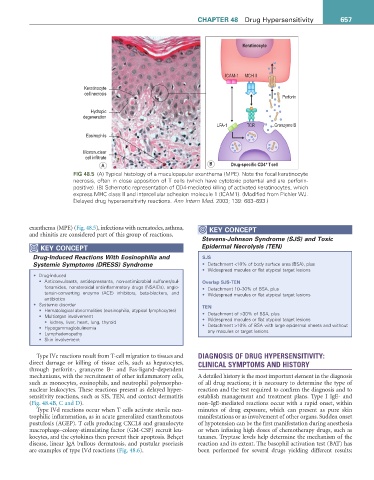
                         FiG 48.5  (A) Typical histology of a maculopapular exanthema (MPE). Note the focal keratinocyte
                         necrosis, often in close apposition of T cells (which have cytotoxic potential and are perforin-
                         positive). (B) Schematic representation of CD4-mediated killing of activated keratinocytes, which
                         express MHC class II and intercellular adhesion molecule 1 (ICAM1). (Modified from Pichler WJ.
                         Delayed drug hypersensitivity reactions. Ann Intern Med. 2003; 139: 683–693.)


           exanthema (MPE) (Fig. 48.5), infections with nematodes, asthma,    KEY CONCEPT
           and rhinitis are considered part of this group of reactions.
                                                                   Stevens-Johnson Syndrome (SJS) and Toxic
               KEY CONCEPT                                         Epidermal Necrolysis (TEN)
            Drug-Induced Reactions With Eosinophilia and           SJS
            Systemic Symptoms (DRESS) Syndrome                     •  Detachment <10% of body surface area (BSA), plus
                                                                   •  Widespread macules or flat atypical target lesions
            •  Drug-induced
              •  Anticonvulsants, antidepressants, non-antimicrobial sulfones/sul-  Overlap SJS-TEN
                fonamides, nonsteroidal antiinflammatory drugs (NSAIDs), angio-  •  Detachment 10–30% of BSA, plus
                tensin-converting  enzyme  (ACE)  inhibitors,  beta-blockers,  and   •  Widespread macules or flat atypical target lesions
                antibiotics
            •  Systemic disorder                                   TEN
              •  Hematological abnormalities (eosinophilia, atypical lymphocytes)
              •  Multiorgan involvement                            •  Detachment of >30% of BSA, plus
                •  kidney, liver, heart, lung, thyroid             •  Widespread macules or flat atypical target lesions
              •  Hypogammaglobulinemia                             •  Detachment >10% of BSA with large epidermal sheets and without
              •  Lymphadenopathy                                     any macules or target lesions
              •  Skin involvement

             Type IVc reactions result from T-cell migration to tissues and   DIAGNOSIS OF DRUG HYPERSENSITIVITY:
           direct damage or killing of tissue cells, such as hepatocytes,   CLINICAL SYMPTOMS AND HISTORY
           through perforin-, granzyme B– and Fas-ligand–dependent
           mechanisms, with the recruitment of other inflammatory cells,   A detailed history is the most important element in the diagnosis
           such as monocytes, eosinophils, and neutrophil polymorpho-  of all drug reactions; it is necessary to determine the type of
           nuclear leukocytes. These reactions present as delayed hyper-  reaction and the test required to confirm the diagnosis and to
           sensitivity reactions, such as SJS, TEN, and contact dermatitis   establish management and treatment plans. Type I IgE- and
           (Fig. 48.4B, C and D).                                 non–IgE-mediated reactions occur with a rapid onset, within
             Type IVd reactions occur when T cells activate sterile neu-  minutes of drug exposure, which can present as pure skin
           trophilic inflammation, as in acute generalized exanthematous   manifestations or as involvement of other organs. Sudden onset
           pustulosis (AGEP). T cells producing CXCL8 and granulocyte   of hypotension can be the first manifestation during anesthesia
           macrophage–colony-stimulating factor (GM-CSF) recruit leu-  or when infusing high doses of chemotherapy drugs, such as
           kocytes, and the cytokines then prevent their apoptosis. Behçet   taxanes. Tryptase levels help determine the mechanism of the
           disease, linear IgA bullous dermatosis, and pustular psoriasis   reaction and its extent. The basophil activation test (BAT) has
           are examples of type IVd reactions (Fig. 48.6).        been performed for several drugs yielding different results;

