


Page 685 - Clinical Immunology_ Principles and Practice ( PDFDrive )
P. 685
658          ParT FivE  Allergic diseases


            A


                                                               C


             B

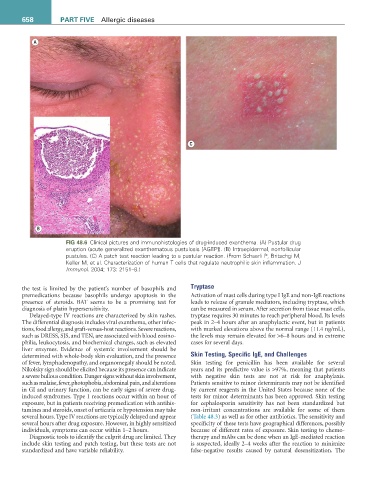
                       FiG 48.6  Clinical pictures and immunohistologies of drug-induced exanthema. (A) Pustular drug
                       eruption (acute generalized exanthematous pustulosis [AGEP]). (B) Intraepidermal, nonfollicular
                       pustules. (C) A patch test reaction leading to a pustular reaction. (From Schaerli P, Britschgi M,
                       Keller M, et al. Characterization of human T cells that regulate neutrophilic skin inflammation. J
                       Immunol. 2004; 173: 2151–8.)


                                                               Tryptase
        the  test  is  limited  by  the  patient’s  number  of  basophils  and
        premedications because basophils undergo apoptosis in the   Activation of mast cells during type I IgE and non-IgE reactions
        presence of steroids. BAT seems to be a promising test for   leads to release of granule mediators, including tryptase, which
        diagnosis of platin hypersensitivity.                  can be measured in serum. After secretion from tissue mast cells,
           Delayed-type IV reactions are characterized by skin rashes.   tryptase requires 30 minutes to reach peripheral blood. Its levels
        The differential diagnosis includes viral exanthema, other infec-  peak in 2–4 hours after an anaphylactic event, but in patients
        tions, food allergy, and graft-versus-host reactions. Severe reactions,   with marked elevations above the normal range (11.4 ng/mL),
        such as DRESS, SJS, and TEN, are associated with blood eosino-  the levels may remain elevated for >6–8 hours and in extreme
        philia, leukocytosis, and biochemical changes, such as elevated   cases for several days.
        liver enzymes. Evidence of systemic involvement should  be
        determined with whole-body skin evaluation, and the presence   Skin Testing, Specific IgE, and Challenges
        of fever, lymphadenopathy, and organomegaly should be noted.   Skin testing for penicillin has been available for several
        Nikolsky sign should be elicited because its presence can indicate   years and its predictive value is >97%, meaning that patients
        a severe bullous condition. Danger signs without skin involvement,   with negative skin tests are not at risk for anaphylaxis.
        such as malaise, fever, photophobia, abdominal pain, and alterations   Patients sensitive to minor determinants may not be identified
        in GI and urinary function, can be early signs of severe drug-  by current reagents in the United States because none of the
        induced syndromes. Type 1 reactions occur within an hour of   tests for minor determinants has been approved. Skin testing
        exposure, but in patients receiving premedication with antihis-  for  cephalosporin  sensitivity  has  not  been  standardized  but
        tamines and steroids, onset of urticaria or hypotension may take   non-irritant concentrations are available for some of them
        several hours. Type IV reactions are typically delayed and appear   (Table 48.3) as well as for other antibiotics. The sensitivity and
        several hours after drug exposure. However, in highly sensitized   specificity of these tests have geographical differences, possibly
        individuals, symptoms can occur within 1–2 hours.      because of different rates of exposure. Skin testing to chemo-
           Diagnostic tools to identify the culprit drug are limited. They   therapy and mAbs can be done when an IgE-mediated reaction
        include skin testing and patch testing, but these tests are not   is suspected, ideally 2–4 weeks after the reaction to minimize
        standardized and have variable reliability.            false-negative results caused by natural desensitization. The

