


Page 686 - Clinical Immunology_ Principles and Practice ( PDFDrive )
P. 686
CHaPTEr 48  Drug Hypersensitivity             659


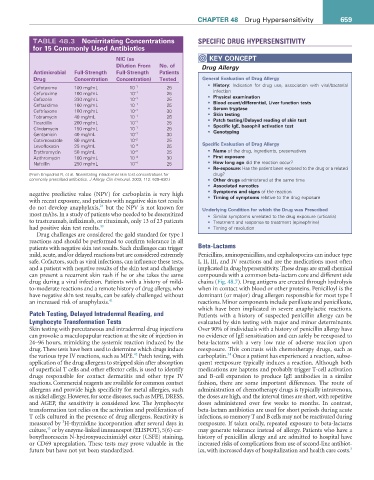
            TABLE 48.3  Nonirritating Concentrations              SPECIFIC DRUG HYPERSENSITIVITY
            for 15 Commonly Used antibiotics
                                       NiC (as                        KEY CONCEPT
                                       Dilution From   No. of      Drug Allergy
            antimicrobial   Full-Strength   Full-Strength   Patients
            Drug         Concentration  Concentration)  Tested     General Evaluation of Drug allergy
            Cefotaxime   100 mg/mL         10 −1        25           •  History:  Indication  for  drug  use,  association  with  viral/bacterial
                                                                       infection
            Cefuroxime   100 mg/mL         10 −1        25           •  Physical examination
            Cefazolin    330 mg/mL         10 −1        25
            Ceftazidime  100 mg/mL         10 −1        25           •  Blood count/differential, Liver function tests
                                                                     •  Serum tryptase
            Ceftriaxone  100 mg/mL         10 −1        30
            Tobramycin   40 mg/mL          10 −1        25           •  Skin testing
                                                                     •  Patch testing/Delayed reading of skin test
            Ticarcillin  200 mg/mL         10 −1        25
            Clindamycin  150 mg/mL         10 −1        25           •  Specific igE, basophil activation test
                                                                     •  Genotyping
            Gentamicin   40 mg/mL          10 −1        30
            Cotrimoxazole  80 mg/mL        10 −2        25
            Levofloxacin  25 mg/mL         10 −3        25         Specific Evaluation of Drug allergy
            Erythromycin  50 mg/mL         10 −3        25           •  Name of the drug, ingredients, preservatives
            Azithromycin  100 mg/mL        10 −4        30           •  First exposure
            Nafcillin    250 mg/mL         10 −4        25           •  How long ago did the reaction occur?
                                                                     •  re-exposure: Has the patient been exposed to the drug or a related
           (From Empedrad R, et al. Nonirritating intradermal skin test concentrations for   drug?
           commonly prescribed antibiotics. J Allergy Clin Immunol. 2003; 112: 629–630.)  •  Other drugs administered at the same time
                                                                     •  associated narcotics
                                                                     •  Symptoms and signs of the reaction
           negative predictive value (NPV) for carboplatin is very high   •  Timing of symptoms relative to the drug exposure
           with recent exposure, and patients with negative skin test results
                                  24
           do not develop anaphylaxis,  but the NPV is not known for   Underlying Condition for which the Drug was Prescribed
           most mAbs. In a study of patients who needed to be desensitized   •  Similar symptoms unrelated to the drug exposure (urticaria)
           to trastuzumab, infliximab, or rituximab, only 13 of 23 patients   •  Treatment and response to treatment (epinephrine)
           had positive skin test results. 40                        •  Timing of resolution
             Drug challenges are considered the gold standard for type I
           reactions and should be performed to confirm tolerance in all
           patients with negative skin test results. Such challenges can trigger   Beta-Lactams
           mild, acute, and/or delayed reactions but are considered extremely   Penicillins, aminopenicillins, and cephalosporins can induce type
           safe. Cofactors, such as viral infections, can influence these tests,   I, II, III, and IV reactions and are the medications most often
           and a patient with negative results of the skin test and challenge   implicated in drug hypersensitivity. These drugs are small chemical
           can present a recurrent skin rash if he or she takes the same   compounds with a common beta-lactam core and different side
           drug during a viral infection. Patients with a history of mild-  chains (Fig. 48.7). Drug antigens are created through hydrolysis
           to-moderate reactions and a remote history of drug allergy, who   when in contact with blood or other proteins. Penicilloyl is the
           have negative skin test results, can be safely challenged without   dominant (or major) drug allergen responsible for most type I
           an increased risk of anaphylaxis. 41                   reactions. Minor components include penilloate and penicilloate,
                                                                  which have been implicated in severe anaphylactic reactions.
           Patch Testing, Delayed Intradermal Reading, and        Patients  with  a  history  of  suspected  penicillin  allergy  can  be
           Lymphocyte Transformation Tests                        evaluated by skin testing with major and minor determinants.
           Skin testing with percutaneous and intradermal drug injections   Over 90% of individuals with a history of penicillin allergy have
           can provoke a maculopapular reaction at the site of injection in   no evidence of IgE sensitization and can safely be reexposed to
           24–96 hours, mimicking the systemic reaction induced by the   beta-lactams with a very low rate of adverse reaction upon
           drug. These tests have been used to determine which drugs induce   reexposure. This contrasts with chemotherapy drugs, such as
                                                                           34
                                             42
           the various type IV reactions, such as MPE.  Patch testing, with   carboplatin.  Once a patient has experienced a reaction, subse-
           application of the drug allergens to stripped skin after absorption   quent reexposure typically induces a reaction. Although both
           of superficial T cells and other effector cells, is used to identify   medications are haptens and probably trigger T-cell activation
           drugs  responsible  for contact  dermatitis  and  other type IV   and B-cell expansion to produce IgE antibodies in a similar
           reactions. Commercial reagents are available for common contact   fashion, there are some important differences. The route of
           allergens and provide high specificity for metal allergies, such   administration of chemotherapy drugs is typically intravenous,
           as nickel allergy. However, for some diseases, such as MPE, DRESS,   the doses are high, and the interval times are short, with repetitive
           and AGEP, the sensitivity is considered low. The lymphocyte   doses administered over few weeks to months. In contrast,
           transformation test relies on the activation and proliferation of   beta-lactam antibiotics are used for short periods during acute
           T cells cultured in the presence of drug allergens. Reactivity is   infections, so memory T and B cells may not be reactivated during
                     3
           measured by  H-thymidine incorporation after several days in   reexposure. If taken orally, repeated exposure to beta-lactams
                43
           culture,  or by enzyme-linked immunospot (ELISPOT), 5(6)-car-  may generate tolerance instead of allergy. Patients who have a
           boxyfluorescein N-hydroxysuccinimidyl ester (CSFE) staining,   history of penicillin allergy and are admitted to hospital have
           or CD69 upregulation. These tests may prove valuable in the   increased risks of complications from use of second-line antibiot-
                                                                                                                    5
           future but have not yet been standardized.             ics, with increased days of hospitalization and health care costs.

