


Page 860 - Clinical Immunology_ Principles and Practice ( PDFDrive )
P. 860
CHaPTEr 60  Systemic Autoinflammatory Syndromes                   831


            TABLE 60.5  Diagnostic Criteria for                     As colchicine is the only drug with proven protection against
            Periodic Fever, aphthous Stomatitis,                  the development of amyloidosis, all patients with FMF should
            Pharyngitis, and adenitis (PFaPa) Syndrome            be prescribed colchicine, regardless of disease severity and attack
                                                                  frequency. When anti–IL-1 treatment is started, expert opinion
            I  Regularly recurring fevers with an early age of onset (<5 years of   recommends continuation of colchicine in the highest tolerable
              age)                                                dose for the prevention of amyloidosis.
            II  Constitutional symptoms in the absence of upper respiratory   The most common side effects of colchicine are diarrhea
              infection, which include at least one of the following:
              a)  Aphthous stomatitis                             and abdominal pain. These are dose dependent. In patients with
              b)  Cervical lymphadenitis                          persistent diarrhea, dose reduction can be tried to reduce severity.
              c)  Pharyngitis                                     Myopathy, neuropathy, and leukopenia are very rare, but severe
            III  Exclusion of cyclic neutropenia                  side effects occur primarily in patients with abnormal kidney
            IV  Completely asymptomatic interval between episodes  or liver function or because of interaction with other drugs.
            V  Normal growth and development
                                                                    High-dose colchicine has been shown to be teratogenic in
           From: Thomas et al. Diagnostic criteria used for PFAPA Periodic fever syndrome in   animals. However, multiple cohort studies have shown that
           children. J Pediatr 1999;135:15–21                     colchicine can be used safely during pregnancy and breastfeeding.
                                                                  In therapeutic doses, colchicine does not have a negative effect
                                                                  on sperm number and quality, and it has no negative effect on
                                                                  male or female fertility.
                                                                    As a general rule, there is no place for colchicine in the treat-
           Periodic Fever, Aphthous Stomatitis, Pharyngitis,      ment of autoinflammatory syndromes other than FMF. As an
           and Adenitis Syndrome                                  exception to this rule, patients with autoinflammation of unknown
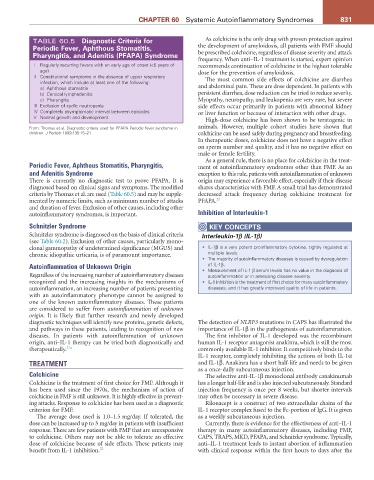
           There is currently no diagnostic test to prove PFAPA. It is   origin may experience a favorable effect, especially if their disease
           diagnosed based on clinical signs and symptoms. The modified   shares characteristics with FMF. A small trial has demonstrated
           criteria by Thomas et al. are used (Table 60.5) and may be supple-  decreased attack frequency during colchicine treatment for
           mented by numeric limits, such as minimum number of attacks   PFAPA. 23
           and duration of fever. Exclusion of other causes, including other
           autoinflammatory syndromes, is important.              Inhibition of Interleukin-1
           Schnitzler Syndrome                                        KEY CONCEPTS
           Schnitzler syndrome is diagnosed on the basis of clinical criteria   Interleukin-1β (IL-1β)
           (see Table 60.2). Exclusion of other causes, particularly mono-
           clonal gammopathy of undetermined significance (MGUS) and   •  IL-1β is a very potent proinflammatory cytokine, tightly regulated at
           chronic idiopathic urticaria, is of paramount importance.  multiple levels.
                                                                   •  The majority of autoinflammatory diseases is caused by dysregulation
           Autoinflammation of Unknown Origin                        of IL-1β.
                                                                   •  Measurement of IL-1 β serum levels has no value in the diagnosis of
           Regardless of the increasing number of autoinflammatory diseases   autoinflammation or in assessing disease severity.
           recognized and the increasing insights in the mechanisms of   •  IL-1 inhibition is the treatment of first choice for many autoinflammatory
           autoinflammation, an increasing number of patients presenting   diseases, and it has greatly improved quality of life in patients.
           with an autoinflammatory phenotype cannot be assigned to
           one of the known autoinflammatory diseases. These patients
           are considered to suffer from  autoinflammation of unknown
           origin. It is likely that further research and newly developed
           diagnostic techniques will identify new proteins, genetic defects,   The detection of NLRP3 mutations in CAPS has illustrated the
           and pathways in these patients, leading to recognition of new   importance of IL-1β in the pathogenesis of autoinflammation.
           diseases. In patients with autoinflammation of unknown   The first inhibitor of IL-1 developed was the recombinant
           origin, anti–IL-1 therapy can be tried both diagnostically and     human IL-1 receptor antagonist anakinra, which is still the most
           therapeutically. 21a                                   commonly available IL-1 inhibitor. It competitively binds to the
                                                                  IL-1 receptor, completely inhibiting the actions of both IL-1α
           TREATMENT                                              and IL-1β. Anakinra has a short half-life and needs to be given
                                                                  as a once-daily subcutaneous injection.
           Colchicine                                               The selective anti-IL-1β monoclonal antibody canakinumab
           Colchicine is the treatment of first choice for FMF. Although it   has a longer half-life and is also injected subcutaneously. Standard
           has been used since the 1970s, the mechanism of action of   injection frequency is once per 8 weeks, but shorter intervals
           colchicine in FMF is still unknown. It is highly effective in prevent-  may often be necessary in severe disease.
           ing attacks. Response to colchicine has been used as a diagnostic   Rilonacept is a construct of two extracellular chains of the
           criterion for FMF.                                     IL-1 receptor complex fused to the Fc-portion of IgG. It is given
             The average dose used is 1.0–1.5 mg/day. If tolerated, the   as a weekly subcutaneous injection.
           dose can be increased up to 3 mg/day in patients with insufficient   Currently, there is evidence for the effectiveness of anti–IL-1
           response. There are few patients with FMF that are unresponsive   therapy in many autoinflammatory diseases, including FMF,
           to colchicine. Others may not be able to tolerate an effective   CAPS, TRAPS, MKD, PFAPA, and Schnitzler syndrome. Typically,
           dose of colchicine because of side effects. These patients may   anti–IL-1 treatment leads to instant abortion of inflammation
           benefit from IL-1 inhibition. 22                       with clinical response within the first hours to days after the

