


Page 856 - Clinical Immunology_ Principles and Practice ( PDFDrive )
P. 856
CHaPTEr 60  Systemic Autoinflammatory Syndromes                   827


           of vision. In severely affected patients, arthropathy, with distinct
           radiographic findings of premature patellar and epiphyseal long   Mevalonate Kinase Deficiency
           bone ossification and osseous overgrowth, develops early in life.   Before the discovery of the underlying genetic defect in the
           If left untreated, this leads to growth retardation, severe joint   mevalonate kinase gene, two distinct autosomal recessive diseases
           contractures, and persisting disability.               were distinguished, which are now known to form two ends of
             The duration of attacks is variable and ranges from hours to   a continuous spectrum: HIDS at the less severe end and mevalonic
           days. At the severe end of the spectrum, patients have continuous   aciduria (MA) at the most severe end.
           inflammation. Attacks may be triggered by exposure to cold,   HIDS is characterized by recurrent fever attacks that last for
           minor trauma, or emotional stress.                     4–6 days, starting in early childhood. The inflammatory attacks
             In the past, patients with severe CAPS often died in childhood.   occur on average every 4–6 weeks. Attack frequency varies in a
           This changed after the introduction of anti–interleukin-1 (IL-1)   single patient and among patients and tends to decrease later in
           therapy, which is very effective in treating CAPS. Overall, patients   life. Attacks often start with chills, followed by a rapid rise in
           without neurological involvement are now believed to have a   temperature. Factors that can provoke an attack are infections,
           normal life expectancy.                                trauma,  vaccination,  and  both  physical  and  emotional  stress,
                                                                  although a clear trigger is often absent. Characteristic for HIDS
           Tumor Necrosis Factor Receptor–Associated              is the first attack being triggered by childhood vaccination.
           Periodic Syndrome                                        Fever is accompanied by cervical lymphadenopathy and
           TRAPS is inherited in an autosomal dominant fashion. Age of   abdominal pain with vomiting and diarrhea. The skin may show
           onset varies widely. Many patients become symptomatic within   erythema, papules, urticarial rash, or exanthema. The majority
           the first years of life, with a median age of onset of 3 years, but   of patients suffer from large-joint arthralgia or arthritis. Oral or
           adult onset is also possible. The usual duration of fever in TRAPS   genital aphthous ulcers may be present during attacks. Hepato-
           is considerably longer than in the other classic autoinflammatory   splenomegaly has been reported. Patients with HIDS appear to
           syndromes: attacks persist for a minimum of 3 days but can last   have normal life expectancy and experience no complications.
           for several weeks. The interval between attacks in a single patient   MA is located at the severe end of the MKD spectrum. This
           can vary substantially.                                severe disease is present from birth and is characterized by
             Localized myalgia, a deep cramping, and often severely dis-  psychomotor retardation, ataxia, failure to thrive, cataracts, and
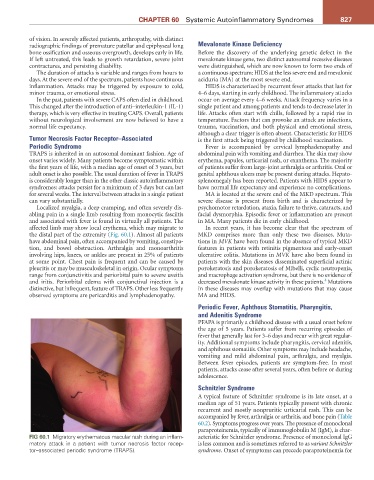
           abling pain in a single limb resulting from monocytic fasciitis   facial dysmorphia. Episodic fever or inflammation are present
           and associated with fever is found in virtually all patients. The   in MA. Many patients die in early childhood.
           affected limb may show local erythema, which may migrate to   In recent years, it has become clear that the spectrum of
           the distal part of the extremity (Fig. 60.1). Almost all patients   MKD comprises more than only these two diseases. Muta-
           have abdominal pain, often accompanied by vomiting, constipa-  tions in MVK have been found in the absence of typical MKD
           tion, and bowel obstruction.  Arthralgia and monoarthritis   features in patients with retinitis pigmentosa and early-onset
           involving hips, knees, or ankles are present in 25% of patients   ulcerative colitis. Mutations in MVK have also been found in
           at some point. Chest pain is frequent and can be caused by   patients with the skin diseases disseminated superficial actinic
           pleuritis or may be musculoskeletal in origin. Ocular symptoms   porokeratosis and porokeratosis of Mibelli, cyclic neutropenia,
           range from conjunctivitis and periorbital pain to severe uveitis   and macrophage activation syndrome, but there is no evidence of
                                                                                                           8
           and iritis. Periorbital edema with conjunctival injection is a   decreased mevalonate kinase activity in these patients.  Mutations
           distinctive, but infrequent, feature of TRAPS. Other less frequently   in these diseases may overlap with mutations that may cause
           observed symptoms are pericarditis and lymphadenopathy.  MA and HIDS.
                                                                  Periodic Fever, Aphthous Stomatitis, Pharyngitis,
                                                                  and Adenitis Syndrome
                                                                  PFAPA is primarily a childhood disease with a usual onset before
                                                                  the age of 5 years. Patients suffer from recurring episodes of
                                                                  fever that generally last for 3–6 days and recur with great regular-
                                                                  ity. Additional symptoms include pharyngitis, cervical adenitis,
                                                                  and aphthous stomatitis. Other symptoms may include headache,
                                                                  vomiting and mild abdominal  pain, arthralgia, and myalgia.
                                                                  Between fever episodes, patients are symptom-free. In most
                                                                  patients, attacks cease after several years, often before or during
                                                                  adolescence.
                                                                  Schnitzler Syndrome
                                                                  A typical feature of Schnitzler syndrome is its late onset, at a
                                                                  median age of 51 years. Patients typically present with chronic
                                                                  recurrent and mostly nonpruritic urticarial rash. This can be
                                                                  accompanied by fever, arthralgia or arthritis, and bone pain (Table
                                                                  60.2). Symptoms progress over years. The presence of monoclonal
                                                                  paraproteinemia, typically of immunoglobulin M (IgM), is char-
           FIG 60.1  Migratory erythematous macular rash during an inflam-  acteristic for Schnitzler syndrome. Presence of monoclonal IgG
           matory attack in a patient with tumor necrosis factor recep-  is less common and is sometimes referred to as variant Schnitzler
           tor–associated periodic syndrome (TRAPS).              syndrome. Onset of symptoms can precede paraproteinemia for

