


Page 857 - Clinical Immunology_ Principles and Practice ( PDFDrive )
P. 857
828          ParT SIX  Systemic Immune Diseases


         TABLE 60.2  Diagnostic Criteria for                            NLRP3
         Schnitzler Syndrome    a                                 LRR          NOD        PYD
          Major Criteria (≥1 present)                                          FIIND      PYD     CARD  ASC
          (Chronic) urticarial rash
          Monoclonal immunoglobulin M (IgM; or IgG: variant type)                 CARD            CARD  Pro-caspase-1
                                                                                     CARD
          Minor Criteria (≥2 present)                                                           Caspase-1
          Intermittent fever                                                             Caspase-1
          Arthralgia or arthritis
          Bone pain
          Lymphadenopathy                                                                     Pro-
          Hepatomegaly and/or splenomegaly                                                   IL-1β    IL-1β
          Elevated erythrocyte sedimentation rate (ESR) and/or leukocytosis
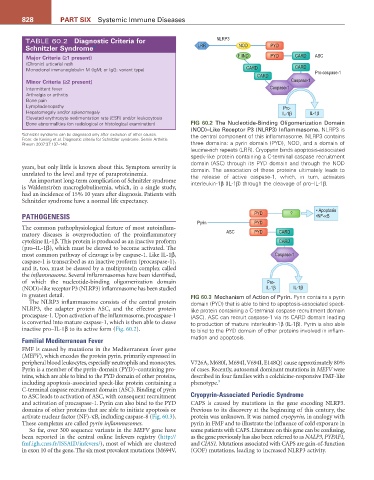
          Bone abnormalities (on radiological or histological examination)  FIG 60.2  The  Nucleotide-Binding  Oligomerization  Domain
                                                               (NOD)–Like Receptor P3 (NLRP3) Inflammasome. NLRP3 is
        a Schnizler syndrome can be diagnosed only after exclusion of other causes.  the central component of this inflammasome. NLRP3 contains
        From: de Koning et al. Diagnostic criteria for Schnitzler syndrome. Semin Arthritis
        Rheum 2007:37:137–148.                                 three domains: a pyrin domain (PYD), NOD, and a domain of
                                                               leucine-rich repeats (LRR). Cryopyrin binds apoptosis-associated
                                                               speck-like protein containing a C-terminal caspase recruitment
                                                               domain (ASC) through its PYD domain and through the NOD
        years, but only little is known about this. Symptom severity is   domain. The association of these proteins ultimately leads to
        unrelated to the level and type of paraproteinemia.    the release of active caspase-1, which, in turn, activates
           An important long-term complication of Schnitzler syndrome   interleukin-1β (IL-1β) through the cleavage of pro–IL-1β.
        is Waldenström macroglobulinemia, which, in a single study,
        had an incidence of 15% 10 years after diagnosis. Patients with
        Schnitzler syndrome have a normal life expectancy.
                                                                                                        • Apoptosis
        PATHOGENESIS                                                                PYD         ?       •NF-κB
                                                                  Pyrin             PYD
        The common pathophysiological feature of most autoinflam-
        matory diseases is overproduction of the proinflammatory           ASC      PYD     CARD
        cytokine IL-1β. This protein is produced as an inactive proform                     CARD
        (pro–IL-1β), which must be cleaved to become activated. The
        most common pathway of cleavage is by caspase-1. Like IL-1β,                       Caspase-1
        caspase-1 is transcribed as an inactive proform (procaspase-1),
        and it, too, must be cleaved by a multiprotein complex called
        the inflammasome. Several inflammasomes have been identified,
        of which the nucleotide-binding oligomerization domain                          Pro-
        (NOD)–like receptor P3 (NLRP3) inflammasome has been studied                    IL-1β    IL-1β
        in greatest detail.                                    FIG 60.3  Mechanism of Action of Pyrin. Pyrin contains a pyrin
           The NLRP3 inflammasome consists of the central protein   domain (PYD) that is able to bind to apoptosis-associated speck-
        NLRP3, the adapter protein  ASC, and the effector protein   like protein containing a C-terminal caspase recruitment domain
        procaspase-1. Upon activation of the inflammasome, procaspase-1   (ASC). ASC can recruit caspase-1 via its CARD domain leading
        is converted into mature caspase-1, which is then able to cleave   to production of mature interleukin-1β (IL-1β). Pyrin is also able
        inactive pro–IL-1β to its active form (Fig. 60.2).     to bind to the PYD domain of other proteins involved in inflam-

        Familial Mediterranean Fever                           mation and apoptosis.
        FMF is caused by mutations in the Mediterranean fever gene
        (MEFV), which encodes the protein pyrin, primarily expressed in
        peripheral blood leukocytes, especially neutrophils and monocytes.   V726A, M680I, M694I, V694I, E148Q) cause approximately 80%
        Pyrin is a member of the pyrin-domain (PYD)–containing pro-  of cases. Recently, autosomal dominant mutations in MEFV were
        teins, which are able to bind to the PYD domain of other proteins,   described in four families with a colchicine-responsive FMF-like
        including apoptosis-associated speck-like protein containing a   phenotype. 9
        C-terminal caspase recruitment domain (ASC). Binding of pyrin
        to ASC leads to activation of ASC, with consequent recruitment   Cryopyrin-Associated Periodic Syndrome
        and activation of procaspase-1. Pyrin can also bind to the PYD   CAPS is caused by mutations in the gene encoding NLRP3.
        domains of other proteins that are able to initiate apoptosis or   Previous to its discovery at the beginning of this century, the
        activate nuclear factor (NF)-κB, including caspase-8 (Fig. 60.3).   protein was unknown. It was named cryopyrin, in analogy with
        These complexes are called pyrin inflammasomes.        pyrin in FMF and to illustrate the influence of cold exposure in
           So far, over 300 sequence variants in the MEFV gene have   some patients with CAPS. Literature on this gene can be confusing,
        been reported in the central online Infevers registry (http://  as the gene previously has also been referred to as NALP3, PYPAF1,
        fmf.igh.cnrs.fr/ISSAID/infevers/), most of which are clustered   and CIAS1. Mutations associated with CAPS are gain-of-function
        in exon 10 of the gene. The six most prevalent mutations (M694V,   (GOF) mutations, leading to increased NLRP3 activity.

