


Page 858 - Clinical Immunology_ Principles and Practice ( PDFDrive )
P. 858
CHaPTEr 60  Systemic Autoinflammatory Syndromes                   829


                                                                    There are two exceptional TNFRSF1A mutations: R92Q and
           Tumor Necrosis Factor Receptor–Associated              P46L. These mutations do not lead to receptor misfolding and
           Periodic Syndrome                                      are present in low frequency in the general population. They
           Mutations in the gene TNFRSF1A are responsible for TRAPS. This   may, however, cause a mild inflammatory phenotype.
           gene encodes the TNF-receptor superfamily 1A (TNFRSF1A),
           the main cell surface receptor for TNF. This receptor consists   Mevalonate Kinase Deficiency
           of three domains: an extracellular ligand-binding domain, a   The genetic defect in MKD is located in MVK. Mevalonate kinase
           transmembrane domain, and an intracellular effector domain.   is a key enzyme in the isoprenoid pathway and is located directly
           So far, over 100 TNFRSF1A sequence variants have been described,   downstream from 3-hydroxy-3methylglutaryl-coenzyme  A
           and all TRAPS-associated mutations are located within the   reductase (HMG-coA-reductase). The end products of the
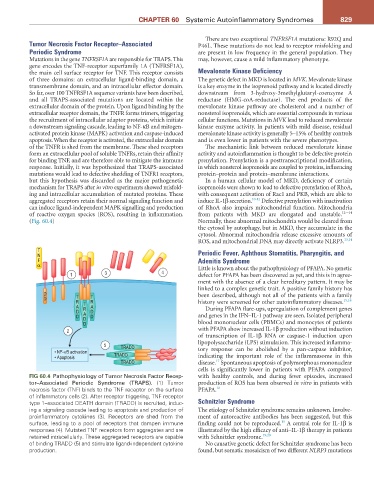
           extracellular domain of the protein. Upon ligand binding by the   mevalonate kinase pathway are cholesterol and a number of
           extracellular receptor domain, the TNFR forms trimers, triggering   nonsterol isoprenoids, which are essential compounds in various
           the recruitment of intracellular adaptor proteins, which initiate   cellular functions. Mutations in MVK lead to reduced mevalonate
           a downstream signaling cascade, leading to NF-κB and mitogen-  kinase enzyme activity. In patients with mild disease, residual
           activated protein kinase (MAPK) activation and caspase-induced   mevalonate kinase activity is generally 5–15% of healthy controls
           apoptosis. When the receptor is activated, the extracellular domain   and is even lower in patients with the severe phenotypes.
           of the TNFR is shed from the membrane. These shed receptors   The mechanistic link between reduced mevalonate kinase
           form an extracellular pool of soluble TNFRs, retain their affinity   activity and autoinflammation is thought to be defective protein
           for binding TNF, and are therefore able to mitigate the immune   prenylation. Prenylation is a posttranscriptional modification,
           response. Initially, it was hypothesized that TRAPS-associated   in which nonsterol isoprenoids are coupled to proteins, influencing
           mutations would lead to defective shedding of TNFR1 receptors,   protein–protein and protein–membrane interactions.
           but this hypothesis was discarded as the major pathogenetic   In a human cellular model of MKD, deficiency of certain
           mechanism for TRAPS after in vitro experiments showed misfold-  isoprenoids were shown to lead to defective prenylation of RhoA,
           ing and intracellular accumulation of mutated proteins. These   with consequent activation of Rac1 and PKB, which are able to
           aggregated receptors retain their normal signaling function and   induce IL-1β secretion. 10-12  Defective prenylation with inactivation
           can induce ligand-independent MAPK signalling and production   of RhoA also impairs mitochondrial function. Mitochondria
           of  reactive  oxygen  species  (ROS),  resulting  in  inflammation.    from patients with MKD are elongated and unstable. 12-–14
           (Fig. 60.4)                                            Normally, these abnormal mitochondria would be cleared from
                                                                  the cytosol by autophagy, but in MKD, they accumulate in the
                                                                  cytosol. Abnormal mitochondria release excessive amounts of
                                                                  ROS, and mitochondrial DNA may directly activate NLRP3. 13,14
             T
             N                                                    Periodic Fever, Aphthous Stomatitis, Pharyngitis, and
             F                                                    Adenitis Syndrome
             α                                                    Little is known about the pathophysiology of PFAPA. No genetic
                        1          3                  4           defect for PFAPA has been discovered as yet, and this is in agree-
                                                                  ment with the absence of a clear hereditary pattern. It may be
                                                                  linked to a complex genetic trait. A positive family history has
               D                                                  been described, although not all of the patients with a family
               D          T    T                                                                                 15,16
                          R  T  R                                 history were screened for other autoinflammatory diseases.
                          A  R  A                                   During PFAPA flare-ups, upregulation of complement genes
                          D  A  D
                          D  D  D                                 and genes in the IFN–IL-1 pathway are seen. Isolated peripheral
                            D                                     blood mononuclear cells (PBMCs) and monocytes of patients
                       2                                          with PFAPA show increased IL-1β production without induction
                                                                  of transcription of IL-1β RNA or caspase-1 induction upon
                                   5     TRADD                    lipopolysaccharide (LPS) stimulation. This increased inflamma-
                   • NF-κB activation                             tory response can be abolished by a pan-caspase inhibitor,
                   • Apoptosis        TRADD                       indicating the important role of the inflammasome in this
                                                                        17
                                         TRADD                    disease.  Spontaneous apoptosis of polymorphous mononuclear
                                                                  cells is significantly lower in patients with PFAPA compared
           FIG 60.4  Pathophysiology of Tumor Necrosis Factor Recep-  with  healthy  controls,  and  during  fever  episodes,  increased
           tor–Associated Periodic Syndrome (TRAPS). (1) Tumor    production of ROS has been observed in vitro in patients with
           necrosis factor (TNF) binds to the TNF receptor on the surface   PFAPA. 18
           of inflammatory cells (2). After receptor triggering, TNF receptor
           type 1–associated DEATH domain (TRADD) is recruited, induc-  Schnitzler Syndrome
           ing a signaling cascade leading to apoptosis and production of   The etiology of Schnitzler syndrome remains unknown. Involve-
           proinflammatory cytokines (3). Receptors are shed from the   ment of autoreactive antibodies has been suggested, but this
           surface, leading to a pool of receptors that dampen immune   finding could not be reproduced.  A central role for IL-1β is
                                                                                             19
           responses (4). Mutated TNF receptors form aggregates and are   illustrated by the high efficacy of anti–IL-1β therapy in patients
           retained intracellularly. These aggregated receptors are capable   with Schnitzler syndrome. 19,20
           of binding TRADD (5) and stimulate ligand-independent cytokine   No causative genetic defect for Schnitzler syndrome has been
           production.                                            found, but somatic mosaicism of two different NLRP3 mutations

