


Page 859 - Clinical Immunology_ Principles and Practice ( PDFDrive )
P. 859
830          ParT SIX  Systemic Immune Diseases


        restricted to myeloid cells has been described recently in two   For experienced physicians, it is not difficult to diagnose FMF
                                     21
        patients with Schnitzler syndrome.  Strikingly, these patients   in patients who have a medical history compatible with FMF
        had the most severe phenotype in this cohort. Somatic mosaicism   and who come from an ethnic group with high prevalence of
        may be an explanation for the late onset of Schnitzler syndrome,   FMF. In countries with a low incidence of FMF, several years of
        and low-grade mosaicism may not be picked up by routine gene   diagnostic delay are not unusual, as typical attacks remain
        sequencing. Other genetic defects have also been described in   unrecognized.
        very small numbers of patients, but their role in the pathogenesis   When FMF is suspected on clinical grounds, treatment with
        of Schnitzler syndrome remains unclear.                colchicine should be initiated immediately. A positive effect of
           Schnitzler syndrome is regarded as a paraneoplastic syn-  colchicine is confirmatory for the diagnosis FMF.
        drome by some because of its association with Waldenström   In populations with a low prevalence of FMF and in atypical
        macroglobulinemia.                                     cases, sequencing of the  MEFV gene can be helpful in the
                                                               diagnostic workup.
        LABORATORY TESTS                                       Cryopyrin-Associated Periodic Syndrome

        In classic monogenetic autoinflammatory diseases, an explicit   CAPS  is  diagnosed  on  the  basis  of  typical  clinical  features,
        acute-phase response, with elevated inflammatory markers   sometimes supported by a positive family history reflecting
        (cross-reactive protein [CRP], erythrocyte sedimentation rate   autosomal dominant inheritance. Detection of mutations in the
        [ESR], serum amyloid A [SAA]) and leukocytosis, is invariably   NLRP3 gene will confirm the diagnosis in most cases, but cases
        present during symptomatic periods. In other autoinflammatory   with “mutation-negative” CAPS have been described. Some of
        diseases, this may be less evident.                    these patients may have somatic mosaicism. Reaction to treatment
           During clinical disease remission, persistent subclinical inflam-  is the same for these patients as for patients with proven NLRP3
        mation can be found. Cold agglutinins, antinuclear autoantibodies   mutation.
        (ANAs), or cryoglobulins are usually not present but may be
        found in low titers. Proteinuria (over 0.5 g of protein per 24   Tumor Necrosis Factor Receptor–Associated
        hours) is highly suggestive for secondary AA amyloidosis.  Periodic Syndrome
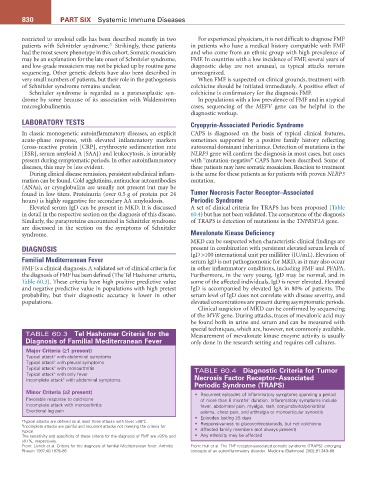
           Elevated serum IgD can be present in MKD. It is discussed   A set of clinical criteria for TRAPS has been proposed (Table
        in detail in the respective section on the diagnosis of this disease.   60.4) but has not been validated. The cornerstone of the diagnosis
        Similarly, the paraproteins encountered in Schnitzler syndrome   of TRAPS is detection of mutations in the TNFRSF1A gene.
        are discussed in the section on the symptoms of Schnitzler
        syndrome.                                              Mevalonate Kinase Deficiency
                                                               MKD can be suspected when characteristic clinical findings are
        DIAGNOSIS                                              present in combination with persistent elevated serum levels of
                                                               IgD >100 international unit per milliliter (IU/mL). Elevation of
        Familial Mediterranean Fever                           serum IgD is not pathognomonic for MKD, as it may also occur
        FMF is a clinical diagnosis. A validated set of clinical criteria for   in other inflammatory conditions, including FMF and PFAPA.
        the diagnosis of FMF has been defined (The Tel Hashomer criteria,   Furthermore, in the very young, IgD may be normal, and in
        Table 60.3). These criteria have high positive predictive value   some of the affected individuals, IgD is never elevated. Elevated
        and negative predictive value in populations with high pretest   IgD is accompanied by elevated IgA in 80% of patients. The
        probability, but their diagnostic accuracy is lower in other   serum level of IgD does not correlate with disease severity, and
        populations.                                           elevated concentrations are present during asymptomatic periods.
                                                                  Clinical suspicion of MKD can be confirmed by sequencing
                                                               of the MVK gene. During attacks, traces of mevalonic acid may
                                                               be found both in urine and serum and can be measured with
                                                               special techniques, which are, however, not commonly available.
         TABLE 60.3  Tel Hashomer Criteria for the             Measurement of mevalonate kinase enzyme activity is usually
         Diagnosis of Familial Mediterranean Fever             only done in the research setting and requires cell cultures.
          Major Criteria (≥1 present)
                   a
          Typical attack  with abdominal symptoms
          Typical attack  with pleural symptoms
                   a
          Typical attack  with monoarthritis                     TABLE 60.4  Diagnostic Criteria for Tumor
                   a
          Typical attack  with only fever
                   a
          Incomplete attack  with abdominal symptoms             Necrosis Factor receptor–associated
                      b
                                                                 Periodic Syndrome (TraPS)
          Minor Criteria (≥2 present)                            •  Recurrent episodes of inflammatory symptoms spanning a period
          Favorable response to colchicine                         of more than 6 months’ duration. Inflammatory symptoms include
          Incomplete attack with monoarthritis                     fever, abdominal pain, myalgia, rash, conjunctivitis/periorbital
          Exertional leg pain                                      edema, chest pain, and arthralgia or monoarticular synovitis
                                                                 •  Episodes lasting ≥5 days
        a Typical attacks are defined as at least three attacks with fever >38°C.
        b Incomplete attacks are painful and recurrent attacks not meeting the criteria for   •  Responsiveness to glucocorticosteroids, but not colchicine
        typical.                                                 •  Affected family members (not always present)
        The sensitivity and specificity of these criteria for the diagnosis of FMF are >95% and   •  Any ethnicity may be affected
        >97%, respectively.
        From: Livneh et al. Criteria for the diagnosis of familial Mediterranean fever. Arthritis   From: Hull et al. The TNF receptor-associated periodic syndrome (TRAPS): emerging
        Rheum 1997;40:1879–85                                  concepts of an autoinflammatory disorder. Medicine (Baltimore) 2002;81:349–68

