


Page 96 - Clinical Immunology_ Principles and Practice ( PDFDrive )
P. 96
CHAPtER 5  The Major Histocompatibility Complex                  81


               KEY CoNCEPtS                                                              Peptide
            Genomic Organization of the MHC
                                                                           α 1   α 2              α 1   β 1
            •  The major histocompatibility complex (MHC) is the most complex
              genomic region in the whole human genome. It is associated with
              more diseases than any other genomic region of comparable size.
            •  The class I region contains the polymorphic human leukocyte antigen   β m  α 3     α 2   β 2
                                                                            2
              (HLA)-A, -B, and -C genes; the less polymorphic nonclassic class I
              HLA-E, HLA-F, and HLA-G genes; and the class I-related MICA and
              MICB.
            •  The class II region contains the HLA-DR A and B, DQ A and B, and       Cell membrane
              DP A and B genes. It also contains the TAP, LMP, DM, and DO genes,
              which encode molecules that help process antigens into peptides
              that can bind class I and class II molecules.
            •  Genes within the MHC demonstrate extensive linkage disequilibrium.   HLA class I molecule  HLA class II molecule
              A string of alleles of polymorphic MHC genes that commonly exist
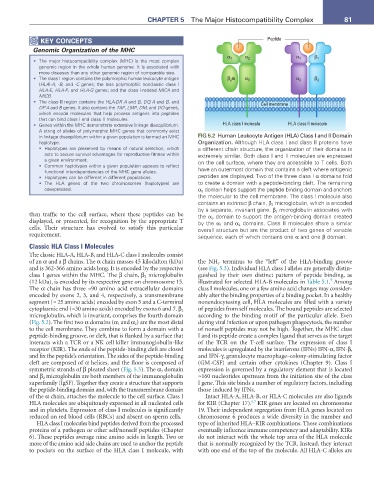
              in linkage disequilibrium within a given population is termed an MHC   FIG 5.2  Human Leukocyte Antigen (HLA) Class I and II Domain
              haplotype.                                          Organization. Although HLA class I and class II proteins have
              •  Haplotypes are preserved by means of natural selection, which   a different chain structure, the organization of their domains is
                acts to secure survival advantages for reproductive fitness within   extremely similar. Both class I and II molecules are expressed
                a given environment.                              on the cell surface, where they are accessible to T cells. Both
              •  Common haplotypes within a given population appears to reflect
                functional interdependencies of the MHC gene alleles.  have an outermost domain that contains a cleft where antigenic
              •  Haplotypes can be different in different populations.  peptides are displayed. Two of the three class I α domains fold
              •  The HLA genes of the two chromosomes (haplotypes) are   to create a domain with a peptide-binding cleft. The remaining
                coexpressed.                                      α 3  domain helps support the peptide binding domain and anchors
                                                                  the molecular to the cell membrane. The class I molecule also
                                                                  contains an extrinsic β chain, β 2  microglobulin, which is encoded
                                                                  by a separate, invariant gene. β 2  microglobulin associates with
           then traffic to the cell surface, where these peptides can be   the α 3  domain to support the antigen-binding domain created
           displayed, or presented, for recognition by the appropriate T   by the α 1  and α 2  domains. Class II molecules share a similar
           cells.  Their  structure  has  evolved to  satisfy  this  particular   overall structure but are the product of two genes of variable
           requirement.                                           sequence, each of which contains one α and one β domain.
           Classic HLA Class I Molecules
           The classic HLA-A, HLA-B, and HLA-C class I molecules consist
           of an α and a β chains. The α chain masses 45 kilodalton (kDa)   the NH 2  terminus to the  “left” of the HLA-binding groove
           and is 362-366 amino acids long. It is encoded by the respective   (see Fig. 5.3). Individual HLA class I alleles are generally distin-
           class I genes within the MHC. The β chain, β 2  microglobulin   guished  by  their  own  distinct  pattern  of  peptide  binding,  as
                                                                                                             5
           (12 kDa), is encoded by its respective gene on chromosome 15.   illustrated for selected HLA-B molecules in Table 5.1.  Among
           The α chain has three ≈90 amino acid extracellular domains   class I molecules, one or a few amino acid changes may consider-
           encoded by exons 2, 3, and 4, respectively, a transmembrane   ably alter the binding properties of a binding pocket. In a healthy
           segment (≈ 25 amino acids) encoded by exon 5 and a C-terminal   nonendocytosing cell, HLA molecules are filled with a variety
           cytoplasmic end (≈30 amino acids) encoded by exons 6 and 7. β 2    of peptides from self molecules. The bound peptides are selected
           microglobulin, which is invariant, comprises the fourth domain   according to the binding motif of the particular allele. Even
           (Fig. 5.2). The first two α domains (α 1  and α 2 ) are the most distal   during viral infection or upon pathogen phagocytosis, the number
           to the cell membrane. They combine to form a domain with a   of nonself peptides may not be high. Together, the MHC class
           peptide-binding groove, or cleft, that is flanked by a surface that   I and its peptide create a complex ligand that serves as the target
           interacts with a TCR or a NK cell killer immunoglobulin-like   of the TCR on the T-cell surface. The expression of class I
           receptor (KIR). The ends of the peptide-binding cleft are closed   molecules is upregulated by the interferons (IFNs) IFN-α, IFN-β,
           and fix the peptide’s orientation. The sides of the peptide-binding   and IFN-γ, granulocyte macrophage–colony-stimulating factor
           cleft are composed of α helices, and the floor is composed of   (GM-CSF) and certain other cytokines (Chapter 9). Class I
           symmetric strands of β pleated sheet (Fig. 5.3). The α 3  domain   expression is governed by a regulatory element that is located
           and β 2  microglobulin are both members of the immunoglobulin   ≈160 nucleotides upstream from the initiation site of the class
           superfamily (IgSF). Together they create a structure that supports   I gene. This site binds a number of regulatory factors, including
           the peptide-binding domain and, with the transmembrane domain   those induced by IFNs.
           of the α chain, attaches the molecule to the cell surface. Class I   Intact HLA-A, HLA-B, or HLA-C molecules are also ligands
                                                                                   6,7
           HLA molecules are ubiquitously expressed in all nucleated cells   for KIR (Chapter 17).  KIR genes are located on chromosome
           and in platelets. Expression of class I molecules is significantly   19. Their independent segregation from HLA genes located on
           reduced on red blood cells (RBCs) and absent on sperm cells.  chromosome 6 produces a wide diversity in the number and
             HLA class I molecules bind peptides derived from the processed   type of inherited HLA–KIR combinations. These combinations
           proteins of a pathogen or other self/nonself peptides (Chapter   eventually influence immune competency and adaptability. KIRs
           6). These peptides average nine amino acids in length. Two or   do not interact with the whole top area of the HLA molecule
           more of the amino acid side chains are used to anchor the peptide   that is normally recognized by the TCR. Instead, they interact
           to pockets on the  surface  of the HLA class I  molecule, with     with one end of the top of the molecule. All HLA-C alleles are

