


Page 97 - Clinical Immunology_ Principles and Practice ( PDFDrive )
P. 97
82           PARt oNE  Principles of Immune Response


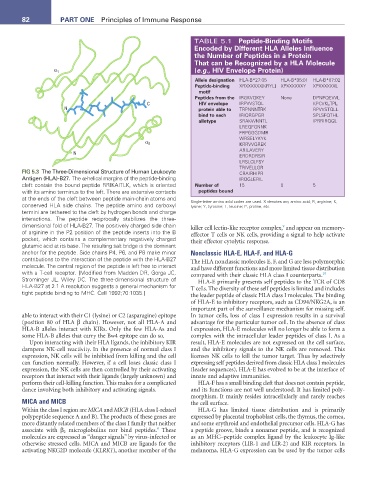
                                                                 TABLE 5.1  Peptide-Binding Motifs
                                                                 Encoded by Different HLA Alleles Influence
                                                                 the Number of Peptides in a Protein
                                                                 that can be Recognized by a HLA Molecule
                   α 1                                           (e.g., HIV Envelope Protein)
                                                                 Allele designation  HLA-B*27:05  HLA-B*35:01  HLA-B*07:02
                                                                 Peptide-binding   XRXXXXXX[KRYL]  XPXXXXXXY  XPXXXXXXL
                                                                  motif
                                                                 Peptides from the  IRGKVQKEY  None    DPNPQEVVL
                                                 C                HIV envelope   IRPVVSTQL             KPCVKLTPL
                      N                                           protein able to   TRPNNNTRK          RPVVSTQLL
                                                                  bind to each   IRIQRGPGR             SPLSFQTHL
                                                                  allotype     SRAKWNNTL               IPRRIRQGL
                                                                               LREQFGNNK
                                                                               FRPGGGDMR
                                                                               WRSELYKYK
                                                 α 2
                                                                               KRRVVQREK
                                                                               ARILAVERY
                         N
                                                                               ERDRDRSIR
                                                                               LRSLCLFSY
                                                                               TRIVELLGR
        FIG 5.3  The Three-Dimensional Structure of Human Leukocyte            CRAIRHIPR
        Antigen (HLA)-B27. The α-helical margins of the peptide-binding        IRQGLERIL
        cleft contain the bound peptide RRIKAITLK, which is oriented   Number of   15        0         5
        with its amino terminus to the left. There are extensive contacts   peptides bound
        at the ends of the cleft between peptide main-chain atoms and
        conserved HLA side chains. The peptide amino and carboxyl   Single-letter amino acid codes are used. X denotes any amino acid; R, arginine; K,
                                                               lysine; Y, tyrosine; L, leucine; P, proline, etc.
        termini are tethered to the cleft by hydrogen bonds and charge
        interactions. The peptide reciprocally stabilizes the three-
        dimensional fold of HLA-B27. The positively charged side chain   killer cell lectin-like receptor complex,  and appear on memory-
                                                                                             9
        of arginine in the P2 position of the peptide inserts into the B   effector T cells or NK cells, providing a signal to help activate
        pocket, which contains a complementary negatively charged   their effector cytolytic response.
        glutamic acid at its base. The resulting salt bridge is the dominant
        anchor for the peptide. Side chains P4, P6, and P8 make minor   Nonclassic HLA-E, HLA-F, and HLA-G
        contributions to the interaction of the peptide with the HLA-B27   The HLA nonclassic molecules E, F, and G are less polymorphic
        molecule. The central region of the peptide is left free to interact   and have different functions and more limited tissue distribution
        with a T-cell receptor. [Modified from Madden DR, Gorga JC,   compared with their classic HLA class I counterparts. 10
        Strominger JL, Wiley DC. The three-dimensional structure of   HLA-E primarily presents self peptides to the TCR of CD8
        HLA-B27 at 2.1 A resolution suggests a general mechanism for   T cells. The diversity of these self peptides is limited and includes
        tight peptide binding to MHC. Cell 1992;70:1035.]      the leader peptide of classic HLA class I molecules. The binding
                                                               of HLA-E to inhibitory receptors, such as CD94/NKG2A, is an
                                                               important part of the surveillance mechanism for missing self.
        able to interact with their C1 (lysine) or C2 (asparagine) epitope   In tumor cells, loss of class I expression results in a survival
        (position 80 of HLA  β chain). However, not all HLA-A and   advantage for the particular tumor cell. In the absence of class
        HLA-B alleles interact with KIRs. Only the few HLA-As and   I expression, HLA-E molecules will no longer be able to form a
        some HLA-B alleles that carry the Bw4 epitope can do so.  complex with the intracellular leader peptides of class I. As a
           Upon interacting with their HLA ligands, the inhibitory KIR   result, HLA-E molecules are not expressed on the cell surface,
        dampens NK-cell reactivity. In the presence of normal class I   and the inhibitory signals to the NK cells are removed. This
        expression, NK cells will be inhibited from killing and the cell   licenses NK cells to kill the tumor target. Thus by selectively
        can function normally. However, if a cell loses classic class I   expressing self peptides derived from classic HLA class I molecules
        expression, the NK cells are then controlled by their activating   (leader sequences), HLA-E has evolved to be at the interface of
        receptors that interact with their ligands (largely unknown) and   innate and adaptive immunities.
        perform their cell-killing function. This makes for a complicated   HLA-F has a small binding cleft that does not contain peptide,
        dance involving both inhibitory and activating signals.  and its functions are not well understood. It has limited poly-
                                                               morphism. It mainly resides intracellularly and rarely reaches
        MICA and MICB                                          the cell surface.
        Within the class I region are MICA and MICB (HLA class I-related   HLA-G has limited tissue distribution and is primarily
        polypeptide sequence A and B). The products of these genes are   expressed by placental trophoblast cells, the thymus, the cornea,
        more distantly related members of the class I family that neither   and some erythroid and endothelial precursor cells. HLA-G has
                                                    8
        associate with  β 2  microglobulins nor bind peptides.  These   a peptide groove, binds a nonamer peptide, and is recognized
        molecules are expressed as “danger signals” by virus-infected or   as  an  MHC–peptide  complex  ligand  by the  leukocyte Ig-like
        otherwise stressed cells. MICA and MICB are ligands for the   inhibitory receptors (LIR-1 and LIR-2) and KIR receptors. In
        activating NKG2D molecule (KLRK1), another member of the   melanoma, HLA-G expression can be used by the tumor cells

