


Page 95 - Clinical Immunology_ Principles and Practice ( PDFDrive )
P. 95
80           PARt oNE  Principles of Immune Response


                                                                                                          G
                                                                                                          A
                                                                                                          B
              H       B                                                                                   B
              F       T                                                                                   R
              E       N                                                                                   1
           Tel
             26195K                                                                                    29750K
                                                 Extended Class I (~4Mb)

                H            H                H                        H                  H   H        M   M
                L            L                L                        L                  L    L       I   I
                A            A                A                        A                  A    A       C   C
                F            G                A                        E                  C    B       A   B
             29800K                                                                                    32300K
                                                 Class I (1.8Mb)
                                                       C
                N             C                        Y  C
                F          L L  6 L L L L  H H H       P  Y  A    N
                K          Y Y  O Y Y Y Y  S S S       2  P  G    O
                B  T  L N A  6 6  R 6 6 6 6  P P P  R  1 T  2 H  P R  P T
                I L  N L  S C I  G G  F G G G G  A A A  N  D  C  A N C  1 L  A A  B C
                L T  F T  T R F  5 5  2 6 6 6 6  1 1 1  E  C B  B  R 4  1 X 4  A A  T G  x H
                1 A  a B  1 3 1  b b  1 e d c b  L A B  U  2 F  P  P B  P A A  2 F  1 E  2 4
             31633K                                  RC CX    32300K
                                                 Class III (0.7Mb)
                   H  H  H  H             H  H
                  H  L  L  L  L  H   H  H  H  L  L
                 B  L  A  A  A  A  L  P  P  L  L  L  A  A   T     K
                 T  A  D  D  D  D  A  T  S  T  S  A  A  A  D  D  R  A  I
                 N D  R  R Q Q  D  A M  A  M  D  D  D  P  P  X  P  F
                 L  R  B  B  A  B  O  P  B  P  B  M  M  O  A  B  R  B  C
                 2  A  3  1  1  1  B  2 8  1  9  B  A  A  1  1  B  P  1
             32470K                            33275K         33485K
                           Class II (0.8Mb)      Extended Class II (0.3Mb)
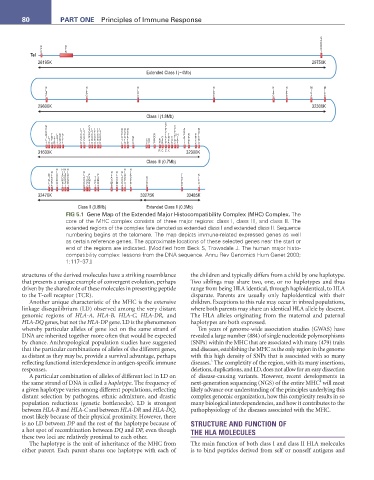
                       FIG 5.1  Gene Map of the Extended Major Histocompatibility Complex (MHC) Complex. The
                       core of the MHC complex consists of three major regions: class I, class III, and class II. The
                       extended regions of the complex fare denoted as extended class I and extended class II. Sequence
                       numbering begins at the telomere. The map depicts immune-related expressed genes as well
                       as certain reference genes. The approximate locations of these selected genes near the start or
                       end of the regions are indicated. [Modified from Beck S, Trowsdale J. The human major histo-
                       compatibility complex: lessons from the DNA sequence. Annu Rev Genomics Hum Genet 2000;
                       1:117–37.]

        structures of the derived molecules have a striking resemblance   the children and typically differs from a child by one haplotype.
        that presents a unique example of convergent evolution, perhaps   Two siblings may share two, one, or no haplotypes and thus
        driven by the shared role of these molecules in presenting peptide   range from being HLA identical, through haploidentical, to HLA
        to the T-cell receptor (TCR).                          disparate. Parents are usually only haploidentical with their
           Another unique characteristic of the MHC is the extensive   children. Exceptions to this rule may occur in inbred populations,
        linkage disequilibrium (LD) observed among the very distant   where both parents may share an identical HLA allele by descent.
        genomic regions of  HLA-A, HLA-B, HLA-C, HLA-DR, and   The HLA alleles originating from the maternal and paternal
        HLA-DQ genes, but not the HLA-DP gene. LD is the phenomenon   haplotypes are both expressed.
        whereby particular alleles of gene loci on the same strand of   Ten years of genome-wide association studies (GWAS) have
        DNA are inherited together more often that would be expected   revealed a large number (884) of single nucleotide polymorphisms
        by chance. Anthropological population studies have suggested   (SNPs) within the MHC that are associated with many (479) traits
        that the particular combinations of alleles of the different genes,   and diseases, establishing the MHC as the only region in the genome
        as distant as they may be, provide a survival advantage, perhaps   with this high density of SNPs that is associated with so many
                                                                      3
        reflecting functional interdependence in antigen-specific immune   diseases.  The complexity of the region, with its many insertions,
        responses.                                             deletions, duplications, and LD, does not allow for an easy dissection
           A particular combination of alleles of different loci in LD on   of disease-causing variants. However, recent developments in
                                                                                                          4
        the same strand of DNA is called a haplotype. The frequency of   next-generation sequencing (NGS) of the entire MHC  will most
        a given haplotype varies among different populations, reflecting   likely advance our understanding of the principles underlying this
        distant selection by pathogens, ethnic admixture, and drastic   complex genomic organization, how this complexity results in so
        population reductions (genetic bottlenecks). LD is strongest   many biological interdependencies, and how it contributes to the
        between HLA-B and HLA-C and between HLA-DR and HLA-DQ,   pathophysiology of the diseases associated with the MHC.
        most likely because of their physical proximity. However, there
        is no LD between DP and the rest of the haplotype because of   STRUCTURE AND FUNCTION OF
        a hot spot of recombination between DQ and DP, even though   THE HLA MOLECULES
        these two loci are relatively proximal to each other.
           The haplotype is the unit of inheritance of the MHC from   The main function of both class I and class II HLA molecules
        either parent. Each parent shares one haplotype with each of   is to bind peptides derived from self or nonself antigens and

