


Page 1172 - Hall et al (2015) Principles of Critical Care-McGraw-Hill
P. 1172
CHAPTER 86: Intracranial Pressure: Monitoring and Management  811


                                      Methods of                    Pictures                     Comments
                                        cooling
                                     Cooling blanket                                        Surface cooling can be
                                                                                            accomplished with
                                                                                            circulating cold water or
                                                                                            cold air-forced blankets.
                                                                                            It takes 2-8 hours or
                                                                                            longer to reduce the core
                                                                                            temperature to
                                                                                            32°C-34°C and
                                                                                            titration and
                                                                                            maintenance of core
                                                                                            temperature can be
                                                                                            difficult.
                                       Cooled gel                                           Cooling pads circulating
                                      surface pads                                          cooled water are
                                                                                            positioned together with
                                                                                            a temperature
                                                                                            conducting gel on the
                                                                                            trunk and upper thighs.
                                                                                            Rapid and well
                                                                                            controlled cooling and
                                                                                            rewarming can be
                                                                                            achieved with this
                                                                                            noninvasive device.
                                                                                            Skin irritation can be a
                                                                                            problem.

                                      Endovascular                                          An intravenous catheter
                                        cooling                                             is inserted into either the
                                                                                            subclavian or femoral
                                                                                            vein and cooled, sterile
                                                                                            saline solution
                                                                                            continuously circulates
                                                                                            within the balloon-like
                                                                                            outer catheter surface in
                                                                                            a closed-loop flow
                                                                                            system from and to the
                                                                                            cooling machine. This
                                                                                            invasive cooling method
                                                                                            is very powerful, yet
                                                                                            invasive (with all
                                                                                            inherent adverse effects
                                                                                            of invasive line
                                                                                            placement) and venous
                                                                                            thromboses and
                                                                                            infections are known
                                                                                            hazards.

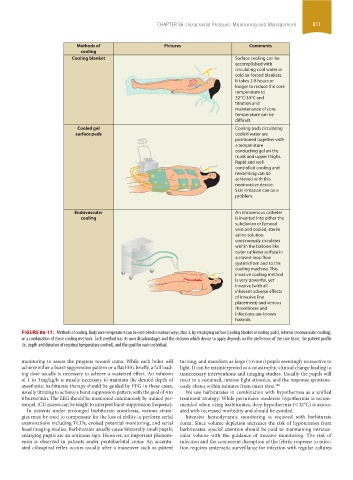
                    FIGURE 86-17.  Methods of cooling. Body core temperature can be controlled in various ways, that is, by employing surface (cooling blanket or cooling pads), internal (endovascular  cooling),
                    or a combination of these cooling methods. Each method has its own disadvantages and the decision which device to apply depends on the preference of the care team, the patient profile
                    (ie, depth and duration of required temperature control), and the goal for each individual.


                    monitoring to assess the progress toward coma. While each bolus will   turning, and manifests as large (>6 mm) pupils seemingly unreactive to
                    achieve either a burst-suppression pattern or a flat EEG briefly, a full load-  light. It can be misinterpreted as a catastrophic clinical change leading to
                    ing dose usually is necessary to achieve a sustained effect. An infusion   unnecessary interventions and imaging studies. Usually the pupils will
                    of 1 to 3 mg/kg/h is usually necessary to maintain the desired depth of   react to a sustained, intense light stimulus, and the response spontane-
                    anesthesia; barbiturate therapy should be guided by EEG in these cases,   ously abates within minutes from onset time. 140
                    usually titrating to achieve a burst suppression pattern with the goal of 4 to   We use barbiturates in combination with hypothermia as a unified
                    6 bursts/min. The EEG should be monitored continuously by trained per-  treatment strategy. While permissive moderate hypothermia is recom-
                    sonnel. ICU nurses can be taught to interpret burst-suppression frequency.  mended when using barbiturates, deep hypothermia (<32°C) is associ-
                     In patients under prolonged  barbiturate  anesthesia,  various strate-  ated with increased morbidity and should be avoided.
                    gies must be used to compensate for the loss of ability to perform serial   Intensive hemodynamic monitoring is required with barbiturate
                    examinations including TCDs, evoked potential monitoring, and serial   coma. Since volume depletion increases the risk of hypotension from
                    head imaging studies. Barbiturates usually cause bilaterally small pupils;   barbiturates, special attention should be paid to maintaining intravas-
                    enlarging pupils are an ominous sign. However, an important phenom-  cular volume with the guidance of invasive monitoring. The risk of
                    enon is observed in patients under pentobarbital coma: An accentu-  infection and the concurrent disruption of the febrile response to infec-
                    ated ciliospinal reflex occurs usually after a maneuver such as patient   tion requires systematic surveillance for infection with regular cultures


            section06.indd   811                                                                                       1/23/2015   12:56:08 PM

