


Page 1173 - Hall et al (2015) Principles of Critical Care-McGraw-Hill
P. 1173
812     PART 6: Neurologic Disorders


                 (at least every other day) of endotracheal secretions, urine, and blood.   can be safely performed to a P CO 2  of 30 mm Hg, and perhaps to less than
                 The long half-life of pentobarbital (approximately 24 hours) leads to   25 mm Hg in selected patients without consequent cerebral ischemia.
                                                                                                                         147
                 slow recovery, even when abruptly stopped. Shivering is common during   Furthermore, it has been shown that hyperoxia can transiently improve
                 the recovery period from barbiturate anesthesia and may require treat-  oxygen delivery to the brain during hyperventilation. 148
                 ment with opiates or short-acting sedatives (eg, propofol). In addition,   The potential benefits of hyperventilation must be balanced against
                 chaotic EEG patterns are common and are often misinterpreted as status   the potential deleterious consequences, including but not limited
                 epilepticus.                                          to diminished cardiac filling pressures with resultant hypotension,
                   In place of barbiturates, propofol and other sedatives have been   decreased myocardial oxygen supply with an increase in myocardial
                 used to induce sedation and coma and have been shown to be safe and   demand, elevation in mean airway pressure leading to accentuation of
                 effective (see Table 86-14).  In addition to neural suppression caused   intracranial hypertension, electrolyte disturbances (eg, alkalosis, hypo-
                                     141
                 by  activation of  the  γ-aminobutyric  acid  A receptor  and inhibition   kalemia, and hyperchloremia), and cardiac arrhythmias. 149
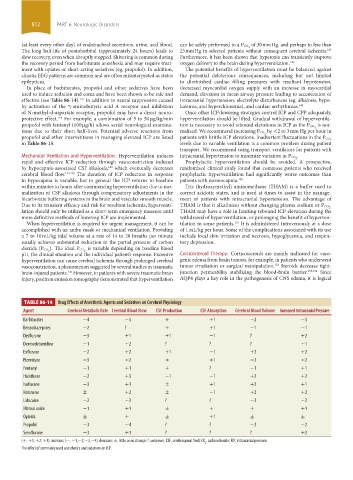
                 of N-methyl-d-aspartate receptor, propofol may have a direct neuro-  Once other ICP-lowering strategies control ICP and CPP adequately,
                 protective effect.  For example, a combination of 5 to 50 µg/kg/min     hyperventilation should be lifted. Gradual withdrawal of hyperventila-
                              142
                 propofol with fentanyl (100 µg/h) allows serial neurological examina-  tion is necessary to avoid rebound elevations in ICP as the P CO 2  is nor-
                 tions due to their short half-lives. Potential adverse reactions from   malized. We recommend increasing P CO 2  by <2 to 3 mm Hg per hour in
                 propofol and other interventions in managing elevated ICP are listed   patients with brittle ICP elevations. Inadvertent fluctuations in the P CO 2
                 in Table 86-15.                                       levels due to variable ventilation is a common problem during patient
                                                                       transport. We recommend using transport ventilators for patients with
                 Mechanical Ventilation and Hyperventilation:  Hyperventilation induces   intracranial hypertension to minimize variation in P CO 2 .
                 rapid and  effective  ICP reduction through  vasoconstriction induced   Prophylactic hyperventilation should be avoided. A prospective,
                 by hypocapnia-associated CSF alkalosis,  which eventually decreases   randomized clinical study found that comatose patients who received
                                               143
                 cerebral blood flow. 144,145  The duration of ICP reduction in response   prophylactic  hyperventilation  had  significantly  worse  outcomes  than
                 to hypocapnia is variable, but in general the ICP returns to baseline   patients with normocapnia. 150
                 within minutes to hours after commencing hyperventilation due to nor-  Tris  (hydroxymethyl)  aminomethane  (THAM)  is  a  buffer  used  to
                 malization of CSF alkalosis through compensatory adjustments in the   correct acidotic states, and is used at times to assist in the manage-
                   bicarbonate buffering systems in the brain and vascular smooth muscle.   ment of patients with intracranial hypertension. The advantage of
                 Due to its transient efficacy and risk for resultant ischemia, hyperventi-  THAM is that it alkalinizes without changing plasma sodium or P CO 2 .
                 lation should only be utilized as a short-term emergency measure until   THAM may have a role in limiting rebound ICP elevation during the
                 more definitive methods of lowering ICP are implemented.  withdrawal of hyperventilation, or prolonging the benefit of hyperven-
                   When hyperventilation is required for urgent management, it can be   tilation in some patients.  It is administered intravenously at a dose
                                                                                          151
                 accomplished with an ambu mask or mechanical ventilation. Providing   of 1 mL/kg per hour. Some of the complications associated with its use
                 a 7 to 10 mL/kg tidal volume at a rate of 14 to 20 breaths per minute   include local skin irritation and necrosis, hypoglycemia, and respira-
                 usually achieves substantial reduction in the partial pressure of carbon   tory depression.
                                         is variable depending on baseline blood
                 dioxide (P CO 2 ). The ideal P CO 2
                 pH, the clinical situation and the individual patient’s response. Excessive   Corticosteroid Therapy:  Corticosteroids are mainly indicated for vaso-
                 hyperventilation can cause cerebral ischemia through prolonged cerebral   genic edema from brain tumors, for example, in patients who underwent
                                                                                                       152
                 vasoconstriction, a phenomenon suggested by several studies in traumatic   tumor irradiation or surgical manipulation.  Steroids decrease tight-
                 brain-injured patients.  However, in patients with severe traumatic brain   junction permeability stabilizing the blood-brain barrier. 153,154  Since
                                 146
                 injury, positron emission tomography demonstrated that hyperventilation   AQP4 plays a key role in the pathogenesis of CNS edema, it is logical

                   TABLE 86-14    Drug Effects of Anesthetic Agents and Sedatives on Cerebral Physiology
                  Agent          Cerebral Metabolic Rate Cerebral Blood Flow  CSF Production  CSF Absorption  Cerebral Blood Volume Increased Intracranial Pressure
                  Barbiturates        −4            −3            +              +1            −2               −3
                  Benzodiazepines     −2            ?             +              +1            −1               −1
                  Desflurane          −3            +1            +1             −1            ?                +2
                  Dexmedetomidine     −1            −2            ?              ?             ?                −1
                  Enflurane           −2            +2            +1             −1            +2               +2
                  Etomidate           −3            −2            +              +1            −2               −2
                  Fentanyl            −1            +1            +              ?             −1               +1
                  Halothane           −2            +3            −1             −1            +2               +2
                  Isoflurane          −3            +1            ±              +1            +2               +1
                  Ketamine            ±             +2            ±              −1            +2               +2
                  Lidocaine           −2            −2            ?              ?             −2               −2
                  Nitrous oxide       −1            +1            ±              +             +                +1
                  Opioids             ±             +             ±              +1            ±                ±
                  Propofol            −3            −4            ?              ?             −2               −2
                  Sevoflurane         −3            +1            ?              ?             ?                +2
                 (+, +1, +2, +3), increase; (−, −1,−2,−3,−4), decrease; ±, little or no change; ?, unknown; CSF, cerebrospinal fluid; CO , carbon dioxide; ICP, intracranial pressure.
                                                                                2
                 The effect of commonly used anesthetics and sedatives on ICP.


            section06.indd   812                                                                                       1/23/2015   12:56:08 PM

