


Page 1261 - Hall et al (2015) Principles of Critical Care-McGraw-Hill
P. 1261
868     PART 7: Hematologic and Oncologic Disorders


                 ALL, but can also occur in patients with AML. Age, peripheral WBC   with the return of normal neutrophil count. In instances of severe
                 count at presentation, detection of blasts in the CSF, and serum LDH   typhlitis, G-CSF treatment may be indicated depending on the timing
                 are risk factors for CNS leukemia in ALL. Thus, CNS chemoprophy-  of leukemia treatment.
                 laxis with intrathecal administration of preservative-free methotrexate
                 (12 mg/m  up to a maximum of 15 mg total) and cytarabine (standard   GENERAL FRAMEWORK FOR MANAGEMENT
                        2
                 and liposomal) are included in all major ALL chemotherapy regimens   OF ACUTE LEUKEMIA
                 in a frequency that depends on the likelihood of active CNS disease.
                                                                    30
                 Intrathecal methotrexate can cause an arachnoiditis, and is therefore   Once the diagnosis of acute leukemia is made, and the subtype deter-
                 coadministered with hydrocortisone (50 mg). CNS chemoprophylaxis   mined (AML vs ALL vs APL), rapid initiation of treatment with an appro-
                 has a positive effect on disease-free and overall survival for patients with   priate regimen (Table 92-3) is indicated. Side effects and complications
                 ALL. Each time that intrathecal chemotherapy is administered, cerebro-  from chemotherapies used in acute leukemia are included in Table 92-4.
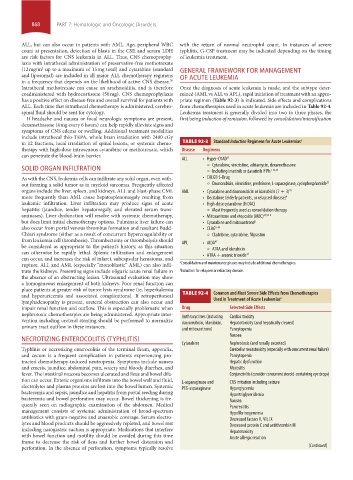
                 spinal fluid should be sent for cytology.             Leukemia treatment is generally divided into two to three phases, the
                   If headache and nausea or focal neurologic symptoms are present,   first being induction of remission, followed by consolidation/intensification
                 dexamethasone (4 mg every 6 hours) can help rapidly alleviate signs and
                 symptoms of CNS edema or swelling. Additional treatment modalities
                 include intrathecal thio-TEPA, whole brain irradiation with 2400 cGy
                 in 12 fractions, local irradiation of spinal lesions, or systemic chemo-    TABLE 92-3    Standard Induction Regimens for Acute Leukemias a
                 therapy with high-dose intravenous cytarabine or methotrexate, which   Disease  Regimens
                 can penetrate the blood-brain barrier.
                                                                        ALL    •  Hyper-CVAD 31
                 SOLID ORGAN INFILTRATION                                       ◦  Cytarabine, vincristine, adriamycin, dexamethasone
                                                                                ◦  Including imatinib or dasatinib if Ph
                                                                                                      +42,54
                 As with the CNS, leukemia cells can infiltrate any solid organ, even with-  •  CALGB 5-Drug
                 out forming a solid tumor as in myeloid sarcomas. Frequently affected   ◦  Daunorubicin, vincristine, prednisone, L-asparaginase, cyclophosphamide 32
                 organs include the liver, spleen, and kidneys. ALL and blast-phase CML   AML  •  Cytarabine and daunorubicin or idarubicin (7 + 3) 59
                 more frequently than AML cause hepatosplenomegaly resulting from   •  Decitabine (elderly patients, or relapsed disease) 4
                 leukemic infiltration. Liver infiltration may produce signs of acute   •  High-dose cytarabine (HiDAC)
                 hepatitis (jaundice, tender hepatomegaly, and elevated serum trans-  ◦  Most frequently used as consolidation therapy
                 aminases). Liver dysfunction will resolve with systemic chemotherapy,   •  Mitoxantrone and etoposide (MEC) 25,52 b
                 but does limit initial chemotherapy options. Fulminate liver failure can   •  Cytarabine and mitoxantrone b
                 also occur from portal venous thrombus formation and resultant Budd-  •  CLAG   b 44
                 Chiari syndrome (either as a result of concurrent hypercoagulability or   ◦  Cladribine, cytarabine, filgrastim
                 from leukemia cell thrombosis). Thrombectomy or thrombolysis should   APL  •  AIDA 47
                 be considered as appropriate to the patient’s history, as this situation   ◦  ATRA and idarubicin
                 can otherwise be rapidly lethal. Splenic infiltration and enlargement   •  ATRA + arsenic trioxide 17
                 can occur, and increases the risk of infarct, subcapsular hematoma, and
                 rupture. ALL and AML (especially “monoblastic” AML) can also infil-  a Consolidation and maintenance phases may include additional chemotherapies.
                 trate the kidneys. Presenting signs include oliguric acute renal failure in   b Induction for relapsed or refractory disease.
                 the absence of an obstructing lesion. Ultrasound evaluation may show
                 a homogeneous enlargement of both kidneys. Poor renal function can
                 place patients at greater risk of tumor lysis syndrome (ie, hyperkalemia
                 and  hyperuricemia  and  associated complications).  If  retroperitoneal     TABLE 92-4     Common and Most Severe Side Effects from Chemotherapies
                                                                                                         a
                 lymphadenopathy is present, ureteral obstruction can also occur and   Used in Treatment of Acute Leukemias
                 impair renal function and outflow. This is especially problematic when   Drug  Selected Side Effects
                 nephrotoxic chemotherapies are being administered. Appropriate inter-  Anthracyclines (including   Cardiac toxicity
                 vention including ureteral stenting should be performed to normalize   daunorubicin, idarubicin,    Hepatotoxicity (and hepatically cleared)
                 urinary tract outflow in these instances.              and mitoxantrone)  Pancytopenia
                                                                                        Nausea
                 NECROTIZING ENTEROCOLITIS (TYPHLITIS)
                                                                        Cytarabine      Nephrotoxic (and renally excreted)
                 Typhlitis or necrotizing enterocolitis of the terminal ileum, appendix,   Cerebellar neurotoxicity (especially with concurrent renal failure)
                 and cecum is a frequent complication in patients experiencing pro-     Pancytopenia
                 tracted chemotherapy-induced neutropenia. Symptoms include nausea      Hepatic dysfunction
                 and emesis, jaundice, abdominal pain, watery and bloody diarrhea, and   Mucositis
                 fever. The intestinal mucosa becomes ulcerated and ileus and bowel dila-  Conjunctivitis (consider concurrent steroid-containing eye drops)
                 tion can occur. Enteric organisms infiltrate into the bowel wall and fluid,   L-asparaginase and    CNS irritation including seizure
                 electrolytes and plasma proteins are lost into the bowel lumen. Systemic   PEG-asparaginase  Hyperglycemia
                 bacteremia and sepsis, jaundice and hepatitis from portal seeding  during   Hypertriglyceridemia
                 bacteremia and bowel perforation may occur. Bowel thickening is fre-   Nausea
                 quently seen on radiographic examination of the abdomen. Medical       Pancreatitis
                 management consists of systemic administration of broad-spectrum       Hypofibrinogenemia
                 antibiotics with gram-negative and anaerobic coverage. Serum electro-  Decreased factors V, VII, IX
                 lytes and blood products should be aggressively repleted, and bowel rest   Decreased protein C and antithrombin III
                 including nasogastric suction is appropriate. Medications that interfere   Hepatotoxicity
                 with bowel function and motility should be avoided during this time    Acute allergic reaction
                 frame to decrease the risk of ileus and further bowel distension and
                   perforation. In the absence of perforation, symptoms typically resolve                          (Continued)


            section07.indd   868                                                                                       1/21/2015   7:42:55 AM

