


Page 1263 - Hall et al (2015) Principles of Critical Care-McGraw-Hill
P. 1263
870     PART 7: Hematologic and Oncologic Disorders


                 plasminogen activator  (t-PA), which  increases  ongoing fibrinolysis     TABLE 92-5    Platelet Transfusion Parameters for Patients with Acute Leukemia 10
                 further propagating DIC.  In addition to careful examination of the
                                    39
                 peripheral smear and bone marrow aspirate for APL cells, diagnostic   Clinical Scenario   Platelet Transfusion Target
                 studies should include polymerase chain reaction (PCR), fluorescent in   Routine platelet transfusion for prophylaxis against bleeding >10,000 platelets/µL
                 situ hybridization (FISH), and cytogenetic analysis to identify the pres-
                 ence of the PML/RAR fusion gene and t(15;17) translocation. 46  “Minor” invasive procedure or active DIC  >50,000 platelets/µL
                   Even before verification of clinically suspected APL by molecular   Suspected CNS bleed  >100,000 platelets/µL
                 studies, treatment of APL with ATRA should begin. The bleeding and   Data from Carlson KS, DeSancho MT. Hematological issues in critically ill patients with cancer. Crit Care
                 clotting complications of APL are a result of undifferentiated circulating   Clin. January 2010;26(1):107-132.
                 APL cells, and differentiation and resolution of the coagulopathy can
                 start with ATRA therapy (45 mg/m  daily in two divided doses).  There is
                                          2
                                                              19
                 little downside to the initiation of ATRA, and if the diagnosis of APL     performed and every effort made to obtain human leukocyte antigen
                 is not verified with molecular studies, ATRA therapy can be discontinued.    antibody (HLA)–matched platelets for the patient.
                 In addition to ATRA, fibrinogen, PT and aPTT levels should be deter-  The transfusion goal for packed red blood cell transfusion has histori-
                 mined as frequently as every 6 hours, and cryoprecipitate and fresh   cally been a hemoglobin concentration above 8 g/dL or a hematocrit of
                 frozen plasma (FFP) should be aggressively administered to normalize   greater than 30%. This is higher than the range suggested for nonleu-
                 clotting parameters. This is a critical part of the initial management of   kemia patients; however, individuals with leukemia are at higher risk
                 APL, and failure to adequately treat DIC with resulting hemorrhage is   of thrombocytopenia-associated bleeding, and the additional reserve is
                 the cause of early mortality in what is considered an otherwise curable   felt to be helpful in this scenario. This is also a group of patients who
                 form of leukemia.                                     are often profoundly hypoalbuminemic, and there is therapeutic benefit
                   Differentiation of APL cells is an important step in management of   from improved oncotic pressure with higher red cell volumes. The one
                 APL, but carries with it the risk of differentiation syndrome. The hall-  caveat is with patients at risk for hyperleukocytosis in which addition of
                 marks of this differentiation syndrome include capillary leak pathophysi-  further cell mass within the bloodstream could tip the balance toward
                 ology and the presence of dyspnea, fever, peripheral edema, hypotension,   hyperviscosity and leukostasis. In these cases, red cell transfusion should
                 acute renal failure, and congestive heart failure. Pulmonary infiltrates   be minimized or avoided until pharmacologic or mechanical cytoreduc-
                 and pericardial and pleural effusions may be seen radiographically.     tion has started and risk of leukostasis resolved.
                                                                    15
                 If differentiation syndrome or ATRA-syndrome is suspected, steroids   There are now thrombopoietic agents such as romiplostim and eltrom-
                 should be administered immediately (10 mg intravenous dexametha-  bopag that are approved for treatment of steroid-refractory thrombocyto-
                 sone twice daily until resolution of symptoms followed by a taper).   penia, but these are not indicated in the acute leukemia population at this
                 ATRA therapy also carries the risk of triggering hyperleukocytosis as   time. They increase platelet counts over the course of days to weeks, and are
                 undifferentiated APL cells within the bone marrow are rapidly released   not appropriate in an acute setting. Furthermore, the effect of these agents
                 into circulation. WBC counts >10,000/m  should prompt consideration   in a leukemic bone marrow is unknown. Similarly, erythroid-stimulating
                                               3
                 of addition of anthracycline (idarubicin is traditionally used) if not   agents are not indicated as the  erythropoietin receptor is expressed in some
                 already included in the induction regimen to acutely bring down the   subtypes of acute leukemia and in vitro studies have suggested that eryth-
                                                                                                                       24,29,51
                 peripheral leukocyte count to prevent this complication.  ropoietin stimulation can provide growth advantage to leukemia cells.
                   ATRA can also cause pseudotumor cerebri. This complication is most
                 common in younger patients receiving ATRA therapy, and should be   DISSEMINATED INTRAVASCULAR COAGULATION
                 managed by a combination of lumbar puncture, acetazolamide, cortico-  A complication of acute leukemia and its treatment is acute disseminated
                 steroids, and narcotic analgesia. 36,46               intravascular coagulation (DIC). All forms of acute leukemia predispose
                                                                       to DIC, but it is especially pronounced and significant in APL. DIC is
                 ANEMIA AND THROMBOCYTOPENIA                           the pathologic activation of the coagulation cascade and fibrinolysis and
                                                                       results in inappropriate consumption of platelets, clotting factors,
                 Patients with acute leukemia frequently present with concurrent anemia   and endogenous anticoagulants. The presence of DIC places patients at
                 and thrombocytopenia, and systemic complications from both can be   risk for venous thromboembolism (VTE) and bleeding and should be
                 severe. Transfusion  of  platelets  and  red  blood  cells  is  indicated,  but   aggressively managed with supportive measures. End-organ damage can
                 cutoffs  for these depend on the  clinical situation,  and consideration   also result from microthrombi deposition, which is common in the renal
                 for infectious complications from CMV-contaminated blood products   glomeruli and predisposes to concurrent acute renal failure. Laboratory
                 should be considered in their selection.              evidence of DIC includes prolonged aPTT, PT, and thrombin time as
                   Prophylactic platelet transfusion is indicated for patients with acute   well as hypofibrinogenemia and thrombocytopenia. D-dimer and fibrin
                 leukemia when the platelet count is less than 10,000/m  in order to   degradation products are also markedly elevated. As with all patients
                                                           3
                 decrease the risk of bleeding or at higher platelet numbers if there is   with DIC, treatment of the underlying pathology is critical for resolution
                 active bleeding (ie, epistaxis, significant gingival bleeding, GI bleeding).   of the consumptive coagulopathy. Acute DIC will resolve as the degree of
                 For patients undergoing major surgery or procedures such as central   leukemic burden diminishes, but patients will often persist with chronic
                 venous catheter placement, bronchoscopy, lumbar puncture, thoracen-  low-level DIC for an extended period following induction therapy.
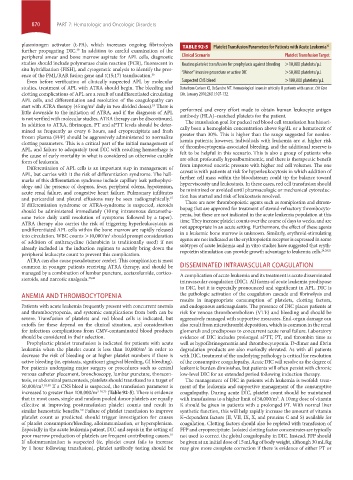
                 tesis, or abdominal paracentesis, platelets should transfused to a target of   The management of DIC in patients with leukemia is twofold: treat-
                 50,000/m .   If a CNS bleed is suspected, the transfusion parameter is   ment of the leukemia and supportive management of the consumptive
                        3 10,50
                 increased to greater than 100,000/m   3 10,23  (Table 92-5). There is evidence   coagulopathy.  During  acute DIC,  platelet  count  should  be  maintained
                 that in most cases, single and random pooled donor platelets are equally   with transfusions to a higher limit of 50,000/m . A 10 mg dose of vitamin
                                                                                                        3
                 effective at improving posttransfusion platelet counts and result in   K should be given in patients with a prolonged PT. With normal liver
                 similar hemostatic benefits.  Failure of platelet transfusion to improve   synthetic function, this will help rapidly increase the amount of vitamin
                                     50
                 platelet count as predicted should trigger investigation for causes    K–dependent factors (II, VII, IX, X, and proteins C and S) available for
                 of platelet consumption/bleeding, alloimmunization, or hypersplenism.   coagulation. Clotting factors should also be repleted with transfusion of
                 Especially in the acute leukemia patient, DIC and sepsis in the setting of   FFP and cryoprecipitate. Isolated clotting factor concentrates are typically
                 poor marrow production of platelets are frequent contributing causes.    not used to correct the global coagulopathy in DIC. Instead, FFP should
                                                                    10
                 If alloimmunization is suspected (ie, platelet count fails to increase   be given at an initial dose of 15 mL/kg of body weight, although 30 mL/kg
                 by 1 hour following transfusion), platelet antibody testing should be   may give more complete correction if there is evidence of either PT or


            section07.indd   870                                                                                       1/21/2015   7:42:56 AM

