


Page 1262 - Hall et al (2015) Principles of Critical Care-McGraw-Hill
P. 1262
CHAPTER 92: Acute Leukemia  869


                      TABLE 92-4     Common and Most Severe Side Effects from Chemotherapies    Induction of  Consolidation
                                                      a
                               Used in Treatment of Acute Leukemias (Continued)  remission      of remission  Maintenance
                                                                                   (CR1)
                    Drug             Selected Side Effects
                    ATRA             Leukocytosis (during APL treatment)
                                     Differentiation/retinoic acid syndrome
                                     Pseudotumor cerebri                                         No CR or
                                     Transaminitis                                               relapse
                                     Birth defects if used during pregnancy
                    Arsenic trioxide  Tachycardia
                                     QT interval prolongation
                                     Hypokalemia                                               Induction of
                                     Hyperglycemia                                Allo-SCT      remission
                                     Hypomagnesemia                                               (CR2)
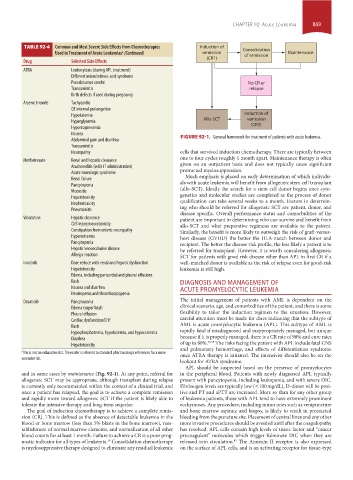
                                     Nausea                               FIGURE 92-1.  General framework for treatment of patients with acute leukemia.
                                     Abdominal pain and diarrhea
                                     Transaminitis
                                     Neuropathy                           cells that survived induction chemotherapy. There are typically between
                                                                          one to four cycles roughly 1 month apart. Maintenance therapy is often
                    Methotrexate     Renal and hepatic clearance
                                     Arachnoiditis (with IT administration)  given on an outpatient basis and does not typically cause significant
                                                                          protracted myelosuppression.
                                     Acute neurologic syndrome
                                                                           Much emphasis is placed on early determination of which individu-
                                     Renal failure                        als with acute leukemia will benefit from allogeneic stem cell transplant
                                     Pancytopenia
                                     Mucositis                            (allo-SCT). Ideally the search for a stem cell donor begins once cyto-
                                                                          genetics and molecular studies are completed as the process of donor
                                     Hepatotoxicity
                                     Nephrotoxicity                       qualification can take several weeks to a month. Factors in determin-
                                                                          ing who should be referred for allogeneic SCT are patient, donor, and
                                     Pneumonitis
                                                                          disease specific. Overall performance status and comorbidities of the
                    Vincristine      Hepatic clearance                    patient are important in determining who can survive and benefit from
                                     CNS injury/neurotoxicity             allo-SCT  and  what  preparative  regimens  are  available  to  the  patient.
                                     Constipation from enteric neuropathy  Similarly, the benefit is more likely to outweigh the risk of graft-versus-
                                     Hyperuricemia                        host disease (GVHD) the better the HLA-match between donor and
                                     Pancytopenia                         recipient. The better the disease risk profile, the less likely a patient is to
                                     Hepatic venoocclusive disease        be referred for transplant. However, it is worth considering allogeneic
                                     Allergic reaction                    SCT for patients with good risk disease other than APL in first CR if a
                    Imatinib         Dose reduce with renal and hepatic dysfunction  well-matched donor is available as the risk of relapse even for good-risk
                                     Hepatotoxicity                       leukemia is still high.
                                     Edema, including pericardial and pleural  effusions
                                     Rash                                 DIAGNOSIS AND MANAGEMENT OF
                                     Nausea and diarrhea                  ACUTE PROMYELOCYTIC LEUKEMIA
                                     Neutropenia and thrombocytopenia
                    Dasatinib        Pancytopenia                         The initial management of patients with AML is dependent on the
                                     Edema (superficial)                  clinical scenario, age, and comorbidities of the patient, and there is some
                                     Pleural effusion                     flexibility to tailor the induction regimen to the situation. However,
                                     Cardiac dysfunction/CHF              careful attention must be made for clues indicating that the subtype of
                                     Rash                                 AML is acute promyelocytic leukemia (APL). This subtype of AML is
                                     Hypophosphatemia, hypokalemia, and hypocalcemia  rapidly fatal if misdiagnosed and inappropriately managed, but unique
                                     Diarrhea                             because if it is properly managed, there is a CR rate of 90% and cure rates
                                                                                   46,48
                                     Hepatotoxicity                       of up to 80%.   The risks facing the patient with APL include fatal CNS
                                                                          and pulmonary hemorrhage, and effects of differentiation syndrome
                    a This is not an exhaustive list. The reader is referred to standard pharmacologic references for a more   once ATRA therapy is initiated. The intensivist should also be on the
                    extensive list.
                                                                          lookout for ATRA syndrome.
                                                                           APL should be suspected based on the presence of promyelocytes
                    and in some cases by maintenance (Fig. 92-1). At any point, referral for   in the peripheral blood. Patients with newly diagnosed APL typically
                    allogeneic SCT may be appropriate, although transplant during relapse   present with pancytopenia, including leukopenia, and with severe DIC.
                    is currently only recommended within the context of a clinical trial, and   Fibrinogen levels are typically low (<100 mg/dL), D-dimer will be posi-
                    once a patient has relapsed, the goal is to achieve a complete remission   tive and PT and aPTT are increased. More so than for any other group
                    and rapidly move toward allogeneic SCT if the patient is likely able to   of leukemia patients, those with APL tend to have extremely prominent
                    tolerate the intensive therapy and long-term sequelae.  ecchymoses. Any procedure, including minor ones such as venipuncture
                     The goal of induction chemotherapy is to achieve a complete remis-  and bone marrow aspirate and biopsy, is likely to result in protracted
                    sion (CR). This is defined as the absence of detectable leukemia in the   bleeding from the puncture site. Placement of central lines and any other
                    blood or bone marrow (less than 5% blasts in the bone marrow), rees-  more invasive procedures should be avoided until after the coagulopathy
                    tablishment of normal marrow elements, and normalization of all other   has resolved. APL cells contain high levels of tissue factor and “cancer
                    blood counts for at least 1 month. Failure to achieve a CR is a poor prog-  procoagulant” molecules which trigger fulminate DIC when they are
                    nostic indicator for all types of leukemia.  Consolidation chemotherapy   released into circulation.  The Annexin II  receptor is also expressed
                                                                                            43
                                                 18
                    is myelosuppressive therapy designed to eliminate any residual leukemic   on the surface of APL cells, and is an activating receptor for tissue-type


            section07.indd   869                                                                                       1/21/2015   7:42:55 AM

