


Page 1264 - Hall et al (2015) Principles of Critical Care-McGraw-Hill
P. 1264
CHAPTER 92: Acute Leukemia  871


                    aPTT prolongation. FFP transfusion can give a significant fluid volume,   intravenous fluids that do not contain potassium is critical for  preventing
                    so attention should be paid to the patient’s overall clinical status during   clinical consequences of TLS. Hydration targets in adults should be
                    plasma infusions and diuresis should match the additional fluid load.   three to four times daily maintenance fluid requirements and urine
                    With severe hypofibrinogenemia (<1 g/L), cryoprecipitate or fibrinogen   output of at least 100 mL/h.  A trial of furosemide may also be helpful
                                                                                              49
                    concentrate  should  also  be  given.  Plasma  fibrinogen  will  increase  on   in maintaining urine output in volume repleted patients, although this is
                    average 100 mg/dL for every 3 g dose of fibrinogen administered as either   controversial given the risk for further renal injury. It is critical to keep a
                    two cryoprecipitate pools (10 donor units) or as 3 g of fibrinogen con-  close measurement of urine output during the initial treatment of acute
                    centrate. 16,34  The one exception to this is for patients with ALL who are   leukemias while maintaining this degree of hydration as patients are at
                    hypofibrinogenemic following L-asparaginase therapy. These patients are   high risk for pulmonary congestion and fluid overload. 40
                    at further increased risk of DIC and especially of thrombosis. In addition   Historically, urinary alkalinization has been used for prevention of
                    to decreased fibrinogen levels, this patient group also tends to develop   TLS. However, there is increasing evidence that systemic alkalinization
                    low  levels  of antithrombin-III  which  is  also  prothrombotic.   Studies   is both ineffective at preventing urate-induced nephropathy, and can
                                                                28
                    are underway investigating the use of antithrombin concentrates for the   precipitate worsening renal function and TLS-associated electrolyte
                    management of DIC in this high-risk population.       disturbances. The current recommendation is against routine systemic
                                                                          alkalinization for treatment or prevention of TLS. 40
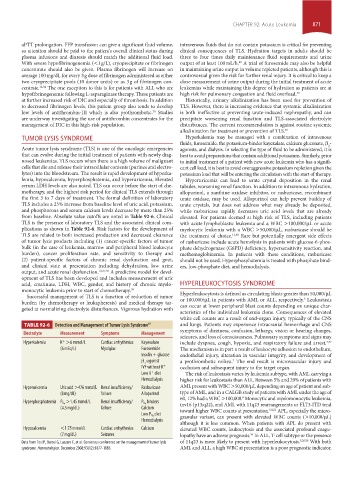
                    TUMOR LYSIS SYNDROME                                   Hyperkalemia may be managed with a combination of intravenous
                                                                          fluids, furosemide, the potassium-binder kayexalate, calcium gluconate, β -
                                                                                                                            2
                    Acute tumor lysis syndrome (TLS) is one of the oncologic emergencies   agonists, and dialysis. In selecting the type of fluid to be  administered, it is
                    that can evolve during the initial treatment of patients with newly diag-  best to avoid preparations that contain additional potassium. Similarly, prior
                    nosed leukemias. TLS occurs when there is a high volume of malignant   to initial treatment of a patient with new acute leukemia who has a signifi-
                    cells that die and release their intracellular contents (purines and electro-  cant cell load, it is best to avoid overaggressive potassium repletion given the
                    lytes) into the bloodstream. The result is rapid development of hyperka-  potassium load that will be entering the circulation with the start of therapy.
                    lemia, hypocalcemia, hyperphosphatemia, and hyperuricemia. Elevated   Hyperuricemia  can  lead  to  urate  crystal  deposition  in  the  renal
                    serum LDH levels are also noted. TLS can occur before the start of che-  tubules, worsening renal function. In addition to intravenous hydration,
                    motherapy, and the highest risk period for clinical TLS extends through   allopurinol, a xanthine oxidase inhibitor, or rasburicase, recombinant
                    the first 3 to 7 days of treatment. The formal definition of laboratory   urate oxidase, may be used. Allopurinol can help prevent buildup of
                    TLS includes a 25% increase from baseline level of uric acid, potassium,   urate crystals, but does not address what may already be deposited,
                    and phosphorous and serum calcium levels decrease by more than 25%   while rasburicase rapidly decreases uric acid levels that are already
                    from baseline. Absolute value cutoffs are noted in Table 92-6. Clinical   elevated. For patients deemed at high risk of TLS, including patients
                    TLS is the presence of laboratory TLS and the associated clinical com-  with acute lymphoblastic leukemia and a WBC >100,000/µL or acute
                    plications as shown in Table 92-6. Risk factors for the development of    myelocytic leukemia with a WBC >50,000/µL, rasburicase should be
                    TLS are related to both increased production and decreased clearance   the treatment of choice. 11,40  Rare but potentially emergent side effects
                    of tumor lysis products including (1) cancer-specific factors of tumor   of rasburicase include acute hemolysis in patients with glucose-6-phos-
                    bulk (in the case of leukemia, marrow and peripheral blood leukocyte    phate dehydrogenase (G6PD) deficiency, hypersensitivity reaction, and
                    burden), cancer proliferation rate, and sensitivity to therapy and     methemoglobinemia. In patients with these conditions, rasburicase
                    (2) patient-specific factors of chronic renal dysfunction and gout,    should not be used. Hyperphosphatemia is treated with phosphate bind-
                    and clinical state at presentation including dehydration, low urine   ers, low-phosphate diet, and hemodialysis.
                    output, and acute renal dysfunction. 14,27,38  A predictive model for devel-
                    opment of TLS has been developed and includes measurement of uric
                    acid, creatinine, LDH, WBC, gender, and history of chronic myelo-  HYPERLEUKOCYTOSIS SYNDROME
                    monocytic leukemia prior to start of chemotherapy. 38  Hyperleukocytosis is defined as circulating blasts greater than 50,000/µL
                     Successful management of TLS is a function of reduction of tumor                               5
                    burden (by chemotherapy or leukapheresis) and medical therapy tar-  or 100,000/µL in patients with AML or ALL, respectively.  Leukostasis
                                                                          can occur at lower peripheral blast counts depending on unique char-
                    geted at normalizing electrolyte disturbances. Vigorous hydration with
                                                                          acteristics of the individual leukemia clone. Consequences of elevated
                                                                          white cell counts are a result of end-organ injury, typically of the CNS
                      TABLE 92-6    Detection and Management of Tumor Lysis Syndrome 55  and lungs. Patients may experience intracranial hemorrhage and CNS
                                                                          symptoms of dizziness, confusion, lethargy, vision or hearing changes,
                    Electrolyte  Measurement   Symptoms     Management
                                                                          seizures, and loss of consciousness. Pulmonary symptoms and signs may
                    Hyperkalemia  K  >6 mmol/L   Cardiac arrhythmias  Kayexalate  include dyspnea, cough, hypoxia, and respiratory failure and arrest.
                                  +
                                                                                                                           7,37
                                 (6 mEq/L)     Myalgias     Furosemide    The mechanism is in part a result of leukocyte adhesion to endothelium,
                                                            Insulin + glucose  endothelial injury, alteration in vascular integrity, and development of
                                                            β -agonist    a prothrombotic milieu.  The end result is microvascular injury and
                                                                                            7
                                                              2
                                                            IVF without K +  occlusion and subsequent injury to the target organ.
                                                                +
                                                            Low K  diet    The risk of leukostasis varies by leukemia subtype, with AML carrying a
                                                            Hemodialysis  higher risk for leukostasis than ALL. Between 5% and 29% of patients with
                    Hyperuricemia  Uric acid >476 mmol/L  Renal insufficiency/  Rasburicase  AML present with WBC >50,000/µL depending on age of patient and sub-
                                 (8 mg/dL)     failure      Allopurinol   type of AML, and in a CALGB study of patients with AML under the age of
                                                                          60, 12% had a WBC >100,000.  Monocytic and myelomonocytic leukemia,
                                                                                               8
                                   >1.45 mmol/L    Renal insufficiency/   binders
                    Hyperphosphatemia P O 4                 P O 4         inv16 (p13;q22), and AML with 11q23 rearrangements or FLT3-ITD tend
                                 (4.5 mg/dL)   failure      Calcium       toward higher WBC counts at  presentation. 5,8,21  APL, especially the micro-
                                                                  diet
                                                            Low P O 4     granular variant, can present with elevated WBC counts (>10,000/µL)
                                                            Hemodialysis
                                                                          although it is less common. When patients with APL do present with
                    Hypocalcemia  <1.75 mmol/L    Cardiac arrhythmias  Calcium  elevated WBC counts, leukocytosis and the associated profound coagu-
                                 (7 mg/dL)     Seizures                   lopathy have an adverse prognosis.  In ALL, T-cell subtype or the presence
                                                                                                  56
                    Data from Tosi P, Barosi G, Lazzaro C, et al. Consensus conference on the management of tumor lysis   of 11q23 is more likely to present with  hyperleukocytosis. 5,26,58  With both
                    syndrome. Haematologica. December 2008;93(12):1877-1885.  AML and ALL, a high WBC at presentation is a poor prognostic indicator.


            section07.indd   871                                                                                       1/21/2015   7:42:56 AM

