


Page 1266 - Hall et al (2015) Principles of Critical Care-McGraw-Hill
P. 1266
CHAPTER 93: Oncologic Emergencies  873


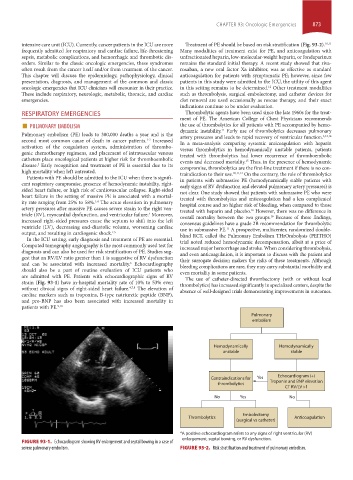
                    intensive care unit (ICU). Currently, cancer patients in the ICU are more   Treatment of PE should be based on risk stratification (Fig. 93-2). 10,11
                    frequently admitted for respiratory and cardiac failure, life-threatening   Many modalities of treatment exist for PE, and anticoagulation with
                    sepsis, metabolic complications, and hemorrhagic and thrombotic dis-  unfractionated heparin, low-molecular-weight heparin, or fondaparinux
                    orders. Similar to the classic oncologic emergencies, these syndromes   remains the standard initial therapy. A recent study showed that riva-
                    often result from the cancer itself and/or from treatment of the cancer.   roxaban,  a new  oral  factor  Xa  inhibitor,  was  as  effective  as standard
                    This chapter will discuss the epidemiology, pathophysiology, clinical   anticoagulation for patients with symptomatic PE; however, since few
                    presentation, diagnosis, and management of the common and classic     patients in this study were admitted to the ICU, the utility of this agent
                    oncologic emergencies that ICU clinicians will encounter in their practice.   in this setting remains to be determined.  Other treatment modalities
                                                                                                        12
                    These include respiratory, neurologic, metabolic, thoracic, and cardiac   such as thrombolysis, surgical embolectomy, and catheter devices for
                    emergencies.                                          clot removal are  used occasionally as rescue therapy, and their exact
                                                                          indications continue to be under evaluation.
                                                                           Thrombolytic agents have been used since the late 1960s for the treat-
                    RESPIRATORY EMERGENCIES                               ment of PE. The American College of Chest Physicians recommends
                        ■  PULMONARY EMBOLISM                             the use of thrombolytics for all patients with PE accompanied by hemo-
                                                                                        11
                    Pulmonary embolism (PE) leads to 300,000 deaths a year and is the   dynamic instability.  Early use of thrombolytics decreases pulmonary
                                                                          artery pressures and leads to rapid recovery of ventricular function.
                                                                                                                          3,13,14
                    second most common cause of death in cancer patients.  Increased   In  a  meta-analysis  comparing  systemic  anticoagulation  with  heparin
                                                              1-3
                    activation of the coagulation system, administration of thrombo-  versus thrombolytics in hemodynamically unstable patients, patients
                    genic chemotherapy regimens, and placement of intravascular venous   treated with thrombolytics had lower recurrence of thromboembolic
                      catheters place oncological patients at higher risk for thromboembolic   events and decreased mortality.  Thus, in the presence of hemodynamic
                                                                                                15
                    disease.  Early recognition and treatment of PE is essential due to its   compromise, thrombolytics are the first-line treatment if there is no con-
                         3
                    high mortality when left untreated.                   traindication to their use. 10,11,13  On the contrary, the role of thrombolytics
                     Patients with PE should be admitted to the ICU when there is signifi-  in  patients with  submassive  PE  (hemodynamically  stable  patients  with
                    cant respiratory compromise, presence of hemodynamic instability, right-  early signs of RV dysfunction and elevated pulmonary artery pressures) is
                    sided heart failure, or high risk of cardiovascular collapse. Right-sided    not clear. One study showed that patients with submassive PE who were
                    heart failure in the setting of massive PE is associated with a mortal-  treated with thrombolytics and anticoagulation had a less complicated
                    ity rate ranging from 25% to 58%.  The acute elevation in pulmonary   hospital course and no higher risk of bleeding, when compared to those
                                             1,4
                    artery pressures after massive PE causes severe strain to the right ven-  treated with heparin and placebo.  However, there was no difference in
                                                                                                  16
                    tricle (RV), myocardial dysfunction, and ventricular failure.  Moreover,   overall mortality between the two groups.  Because of these findings,
                                                               5
                                                                                                        16
                    increased right-sided pressures cause the septum to shift into the left   consensus guidelines have a grade 2B recommendation for thrombolytic
                    ventricle (LV), decreasing end-diastolic volume, worsening cardiac     use in submassive PE.  A prospective, multicenter, randomized double-
                                                                                         11
                    output, and resulting in cardiogenic shock. 1,5       blind RCT, called the Pulmonary Embolism THrOmbolysis (PEITHO)
                     In the ICU setting, early diagnosis and treatment of PE are essential.   trial noted reduced hemodynamic decompensation, albeit at a price of
                    Computed tomography angiography is the most commonly used test for   increased major hemorrhage and stroke. When considering thrombolysis,
                    diagnosis and can also be used for risk stratification of PE. Studies sug-  and even anticoagulation, it is important to discuss with the patient and
                    gest that an RV/LV ratio greater than 1 is suggestive of RV  dysfunction   their surrogate decision makers the risks of these treatments. Although
                    and can be associated with increased mortality.  Echocardiography   bleeding complications are rare, they may carry substantial morbidity and
                                                         6
                    should also be a part of routine evaluation of ICU patients who   even mortality in some patients.
                    are admitted with PE. Patients with echocardiographic signs of RV   The use of catheter-directed thrombectomy (with or without local
                    strain (Fig. 93-1) have in-hospital mortality rate of 10% to 53% even     thrombolytics) has increased significantly in specialized centers, despite the
                    without clinical signs of right-sided heart failure. 4,7,8  The elevation of    absence of well-designed trials demonstrating improvements in outcomes.
                    cardiac markers such as troponins, B-type natriuretic peptide (BNP),
                    and pro-BNP has also been associated with increased mortality in
                    patients with PE. 9,10
                                                                                                  Pulmonary
                                                                                                  embolism


                                                                                     Hemodynamically       Hemodynamically
                                                                                        unstable               stable


                                                                                    Contraindications for  Yes  Echocardiogram (+)
                                                                                      thrombolytics     Troponin and BNP elevation
                                                                                                             CT RV/LV >1
                                                                                     No       Yes              No


                                                                                               Embolectomy
                                                                            Thrombolytics                        Anticoagulation
                                                                                             (surgical vs catheter)
                                                                          a A positive echocardiogram refers to any signs of right ventricular (RV)
                                                                            enlargement, septal bowing, or RV dysfunction.
                    FIGURE 93-1.  Echocardiogram showing RV enlargement and septal bowing in a case of
                    severe pulmonary embolism.                            FIGURE 93-2.  Risk stratification and treatment of pulmonary embolism.


            section07.indd   873                                                                                       1/21/2015   7:42:57 AM

