


Page 1269 - Hall et al (2015) Principles of Critical Care-McGraw-Hill
P. 1269
876     PART 7: Hematologic and Oncologic Disorders


                 suggests direct invasion of the tumor into the epidural space; radicular,   the patient’s overall status and prognosis before undergoing any surgical
                 which may be caused by impingement of nerve roots; and pain that   procedure. 64
                 worsens with movement due to instability of the spine after vertebral   Corticosteroids should be administered as soon as the diagnosis of
                 body collapse.  Rodichok et al demonstrated that over 60% of patients   MSCC is made. These agents not only decrease edema, but may also
                           64
                 with cancer complaining of back pain had compression of the epidural   have a direct effect on tumor destruction such as in cases of lymphoma.
                                                                                                                          64
                 space by tumor even if no neurological deficits were present.  Motor   Sorensen et al reported that administration of intravenous IV dexa-
                                                               67
                 deficits are also common during MSCC; 35% to 75% of patients com-  methasone prior to radiotherapy and for a total of 10 days decreased
                 plain of a certain degree of weakness on presentation, and about 50% to   pain and improved neurologic function.  When comparing 100 mg iv
                                                                                                     77
                 68% of patients diagnosed with MSCC cannot walk before initiation of   bolus to 10 mg iv bolus of dexamethasone, there was no difference in
                 treatment. 60,68  Hamamoto et al observed that motor deficits were present   pain reduction, survival, or neurological outcome. 78
                 in 54% of patients with middle thoracic spine involvement, 30% with   Spinal stereotactic  radiosurgery,  percutaneous  vertebroplasty, and
                 lower lumbar spine, and 15% with cervical spine involvement.  Sensory   kyphoplasty are being considered more localized and less invasive methods
                                                              66
                 deficits can also be present in about 50% to 70% of cases, but are usually   of treatment of MSCC. While some studies have shown promising results,
                 not recognized by the patients.  Autonomic dysfunction, presenting   they are still not widely used and are still considered experimental. 64,79
                                         68
                 with bowel and bladder incontinence, occurs late in the progression of
                 disease and is a poor prognostic factor for recovery. 60,64,68    ■  INTRACRANIAL HEMORRHAGE
                   The gold standard for diagnosis of MSCC is MRI. Prior to MRI, spine   The prevalence of cerebrovascular accidents in the oncological popula-
                 radiographs, CT scans, and myelograms were performed until studies   tion is approximately 15%, with intracranial hemorrhage (ICH) being
                 proved that MRI was the most cost-effective method for diagnosis of   more common than ischemic disease. 80-82  Hematologic cancer patients,
                 MSCC.  All patients suspected with MSCC should have a whole spine   when compared to patients with solid tumors, have a higher incidence
                      69
                 MRI as 17% to 30% of patients have multiple spinal lesions. These   of ICH and a worse outcome.  In comparison to the general popula-
                                                                                             82
                 lesions should be characterized for risk stratification for SCC.  Patients   tion, hypertension and amyloid angiopathy are rarely causes of ICH in
                                                              63
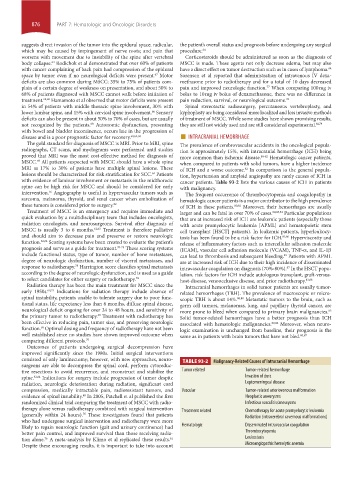
                 with evidence of laminar involvement or metastasis in the midthoracic   cancer patients. Table 93-2 lists the various causes of ICH in patients
                 spine can be high risk for MSCC and should be considered for early   with malignancy.
                 intervention.  Angiography is useful in hypervascular tumors such as   The frequent occurrence of thrombocytopenia and coagulopathy in
                           66
                 sarcoma, melanoma, thyroid, and renal cancer when embolization of   hematologic cancer patients is a major contributor to the high prevalence
                 these tumors is considered prior to surgery. 62       of ICH in these patients. 80,83  Moreover, their hemorrhages are usually
                   Treatment of MSCC is an emergency and requires immediate and   larger and can be fatal in over 70% of cases. 80,83,84  Particular populations
                 quick evaluation by a multidisciplinary team that includes oncologists,   that are at increased risk of ICH are leukemic patients (especially those
                 radiation oncologists, and neurosurgeons. Survival after diagnosis of   with acute promyelocytic leukemia [APML] and hematopoietic stem
                 MSCC is usually 3 to 6 months. 61,63  Treatment is therefore palliative   cell transplant [HSCT] patients). In leukemic patients, hyperleukocy-
                 and should aim to decrease pain and preserve or restore neurologic   tosis has been found to be a risk factor for ICH. 85,86  Hyperviscosity and
                 function. 62,64  Scoring systems have been created to evaluate the patient’s   release of inflammatory factors such as intercellular adhesion molecule
                 prognosis and serve as a guide for treatment. 70-73  These scoring systems   (ICAM), vascular cell adhesion molecule (VCAM), TNF-α, and IL-1β
                 include functional status, type of tumor, number of bone metastases,   can lead to thrombosis and subsequent bleeding.  Patients with APML
                                                                                                           85
                 degree of neurologic dysfunction, number of visceral metastases, and   are at increased risk of ICH due to their high incidence of disseminated
                 response to radiotherapy.  Harrington score classifies spinal metastasis   intravascular coagulation on diagnosis (70%-80%).  In the HSCT popu-
                                   73
                                                                                                            87
                 according to the degree of neurologic dysfunction, and is used as a guide   lation, risk factors for ICH include autologous transplant, graft-versus-
                 to select candidates for either surgery or radiotherapy. 74  host-disease, venoocclusive disease, and prior radiotherapy. 83,88
                   Radiation therapy has been the main treatment for MSCC since the   Intracranial hemorrhages in solid tumor patients are usually tumor-
                 early 1950s. 60,73  Indications for radiation therapy include absence of   related hemorrhages (TRH). The prevalence of macroscopic or micro-
                 spinal instability, patients unable to tolerate surgery due to poor func-  scopic TRH is about 14%. 80,88  Metastatic tumors to the brain, such as
                 tional status, life expectancy less than 6 months, diffuse spinal disease,   germ cell tumors, melanomas, lung, and papillary thyroid cancer, are
                 neurological deficit ongoing for over 24 to 48 hours, and sensitivity of   more prone to bleed when compared to primary brain malignancies.
                                                                                                                          82
                 the primary tumor to radiotherapy.  Treatment with radiotherapy has   Solid tumor-related hemorrhages have a better prognosis than ICH
                                           68
                 been effective in reducing pain, tumor size, and preserving neurologic   associated with hematologic malignancies. 80,82  Moreover, when neuro-
                 function.  Optimal dosing and frequency of radiotherapy have not been   logic examination is unchanged from baseline, their prognosis is the
                        60
                 well established since no studies have shown improved outcome when   same as in patients with brain tumors that have not bled. 80,87
                 comparing different protocols. 75
                   Outcomes of patients undergoing surgical decompression have
                 improved significantly since the 1980s. Initial surgical interventions
                 consisted of only laminectomy; however, with new approaches, neuro-    TABLE 93-2    Malignancy-Related Causes of Intracranial Hemorrhage
                 surgeons are able to decompress  the spinal cord,  perform  cytoreduc-
                 tive  resections to avoid  recurrence, and reconstruct and  stabilize  the   Tumor related  Tumor-related hemorrhage
                 spine. 61,64  Indications for surgery include progression of tumor despite   Invasion of dura
                 radiation, neurologic deterioration during radiation, significant cord      Leptomeningeal disease
                 compression,  medically  intractable  pain,  radioresistant  tumors,  and   Vascular  Tumor-related arteriovenous malformation
                 evidence of spinal instability.  In 2005, Patchell et al published the first   Neoplastic aneurysms
                                      68
                 randomized clinical trial comparing the treatment of MSCC with radio-       Infectious vasculitis/aneurysms
                 therapy alone versus radiotherapy combined with surgical intervention   Treatment related  Chemotherapy for acute promyelocytic leukemia
                 (generally within 24 hours).  These investigators found that patients       Radiation (intracerebral cavernous malformations)
                                      76
                 who had undergone surgical intervention and radiotherapy were more
                 likely to regain neurologic function (gait and urinary continence) had   Hematologic  Disseminated intravascular coagulation
                 better pain control, and improved survival than those receiving radia-      Thrombocytopenia
                 tion alone.  A meta-analysis by Klimo et al replicated these results.       Leukostasis
                         76
                                                                    61
                 Despite these encouraging results, it is important to take into account     Microangiopathic hemolytic anemia


            section07.indd   876                                                                                       1/21/2015   7:42:58 AM

