


Page 1268 - Hall et al (2015) Principles of Critical Care-McGraw-Hill
P. 1268
CHAPTER 93: Oncologic Emergencies  875


                                                                                                               51
                    NEUROLOGIC EMERGENCIES                                failed to show improved outcomes with this practice.  Levetiracetam and
                        ■  STATUS EPILEPTICUS                             for SE, have also been used effectively. 52,53  After the administration of
                                                                          valproic acid, while not approved by the Food and Drug Administration
                    Status epilepticus (SE) can be a life-threatening emergency when unrec-  any antiepileptic drug, clinical and EEG evaluation should be performed
                                                                          to determine if further seizure activity persists.
                    ognized and left untreated. SE is defined as either a persistent seizure   Refractory status epilepticus (RSE) is defined as seizures that persist
                    for >30 minutes or repeated seizures with no recovery of consciousness   after adding a second line of medication therapy. 45,46  In RSE, only 7.3%
                    between each episode. Importantly, any seizure activity that continues   of patients respond to administration of a second drug, and 2% to a
                    for >5 minutes should be treated as SE. 41,42  The incidence of SE in the   third drug.  Even though there are reports of survival after prolonged
                                                                                  51
                    United States is 18.3 to 41 episodes per 100,000 patients/year and about   periods of SE, the prognosis is poor. 41,42,44  Refractory SE requires further
                    7% of seizures progress to SE.  In the cancer population, about 13% of   workup including reevaluation of administered doses of antiepilep-
                                         41
                    patients experience seizures at some point during the course of their   tic drugs (AED), discontinuation of medications that could decrease
                      disease; 50% of these seizures are secondary to brain metastasis or pri-  the therapeutic levels of AED, and further imaging such as magnetic
                    mary brain tumors.  Nevertheless, the prevalence of SE is no higher in   resonance  imaging (MRI),  position emission tomography (PET),  and
                                  43
                    cancer patients when compared to the general population. 44  single-photon emission  computed  tomography  (SPECT) to  rule  out
                     The causes for SE are the same in the general population and in patients       41
                    with cancer. The  most  common causes are noncompliance  to  medica-  unidentified  structural  pathologies.   After  further  workup  has  been
                                                                          performed, medication-induced coma is the next step in the treatment
                    tions (29%), alcohol intoxication or withdrawal (26%), CNS infection   of RSE. In these cases, continuous EEG monitoring is the most reliable
                    (8%), stroke (6%), tumors (6%), trauma (6%), and anoxic encephalopathy   method for the evaluation of responsiveness to treatment.
                    (6%).  In cancer patients, it is important to rule out malignancy-related   Benzodiazepine  infusion  is  used  for  the  initial  treatment  of  RSE.
                       44
                    causes of SE (Table 93-1). Poor prognostic factors are presence of anoxia,   However, their efficacy becomes reduced with prolonged use.  Surveys
                                                                                                                      42
                    old age, multiple comorbidities, and brain tumors. 41,42  performed in Europe and North America report that barbiturates are the
                     Initial management of patients with SE should focus on stabilizing the   first drug of choice for RSE among neurologists and neurointensivists.
                                                                                                                            47
                    patient’s airway and cardiovascular status. Laboratory workup should be   Secondary effects  of  barbiturates  include  cardiovascular depression,
                    performed to determine any possible metabolic or toxic causes as well   aplastic anemia, and liver dysfunction.  Propofol has also been used
                                                                                                      41
                    as brain imaging to determine structural lesions. In patients with poor   successfully for the treatment of RSE. There are no studies suggesting
                    mental status or coma in whom nonconvulsive SE is suspected, an elec-  any benefits of propofol over benzodiazepines; however, barbiturates
                    troencephalogram (EEG) should be obtained. Lumbar puncture should   have shown higher success rates and lower breakthrough seizures when
                    be considered if an infectious cause is suspected. Supportive treatment   compared to benzodiazepines and propofol.  Ketamine, lidocaine, and
                                                                                                          54
                    for SE includes avoiding hyperthermia, hypoxia, hypotension, hypergly-  inhaled anesthetics have also been used for RSE.  If there is no response
                                                                                                            41
                    cemia, hyperventilation, and electrolyte imbalance. 45,46  Treatment and   after a single medication infusion, a combination should be considered,
                    stabilization of the patient should not be delayed by diagnostic tests and   being cautious of possible potentiating side effects. Favorable outcomes
                    procedures since multiple studies have shown that delaying treatment of   have been reported in patients who received simultaneous midazolam
                    SE causes brain injury, and increases morbidity and mortality. 45,47  Delaying   and propofol infusions.  Multiple studies have proven the efficiency
                                                                                           55
                    treatment of SE can decrease the response to treatment from 80% to 30%   of newer drugs such as lacosamide and sec-butyl-propylacetamide
                    and therefore increase the risk for refractory SE.  Moreover, institutional   (a derivative of valproic acid) in SE. 56,57  Hypothermia, described in case
                                                      45
                    protocols for treatment of SE have shown to improve outcomes. 42,45  reports and studied in animal models, appears to also have an encourag-
                     Initial management of SE should be with intermittent boluses of            58,59
                      benzodiazepines. 47,48  There are four double-blind randomized controlled   ing role in the treatment of SE.   However, further studies are required
                                                                          before any of these newer treatment options become standard of care.
                    trials comparing diazepam or midazolam with lorazepam. 48-51  While   Titration of infusions should be considered after 24 to 48 hours of
                    initial studies did not show any preference for one benzodiazepine over   no seizure activity on EEG. 42,45  Slow titration, while continuing other
                    the other, Alldredge et al reported that the use of lorazepam led to earlier   AEDs, should be performed with careful observation for epileptiform
                    termination of SE when compared to diazepam.  Addition of hydanto-  activity on EEG or clinical evaluation. If all of these measures are inef-
                                                      49
                    ins (phenytoin, fosphenytoin) to initial boluses of benzodiazepines is   fective, surgical intervention, electroconvulsive therapy, and transcranial
                    recommended due to the decreased efficacy of benzodiazepines after     magnetic stimulation should be considered. 41,45,46
                    30 minutes of sustained seizure activity  although large studies have
                                                 42
                                                                              ■  MALIGNANT SPINAL CORD COMPRESSION
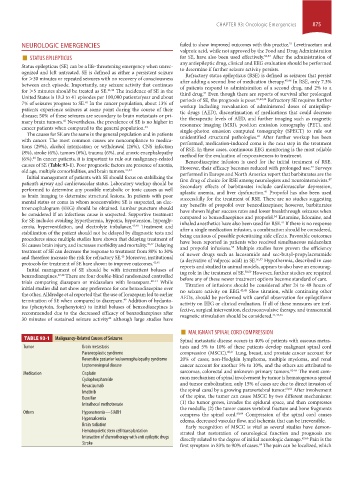
                      TABLE 93-1    Malignancy-Related Causes of Seizures  Spinal metastatic disease occurs in 40% of patients with osseous metas-
                    Tumor               Brain metastasis                  tasis and 5% to 10% of these patients develop malignant spinal cord
                                        Paraneoplastic syndrome           compression (MSCC). 60,61  Lung, breast, and prostate cancer account for
                                        Reversible posterior leukoencephalopathy syndrome  20% of cases; non-Hodgkin lymphoma, multiple myeloma, and renal
                                        Leptomeningeal disease            cancer account for another 5% to 10%, and the others are attributed to
                    Medication          Cisplatin                         sarcomas, colorectal and unknown primary tumors. 62-65  The most com-
                                        Cyclophosphamide                  mon mechanism of spinal involvement by tumor is hematogenous spread
                                        Bevacizumab                       and tumor embolization; only 15% of cases are due to direct invasion of
                                                                                                              60,62
                                        Imatinib                          the spinal canal by a growing paravertebral tumor.   After involvement
                                        Busulfan                          of the spine, the tumor can cause MSCC by two different mechanisms:
                                        Intrathecal methotrexate          (1) the tumor grows, invades the epidural space, and then compresses
                                                                          the medulla; (2) the tumor causes vertebral fracture and bone fragments
                    Others              Hyponatremia—SIADH                compress the spinal cord. 60,64  Compression of the spinal cord causes
                                        Hypercalcemia                     edema, decreased vascular flow, and ischemia that can be irreversible.
                                        Brain radiation                    Early recognition of MSCC is vital as several studies have demon-
                                        Hematopoietic stem cell transplantation  strated that restoration of neurological function and prognosis are
                                        Interaction of chemotherapy with anti epileptic drugs  directly related to the degree of initial neurologic damage. 62,66  Pain is the
                                        Stroke                            first symptom in 83% to 90% of cases.  The pain can be localized, which
                                                                                                     64


            section07.indd   875                                                                                       1/21/2015   7:42:58 AM

