


Page 1354 - Hall et al (2015) Principles of Critical Care-McGraw-Hill
P. 1354
CHAPTER 97: Acute Kidney Injury  927

                        ■  PREGNANCY AND ACUTE RENAL FAILURE                TABLE 97-8    Coexisting Renal and Liver Failure

                    The incidence of AKI complicating pregnancy has been decreasing for   Simultaneous liver and renal injury
                    the past 25 years. This is attributable to improvements in prenatal care
                    and obstetric science  and  fewer  complications related to  septic  abor-  Cardiovascular collapse with shock
                    tions. The timing of AKI in pregnancy has a bimodal distribution.  The   Drugs and toxins
                                                                  111
                    early peak, which occurs during the first 20 weeks of gestation, is due     Chlorinated solvents
                    to septic abortions, while the later peak (at 36-40 weeks) is secondary to
                    preeclampsia and bleeding complications.                Heavy metals (arsenic, chromium, and copper)
                     Preeclampsia and eclampsia are accompanied by decreases in GFR     Antibiotics
                    of  20% to  25%  that are  seldom  clinically significant  (see  Chap.  127).     Isoniazid
                    However, in a small proportion of pregnant women, the renal dys-    Rifampin
                    function progresses to  severe AKI. Women with preeclampsia are  at
                    increased risk for the development of cortical necrosis. Cortical necrosis     Tetracyclines
                    also can occur as a complication of placental abruption (often with     Sulfonamides
                    concealed blood loss) or prolonged intrauterine death. Although severe,     Acetaminophen
                    irreversible renal failure may be seen, partial recovery of renal func-
                    tion due to patchy cortical necrosis is more common.  The diagnosis     Mushroom poisoning (Amanita phalloides)
                                                           112
                    of complete cortical necrosis should be established by renal biopsy or   Infections
                    arteriography to exclude patchy cortical necrosis and ATN, from either     Viral hepatitis
                    of which a degree of functional recovery is to be expected.
                     Coexisting AKI and fulminant hepatic failure have been described     Bacterial sepsis
                    in gravid subjects. In women with acute fatty liver of pregnancy, AKI is   Miscellaneous
                    present in over half. Although the mortality rate for both mother and     Reye syndrome
                    fetus in this condition has been reported to be at least 70%, the prognosis
                    may be improving because of increased recognition of less severe cases.     Acute fatty liver
                    The syndrome known by the acronym HELLP (hemolysis, elevated liver     Systemic lupus erythematosus
                    enzymes, and low platelets) is a variant of unusually severe preeclampsia.     Polyarteritis nodosa
                    The great majority of these patients have evidence of hepatic dysfunc-  Sequential liver and renal injury
                    tion and sinusoidal congestion that may culminate in liver rupture. The
                    mean creatinine clearance in these women is about 55 mL/min (less than   Prerenal azotemia
                    half normal), while 10% have severe AKI with a creatinine clearance of     Ascites
                    <20 mL/min.                                             Alcoholic cardiomyopathy
                     The rare but well-defined clinical entity of idiopathic postpartum AKI
                    is characterized by the onset of AKI in the peripartum period following     Emesis
                    a previously normal pregnancy and childbirth.  The serum creatinine     Excessive diuresis
                                                      113
                    level rises rapidly within a few days to several weeks following parturi-  Intrinsic acute renal failure
                    tion. There is often an associated consumptive coagulopathy. Other
                    common clinical features include malignant hypertension, lethargy,     Cirrhotic glomerulosclerosis
                    seizures, and a dilated cardiomyopathy. The pathophysiology of this     Acute tubular necrosis
                    disorder is unknown. The outcome is poor; most patients have severe     Hepatorenal syndrome
                    chronic renal failure, require dialysis, or die.      Obstructive nephropathy
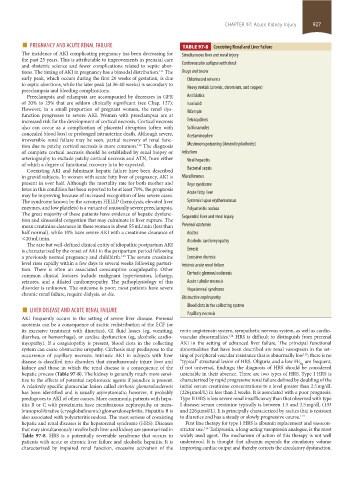
                        ■  LIVER DISEASE AND ACUTE RENAL FAILURE            Blood clots in the collecting system


                    AKI frequently occurs in the setting of severe liver disease. Prerenal     Papillary necrosis
                    azotemia can be a consequence of ascitic redistribution of the ECF (or
                    its excessive treatment with diuretics), GI fluid losses (eg, vomiting,   renin angiotensin system, sympathetic nervous system, as well as cardio-
                    diarrhea, or hemorrhage), or cardiac dysfunction (eg, alcoholic cardio-  vascular abnormalities.  HRS is difficult to distinguish from prerenal
                                                                                          114
                    myopathy). If a coagulopathy is present, blood clots in the collecting   AKI in the setting of advanced liver failure. The principal functional
                    system can cause obstructive uropathy. Cirrhosis may predispose to the   abnormalities that have been described are renal vasospasm in the set-
                    occurrence of papillary necrosis. Intrinsic AKI in subjects with liver   ting of peripheral vascular resistance that is abnormally low ; there is no
                                                                                                                    115
                    disease is classified into disorders that simultaneously injure liver and   “typical” structural lesion of HRS. Oliguria and a low FE  are frequent,
                                                                                                                  Na
                    kidney and those in which the renal disease is a consequence of the   if not universal, findings; the diagnosis of HRS should be considered
                    hepatic process (Table 97-8). The kidney is generally much more sensi-  untenable in their absence. There are two types of HRS. Type I HRS is
                    tive to the effects of potential nephrotoxic agents if jaundice is present.   characterized by rapid progressive renal failure defined by doubling of the
                    A relatively specific glomerular lesion called cirrhotic glomerulosclerosis   initial serum creatinine concentrations to a level greater than 2.5 mg/dL
                    has been identified and is usually asymptomatic; however, it probably   (226 µmol/L) in less than 2 weeks. It is associated with a poor prognosis.
                    predisposes to AKI of other causes. More commonly, patients with hepa-  Type II HRS is less severe renal insufficiency than that observed with type
                    titis B or C with proteinuria have membranous nephropathy or mem-  I disease; serum creatinine typically is between 1.5 and 2.5 mg/dL (133
                    branoproliferative (cryoglobulinemic) glomerulonephritis. Hepatitis B is   and 226 µmol/L). It is principally characterized by ascites that is resistant
                    also associated with polyarteritis nodosa. The most serious of coexisting   to diuretics and has a steady or slowly progressive course. 114
                    hepatic and renal diseases is the hepatorenal syndrome (HRS). Diseases   First line therapy for type 1 HRS is albumin replacement and vasocon-
                                                                                  116
                    that may simultaneously involve both liver and kidney are summarized in    strictor use.  Terlipressin, a long-acting vasopressin analogue, is the most
                    Table 97-8. HRS is a potentially reversible syndrome that occurs in   widely used agent. The mechanism of action of this therapy is not well
                    patients with acute or chronic liver failure and alcoholic hepatitis. It is   understood. It is thought that albumin expands the circulatory volume
                    characterized by impaired renal function, excessive   activation of the   improving cardiac output and thereby corrects the circulatory dysfunction.


            section08.indd   927                                                                                       1/14/2015   8:27:56 AM

