


Page 1352 - Hall et al (2015) Principles of Critical Care-McGraw-Hill
P. 1352
CHAPTER 97: Acute Kidney Injury  925


                    reaction for blood in the urine is consistent with acute glomerular or   concentrations, respectively. The normal FE  is 50% to 65%, reflect-
                                                                                                          UN
                    tubular injury, urinary tract infection, or nephrolithiasis. If blood is     ing reabsorption of approximately 50% of filtered urea in the proximal
                    present on dipstick but not microscopically, or if the findings are dispro-  tubule; urea reabsorption is trivial in the thick ascending limb and distal
                    portionate (eg, 4+ blood on dipstick with rare erythrocytes on micros-  convoluted tubule. Hypovolemia results in increased urea absorption,
                    copy), a pigment nephropathy (hemoglobinuria or myoglobinuria)   decreased urea clearance, and thus a lower FE .  Loop and thiazide
                                                                                                              95
                                                                                                            UN
                    should be considered. The urine sediment is usually unremarkable in    diuretics, which act at the thick ascending limb and distal convoluted
                    prerenal and postrenal azotemia, except for occasional hyaline casts.     tubule, do not interfere directly with urea reabsorption and should not
                    In postrenal AKI due to stones, blood and crystals can be seen. Intrinsic   alter FE . However, proximal tubule diuretics and osmotic diuresis
                                                                                UN
                    AKI is often associated with a characteristic (or even diagnostic) urine   decrease proximal reabsorption of urea and may produce an inappro-
                    sediment. A careful microscopic examination frequently can distinguish   priately high FE . Carvounis and colleagues prospectively evaluated
                                                                                      UN
                    between GN, AIN, ATN, and TIN. Erythrocyte casts, often accompanied   102 hospitalized patients with AKI.  Patients were divided into three
                                                                                                    87
                    by proteinuria and numerous erythrocytes and leukocytes, are pathog-  groups: 50 were deemed prerenal; 27 were deemed prerenal with diuret-
                    nomonic of GN. Detection of large numbers of leukocytes, leukocyte   ics given up to the day of consultation (details were not provided as to
                    casts, and eosinophils in uninfected urine strongly suggests the diagnosis   whether diuretics were given 1 or 23 hours prior to the urine sample);
                    of drug-induced AIN. ATN is suggested by findings including muddy   and 25 were diagnosed with ATN. Patients with AIN, GN, and obstruc-
                    brown granular casts, free renal tubular cells, and tubular cell casts.  tive nephropathy were excluded. Fe  was <1%, as expected, in 92% of
                                                                                                   Na
                     Several measurements of urine composition have been suggested as   group 1 patients, but in only 48% of the prerenal patients treated with
                    ways to differentiate between prerenal azotemia and intrinsic AKI in   diuretics. In contrast, 90% of the group 1 patients and 89% of those given
                    the oliguric patient.  Urine electrolytes are most useful in this regard,   diuretics had a FE  <35%. The ATN patients evidenced a mean FE
                                  93
                                                                                       UN
                                                                                                                            UN
                    especially the fractional excretion of sodium (FE ), calculated as  of 59%. A FE  <35% had 85% sensitivity, 92% specificity, 99% positive
                                                                                   UN
                                                       Na                 predictive value, and 75% negative predictive value for a prerenal state.
                                            U  × P  × 100
                                   FE (%) =  Na  Cr                (97-1)  In this study, the urine:plasma creatinine ratio also performed better
                                               P  × U
                                     Na
                                                                               Na
                                                Na  Cr                    than FE  to distinguish prerenal azotemia from ATN. One other urine
                                                                          chemistry test may be useful in hyperuricemic patients with AKI and
                    where U  and P  are urine and plasma sodium concentrations, respec-  possible urate nephropathy (tumor lysis syndrome and hypovolemia
                               Na
                          Na
                    tively, and U  and P  are urine and plasma creatinine concentrations,   with hyperuricemia and acid urine): urine uric acid:urine creatinine
                             Cr
                                   Cr
                    respectively. Values of FE   <0.01 (1%) in oliguric patients suggest   ratios >1.1 are consistent with acute urate nephropathy. 96
                                       Na
                    avid tubular sodium reclamation and prerenal azotemia with function-  Urine microscopy may also be useful in distinguishing between intrin-
                    ing renal tubules, whereas values  >0.03 (3%) suggest tubular injury.   sic AKI and prerenal AKI, and has the advantage of being widely available
                    The FE  is less useful in patients who are not oliguric.  Contrary to   and inexpensive. However, expertise is required in interpretation. In a
                                                             94
                         Na
                    common belief, however, it may be useful in diuretic-treated patients.   study of 267 patients with AKI, a urine sediment scoring system based on
                    Although an elevated value may be a result of ATN or the effects of   the presence of casts and renal tubular epithelial cells was highly predictive
                    the diuretic, a low level in the face of diuretic therapy strongly suggests     of AKI. In patients with a high pretest probability of ATN, the presence of
                    volume depletion and prerenal AKI. Some causes of AKI presenting   any casts or renal tubular epithelial cells resulted in a positive predictive
                    with a low FE  are listed in  Table 97-6. A low U  (<10 mEq/L)  as   value of 100% and negative predictive value of 41% for ATN. In patients
                              Na
                                                          Na
                    an isolated measurement is often used as evidence of a prerenal state.   with a low pretest probability of ATN, the lack of casts or renal tubular
                    However, this measurement depends exquisitely on the state of water   cells was associated with a negative predictive value for ATN of 91%. 97
                    balance in addition to sodium balance. It cannot be said that it is any   Although the diagnosis and staging of AKI is currently based on
                    easier to use than FE , since an independent evaluation of water balance   indices of kidney function (acute changes in serum creatinine or cys-
                                  Na
                    must be made to interpret it. Therefore, it is not recommended as an   tatin, BUN, or the development of oliguria), the search for earlier and
                    isolated measurement in the routine evaluation of AKI.  more sensitive biomarkers of renal tubular damage (in search of a “renal
                     Most other urinary diagnostic indices do not show any clear-cut   troponin”) has been an active area of investigations in recent years.
                                                                                                                            98
                    superiority over FE  in distinguishing prerenal azotemia from ATN;   These tools have begun to undergo clinical evaluation in a number
                                  Na
                    however,  they are  independently useful in  the assessment of  tubular   of health systems internationally. Early studies suggest that such tools
                    function. Recent data suggest urinary fractional excretion of urea (FE )  may not only help to diagnose AKI with evolving ATN early (facilitat-
                                                                     UN
                    is superior to FE  to distinguish prerenal azotemia from ATN, particu-  ing potentially successful clinical trials of new therapies), but will also
                                Na
                    larly in diuretic-treated patients. FE  is calculated as  help to distinguish reversible, prerenal functional AKI from AKI with
                                             UN
                                                                                                 99
                                            U  × P  × 100                 structural kidney damage (ATN),  and to predict which cases of AKI are
                                   FE (%) =  UN   Cr               (97-2)  likely to progress, require RRT, and have worse clinical outcomes. 98-101
                                     UN       BUN × U
                                                     Cr                   Finally, it is hoped that emerging tools in development for “real-time”
                                                                          monitoring of GFR (as opposed to following serum creatinine changes
                    where U  and BUN are urine and serum urea nitrogen concentra-
                          UN
                    tions, respectively, and U  and P  are urine and plasma creatinine   hours-to-days after renal function is lost) will also help to dynamically
                                       Cr    Cr                           assess kidney function in critically ill patients. 102
                                                                           Several radiographic studies are useful in the evaluation of patients
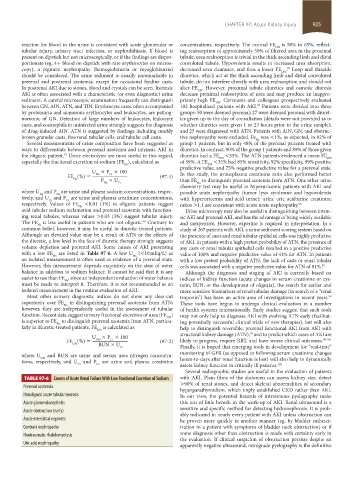
                      TABLE 97-6    Causes of Acute Renal Failure With Low Fractional Excretion of Sodium  with AKI. Plain films of the abdomen can assess kidney size, detect
                                                                          >90% of renal stones, and detect skeletal abnormalities of secondary
                    Prerenal azotemia
                                                                          hyperparathyroidism, which imply established CKD rather than AKI.
                    Nonoliguric acute tubular necrosis                    In our view, the potential hazards of intravenous pyelography make
                    Acute glomerulonephritis                              this test of little benefit in the work-up of AKI. Renal ultrasound is a
                                                                          sensitive and specific method for detecting hydronephrosis. It is prob-
                    Acute obstruction (early)
                                                                          ably indicated in nearly every patient with AKI unless obstruction can
                    Acute interstitial nephritis                          be proven more quickly in another manner (eg, by bladder catheter-
                    Contrast nephropathy                                  ization in a patient with symptoms of bladder neck obstruction) or if
                    Nontraumatic rhabdomyolysis                           some diagnosis other than obstruction is made with certainty early in
                                                                          the  evaluation.  If clinical suspicion of obstruction  persists  despite an
                    Uric acid nephropathy
                                                                          apparently negative ultrasound, retrograde pyelography is the definitive
            section08.indd   925                                                                                       1/14/2015   8:27:56 AM

