


Page 1353 - Hall et al (2015) Principles of Critical Care-McGraw-Hill
P. 1353
926     PART 8: Renal and Metabolic Disorders


                 diagnostic maneuver.  Computed tomography of the kidneys does not   result of tumor lysis syndrome. This is noted most commonly in patients
                                 103
                 have any advantages over ultrasound and retrograde pyelography in the   with germ cell tumors or hematologic malignancies because of their
                 detection of obstruction, but may help clarify its cause (eg, detection of   rapid turnover.  The tumor lysis syndrome is due to the toxic effects
                                                                                  104
                 obstructing ureteral stones, or compressing tumor). Radionuclide scans   of intracellular constituents, which cause AKI, hyperkalemia, hyper-
                 of the kidneys may be useful in the evaluation of patients with suspected   phosphatemia, hypocalcemia, and hyperuricemia. The most common
                 vascular accidents of the kidneys.                    pathogenetic mechanism involved is acute urate nephropathy. When
                                                                       serum uric acid levels exceed about 20 mg/dL, the risk of AKI is high.
                 CLINICAL ACUTE RENAL FAILURE SYNDROMES                The urinary ratio of uric acid to creatinine is >1. Uric acid crystals may
                                                                       be seen in the urinary sediment. Synergistic factors in the development
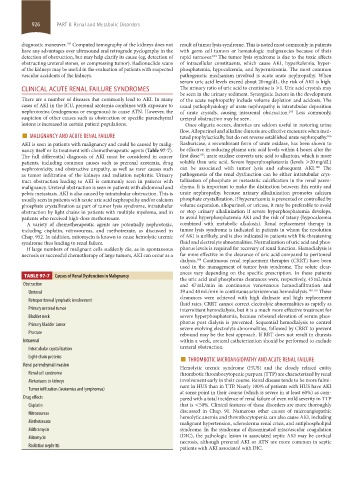
                 There are a number of diseases that commonly lead to AKI. In many   of the acute nephropathy include volume depletion and acidosis. The
                 cases of AKI in the ICU, prerenal azotemia combines with exposure to   usual pathophysiology of urate nephropathy is intratubular deposition
                 nephrotoxins (endogenous or exogenous) to cause ATN. However, the   of urate crystals, causing intrarenal obstruction.  Less commonly,
                                                                                                            105
                 suspicion of other causes such as obstruction or specific parenchymal   ureteral obstruction may be seen.
                 lesions is increased in certain patient populations.    Once oliguria occurs, diuretics are seldom useful in restoring urine
                     ■  MALIGNANCY AND ACUTE RENAL FAILURE             flow. Allopurinol and alkaline diuresis are effective measures when insti-
                                                                       tuted prophylactically, but do not reverse established urate nephropathy.
                                                                                                                         106
                 AKI is seen in patients with malignancy and could be caused by malig-  Rasburicase, a recombinant form of urate oxidase, has been shown to
                 nancy itself or its treatment with chemotherapeutic agents (Table 97-7).   be effective in reducing plasma uric acid levels within 4 hours after the
                                                                              107
                 The full differential diagnosis of AKI must be considered in cancer   first dose ; urate oxidase converts uric acid to allantoin, which is more
                 patients, including common causes such as prerenal azotemia, drug   soluble than uric acid. Severe hyperphosphatemia (levels >20 mg/dL)
                                                                                                                     108
                 nephrotoxicity, and obstructive uropathy, as well as rarer causes such   can be associated with tumor lysis and subsequent AKI.  The
                 as tumor infiltration of the kidneys and radiation nephritis. Urinary     pathogenesis of the renal dysfunction can be either intratubular crys-
                 tract obstruction leading to AKI is commonly seen in patients with   tallization of phosphate or metastatic calcification in the renal paren-
                 malignancy. Ureteral obstruction is seen in patients with abdominal and   chyma. It is important to make the distinction between this entity and
                 pelvic metastasis. AKI is also caused by intratubular obstruction. This is   urate nephropathy, because urinary alkalinization promotes calcium
                 usually seen in patients with acute uric acid nephropathy and/or calcium   phosphate crystallization. If hyperuricemia is prevented or controlled by
                 phosphate crystallization as part of tumor lysis syndrome, intratubular   volume expansion, allopurinol, or uricase, it may be preferable to avoid
                 obstruction by light chains in patients with multiple myeloma, and in   or stop  urinary alkalinization if  severe hyperphosphatemia  develops,
                 patients who received high-dose methotrexate.         to avoid hyperphosphatemia AKI and the risk of tetany (hypocalcemia
                   A variety of chemotherapeutic agents are potentially nephrotoxic,   combined with metabolic alkalosis). Renal replacement therapy in
                 including cisplatin, nitrosoureas, and methotrexate, as discussed in   tumor lysis syndrome is indicated in patients in whom the resolution
                 Chap. 952. In addition, mitomycin is known to cause hemolytic uremic   of AKI is unlikely, and is also indicated in patients with life-threatening
                 syndrome thus leading to renal failure.               fluid and electrolyte abnormalities. Normalization of uric acid and phos-
                   If large numbers of malignant cells suddenly die, as in spontaneous   phorus levels is required for recovery of renal function. Hemodialysis is
                 necrosis or successful chemotherapy of large tumors, AKI can occur as a   far more effective in the clearance of uric acid compared to peritoneal
                                                                       dialysis.  Continuous renal replacement therapies (CRRT) have been
                                                                             104
                                                                       used in the management of tumor lysis syndrome. The solute clear-
                                                                       ances vary depending on the specific prescription. In these patients
                   TABLE 97-7    Causes of Renal Dysfunction in Malignancy
                                                                       the uric acid and phosphorus clearances were, respectively, 45 mL/min
                  Obstruction                                          and 47 mL/min in continuous venovenous hemodiafiltration and
                    Ureteral                                           39 and 40 mL/min in continuous arteriovenous hemodialysis. 109,110  These
                                                                       clearances were achieved with high dialysate and high replacement
                    Retroperitoneal lymphatic involvement
                                                                       fluid rates. CRRT cannot correct electrolyte abnormalities as rapidly as
                    Primary ureteral tumor                             intermittent hemodialysis, but it is a much more effective treatment for
                    Bladder neck                                       severe hyperphosphatemia, because rebound elevation of serum phos-
                    Primary bladder tumor                              phorus  post  dialysis  is  prevented. Sequential  hemodialysis  to control
                                                                       severe evolving electrolyte abnormalities, followed by CRRT to prevent
                    Prostate                                           rebound may be the best approach. If RRT does not result in diuresis
                  Intrarenal                                           within a week, ureteral catheterization should be performed to exclude
                    Intratubular crystallization                       ureteral obstruction.
                    Light-chain proteins                                   ■  THROMBOTIC MICROANGIOPATHY AND ACUTE RENAL FAILURE
                  Renal parenchymal invasion
                                                                       Hemolytic  uremic  syndrome  (HUS)  and  the  closely  related  entity
                    Renal cell carcinoma                               thrombotic thrombocytopenic purpura (TTP) are characterized by renal
                    Metastases to kidneys                              involvement early in their course. Renal disease tends to be more fulmi-
                                                                       nant in HUS than in TTP. Nearly 100% of patients with HUS have AKI
                    Tumor infiltration (leukemias and lymphomas)
                                                                       at some point in their course (which is severe in at least 60%) as com-
                  Drug effects                                         pared with a total incidence of renal failure of even mild severity in TTP
                    Cisplatin                                          that is <50%. Clinical features of these disorders are more thoroughly
                                                                       discussed in Chap. 91. Numerous other causes of microangiopathic
                    Nitrosoureas                                       hemolytic anemia and thrombocytopenia can also cause AKI, including
                    Methotrexate                                       malignant hypertension, scleroderma renal crisis, and antiphospholipid
                    Mithramycin                                        syndrome. In the syndrome of disseminated intravascular coagulation
                    Mitomycin                                          (DIC), the pathologic lesion in associated septic AKI may be cortical
                                                                       necrosis, although prerenal AKI or ATN are more common in septic
                    Radiation nephritis                                patients with AKI associated with DIC.


            section08.indd   926                                                                                       1/14/2015   8:27:56 AM

